Stand in the frozen aisle of any supermarket on a Saturday in November and you will find it: the box with the photograph of a radiant golden gratin on the front, and inside, behind the window, the actual product — pale cauliflower stems arranged like a snowdrift that has given up, next to a small silver sachet of orange powder with cheese sauce printed on it, which is the sort of phrase that in any other context would require a warrant.
The dish has been let down for its own entire history, and the irony is that it is genuinely old and genuinely good. Cauliflowers came to England in the 17th century from the eastern Mediterranean, travelling under the Old French name chou de Chypre — Cyprus cabbage — which Britain dropped with the honesty of a nation that has never kept a foreign name when a short one would do. By 1861, Mrs Beeton’s Book of Household Management was printing “Cauliflowers with Parmesan Cheese” for the respectable middle-class kitchen. And when supermarkets started selling ready meals in the 1960s, Elizabeth David asked wistfully whether a day would ever come when it would be “clever” to serve “some relaxed English dish like cauliflower cheese”. The day came. It just arrived wearing a sachet.
Which brings us to the best-kept secret in the produce aisle, and the reason this recipe exists: growers already call the white head of a cauliflower a curd — the exact word cheesemakers use for the solid part of milk. The vegetable and the sauce share a name. Cauliflower cheese is, technically, the same word twice. That is either the most redundant dish in the English language or the most confident one, and this recipe makes the one the sachet never can: the real thing, promoted from accompaniment to main course, in about the time the frozen box spends apologising for itself.
Ingredients
- 1 large cauliflower, or 2 medium (the white kind; the purple one is showing off)
- 60g butter
- 60g plain flour
- 750ml whole milk, plus a splash extra if the sauce gets ideas above itself
- 200g mature cheddar, grated — 150g in the sauce, 50g for the top
- 2 tsp English mustard powder
- 1 tsp Marmite
- 50g breadcrumbs
- Nutmeg, grated, if you own a nutmeg — this is the dish’s one allowance for flourish
- Salt and black pepper
Note on the missing bottle: no Worcestershire sauce appears below. The usual kind has anchovies in it, and this dish has a vegetarian reputation to protect — one it has held since 1861 and never once defended in public.
Method
- Break the cauliflower into proper florets — bite-sized, stem trimmed. Botanically you are pulling apart a head of aborted flower buds, which the Victorians ate with a straight face and we smother in sauce, which is the British method applied to everything from vegetables to apologies.
- Simmer the florets in boiling salted water for five or six minutes only. They should offer resistance, like a man declining a second biscuit. Then drain them and let them steam dry in the colander for a few minutes. Water is the enemy from here on: a watery cauliflower makes a runny sauce, and a runny sauce is the one failure this dish is famous for.
- Melt the butter in a pan, stir in the flour, and cook it for two minutes without letting it colour. This is a roux, which is French for “the part where you must not walk away”. France invented the technique; Britain sent it to boarding school and it came back as cheese sauce.
- Add the milk in three additions, whisking each one smooth before the next. Three additions, not one dump: a sauce made in one go has the texture of a decision made in one go. Lumps in a cheese sauce are the kitchen equivalent of a stammered apology — understandable, but you wish the person would start again.
- Once it thickens, let it bubble gently for three minutes, then take the pan off the heat. Stir in the mustard powder, the Marmite, nutmeg, pepper, and the 150g of cheddar. The mustard is the load-bearing ingredient: without it you have hot milk with confidence. The Marmite is the understatement of the sauce — you will not taste it, and that is its whole job. Cheese going into a boiling sauce splits and turns grainy, which is also what happens to cheese going into a boiling sauce.
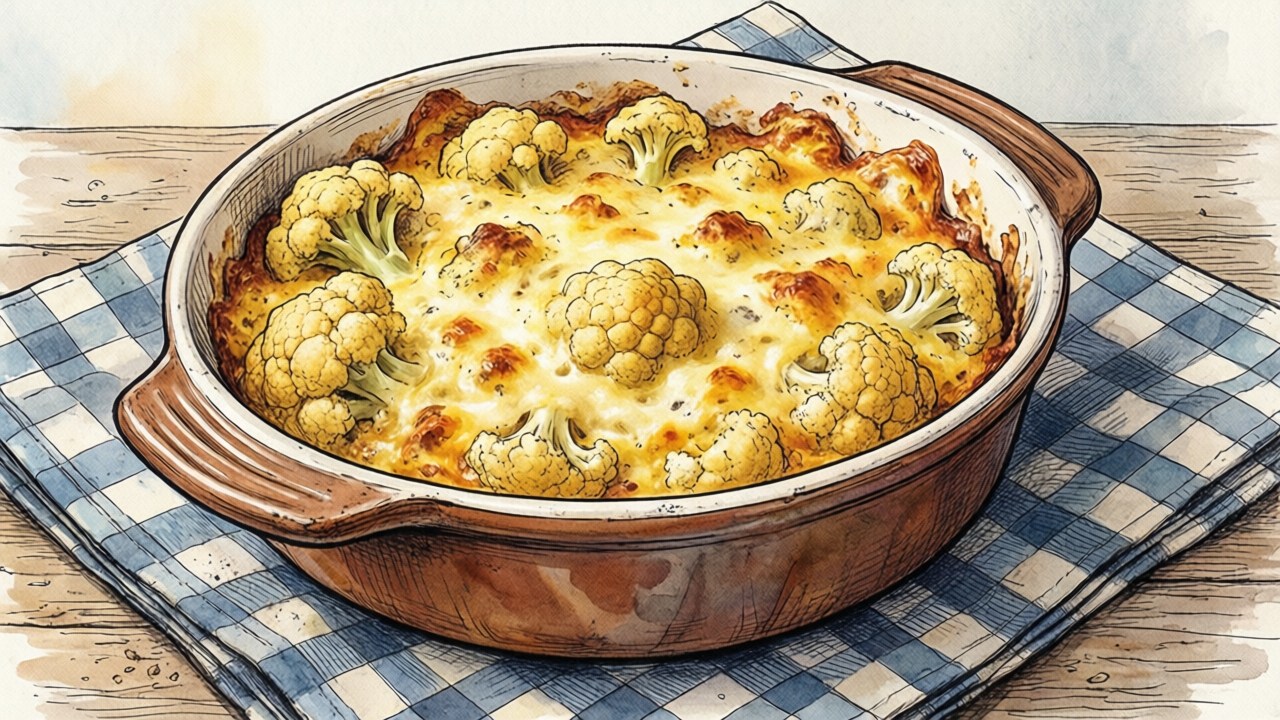
- Pour the sauce over the drained cauliflower in a buttered baking dish, coating everything with the thoroughness Britain applies to carpet. Scatter over the remaining 50g of cheese and the breadcrumbs. The breadcrumb lid is a hat: purely decorative, occasionally structural, and the invention of someone who has never admitted it is decorative.
- Bake at 200C / 180C fan for 20–25 minutes, until the top is burnished and the edges are bubbling. Take it out while it is still bubbling — a cheese sauce that has stopped bubbling has stopped feeling things. The browned corners are the blush: they appear wherever the heat is, and always look better than the centre.
- Rest it for ten minutes before serving. This is the step everyone skips and the reason everyone’s sauce “somehow” goes loose. Like a British emotion, cauliflower cheese serves better once it has had a moment to settle.
Serve it as a main with boiled new potatoes and a gravy on the side — this is the promotion from accompaniment to headliner that keeps the recipe off Sunday’s crowded roast plate — or serve it beside a roast, where it has been standing since Mrs Beeton’s day, unremarked. It keeps a day in the fridge and rebuilds itself under a hot grill, which the sachet cannot do at all.
And that is the whole argument with the frozen box. The sachet offers the result without the twenty minutes, but the twenty minutes were never the inconvenience — they were the dish. Somewhere in Britain tonight, a cauliflower cheese is coming out of an oven bubbling like it’s about to apologise, and the name on the plate will describe itself twice. For once, the redundancy is the point.