Stand at the counter of a Friday-night chip shop anywhere between Dudley and Ebbw Vale and you’ll see them at the far end of the heated display, lined up like a row of very well-behaved cannonballs: the faggots. Nobody advertises them. You order them because somebody in your family has always ordered them, and that counts as a health and safety certificate in this part of the world. In the South Wales valleys the order comes out as one word — faggots an’ peas — and the town of Neath was crowned the faggots ‘n’ peas capital of Wales by the South Wales Evening Post in 2009, a title no rival town has ever bothered to contest. Nobody wants to lose it.
The dish itself is an honest bundle: pig’s heart and liver, onion, sage, breadcrumbs, wrapped in caul fat and baked down in gravy. It started as cheap country cookery in west Wiltshire and the West Midlands, and when agricultural labourers left the land for the mines and steelworks of South Wales in the mid-nineteenth century, the recipe emigrated with them — one of the few products of the agricultural revolution that got to eat. Rationing made it a national staple for a decade; the decades after rationing made the nation quietly forget it said the name out loud. Tens of millions are still eaten every year, according to a 2018 BBC estimate, almost all of them within shouting distance of the chippy counter where they were born.
What the faggot has never had is bad press as a faggot. The Times, January 1914, ran “The Dangers of Bad Teeth” — an inquest heard a dead man’s last meal had been “a faggot”, described as pieces of meat with fat and gristle in it; verdict: natural causes, dish exonerated. The Times, May 1968: “Doctor warns the faggot eaters” — about the arteries, not the vocabulary. Ofcom, 2004: banned a supermarket radio ad in which a man declines his wife’s cooking suggestion with “I’ve got nothing against faggots, I just don’t fancy them” — the offence was innuendo; the dinner itself was never the problem. Facebook, November 2013: a man was temporarily blocked for liking faggots, and the national headlines wrote themselves. A century of institutions taking exception to the word, while the food sat under the heat lamp, unremarked upon, gently steaming, entirely above suspicion.
Yorkshire, Lincolnshire and Lancashire responded to the name problem by renaming the entire dish “savoury ducks” — first in print in the Manchester Courier on 3 June 1843, a name containing no duck, no evidence of duck, and no duck-related complaint ever filed. A rebrand with zero product defects is the world’s most honest piece of marketing, and Britain’s only Victorian food campaign that arguably made things worse.
So here it is: the only dish in Britain with a better legal record than a catering one. A hundred years of complaints, not one of them ever about the food.
Ingredients
- 225g pig’s liver and 150g pig’s heart — the traditional pair. One easy swap if the counter draws a blank: use 375g of pork mince plus an extra 75g of liver from the pack next to the stewing steak. Nobody will audit you; the dish has never been audited.
- 150g pork mince
- 1 large onion, grated
- A small handful of fresh sage, chopped as fine as the censor would allow
- 75g breadcrumbs, soaked in a splash of milk
- 1 tablespoon Marmite, because depth that never names itself
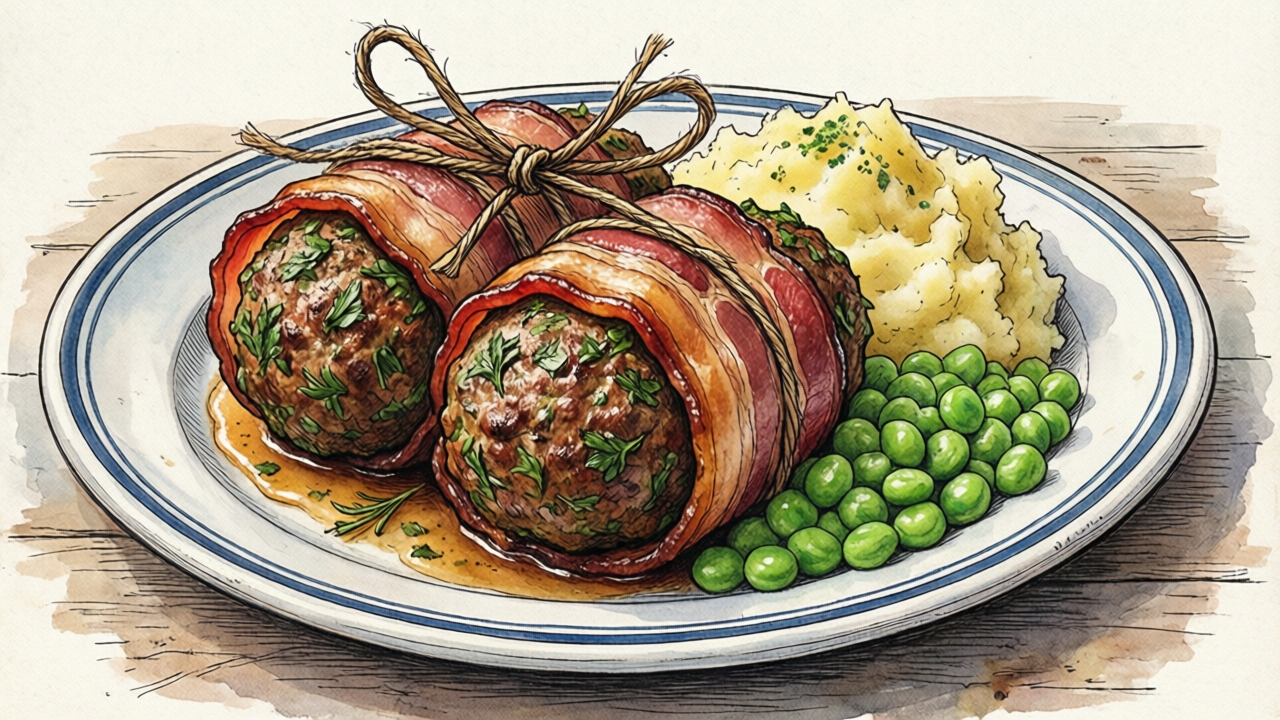
- Caul fat to wrap the balls — ask the butcher, who will either produce it or produce a face. Easy swap: 8–10 thin slices of streaky bacon
- 300ml gravy — jarred is fine; jarred gravy has never offended anybody
- Floury potatoes and butter for mash
- 1 tin of marrowfat peas, for the mush
- Salt, black pepper, a knob of lard or oil
Method
- Ask the butcher to mince the liver and heart together, or mince them yourself twice. This is the step where the dish stops being a rumour and becomes a policy.
- Soften the grated onion in lard until sweet, then beat it into the mince with the sage, soaked breadcrumbs, Marmite, salt and a generous grind of pepper. Mix until the whole thing resembles a comment that has successfully passed moderation: uniform, harmless, and hiding nothing.
- Shape into 8–10 balls. Cricket-ball size commands respect; tennis-ball size is a proper dinner; smaller than that is party food, and this dish has never once agreed to be party food.
- Wrap each ball in a panel of caul fat — or two overlapping bacon slices. The fat wraps the name politely, which is the one thing the dish has never managed for itself.
- Sit them snug in an ovenproof dish, tie string across them if you like (a Victorian habit that keeps their shape, like the prefabs of the meat world), and put the dish in the oven at 190C for 15 minutes to set the wrappers.
- Turn the heat down to 160C, pour the gravy around — never over; the wrappers are the roof and the roof stays yours — and bake another 35–40 minutes. The whole century of complaints survived one oven; this will too.
- Meanwhile, make the mash, and cook the marrowfat peas until they reach their correct state, which is pulp. Anyone who calls them “whole peas” has never stood in a Neath chippy queue. Season the mash with butter and the peas with the gravy from the dish — the same spoon visits both, which is the entire argument for one shared gravy.
- Rest the faggots ten minutes. Even the most censored dinner in Britain deserves a moment of silence before the next complaint cycle.
Serve with mash, mushy peas, and the order said out loud across the counter: two faggots and mush, please. The dish only works at full volume — and after a hundred and eighty years of nobody successfully changing the order, Yorkshire can keep the ducks. A rebrand is only necessary when something is wrong with the product, and there has never once been anything wrong with this one.