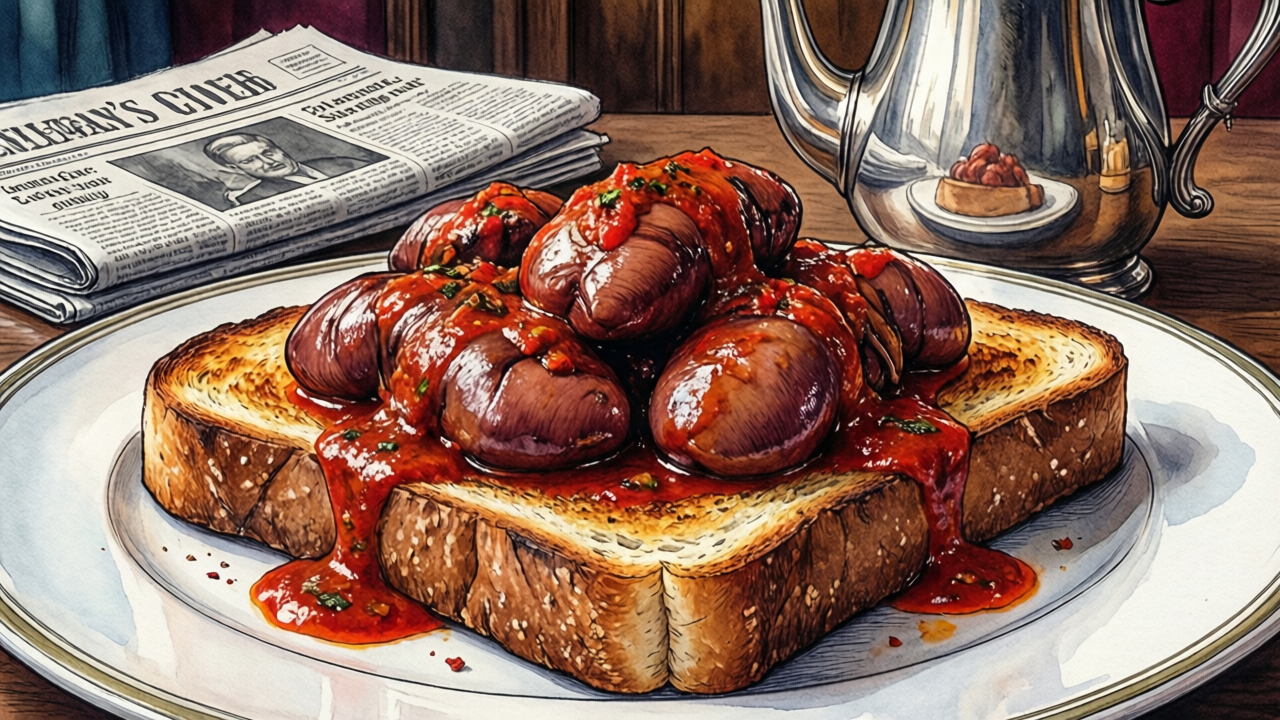
Picture the breakfast room of an Edwardian gentlemen’s club. Silver pots, silence thick enough to chip, and along the row of them sit the members reading the newspaper behind a wall — not of hampers, of kidneys. Red, glistening, cayenne-hot kidneys on toast, consumed before ten in the morning with no one visibly flinching. Devilled kidneys was the flagship of that table, shoulder to shoulder with kedgeree and kippers, and the verb behind it is older still: devilling — spicing food aggressively — was in print by the 18th century, described by James Boswell himself, long before the Victorians turned it into a breakfast habit and the Edwardians carried it into the clubs.
Cassell’s Dictionary of Cookery sums up the period technique with wonderful bluntness: score the meat, plaster it with salt, cayenne and mustard, and grill it fiercely. A familiar feature of the English club and country-house table, it says, through the whole of the 19th century. Nobody in the profession appears to have noticed that they had institutionalised arson. That is the trick devilling plays: it takes a modest ingredient, charges it with chilli, and presents it so correctly dressed that no one dares object.
Which makes devilled kidneys the most honest dishonesty in British cooking — a dish that admits, right in its name, that the fire is theatrical. Nobody knows why the Victorians chose the Devil for it; the cayenne was the suspect and never once charged. Here, at least, is the fire you can set in your own kitchen, in good taste, before noon if you insist.
Ingredients
- 4 lamb’s kidneys (about 400g), from the butcher counter — they’re usually at the back of the meat aisle, wrapped like they know how people react
- 40g butter
- 1 tbsp English mustard
- 1 tbsp Worcestershire sauce (an old acquaintance of this series, still keeping its own counsel about the anchovies)
- ½–1 tsp cayenne, to the heat you can hold a straight face through
- Freshly ground black pepper
- A small splash of beef or vegetable stock
- Salt
- 4 thick slices of good bread, for toast
- Parsley, chopped, to look composed at the end
No vegetarian version, and no apologies: it’s the house rule from the steak-and-kidney episode — we don’t insult the kidney by pretending otherwise. The toast is already vegetarian.
Method
- Slit each kidney open and cut out the pale core. That core is the only reason a kidney has never been invited back to polite company; take it out and the rest is tender, willing and deeply unbothered.
- Score the surface lightly with a sharp knife. This is Cassell’s plaster-receptacle system doing its work: scored meat holds the mustard the way a gentleman holds a grudge — evenly and for some time.
- Get a heavy pan properly hot and drop in the butter. It should be hot enough to alarm a neighbour. This is permitted. It is 1902 in this recipe, and the neighbour has his own kidneys.
- Fry the kidneys two to three minutes, until browned outside but still faintly blush-coloured within. Kidneys are the shyest offal: apply sustained embarrassment — that is, overcooking — and they turn to boot soles. Brief, genuine heat is the entire technique.
- Lower the heat and stir the mustard, Worcestershire sauce, cayenne and a good grind of pepper through the butter to coat the kidneys. This is the waistcoat going on: mustard for the moustache, Worcestershire for a past it won’t discuss, cayenne for the actual charge.
- Add the splash of stock and swirl until the sauce goes glossy and clings. Ten seconds ago this was frying; now it’s devilling, and the difference is entirely in how it’s introduced at dinner.
- Meanwhile toast the bread thick and butter it heavily. The toast is not garnish; it is the alibi. With toast, this is an open sandwich served in a club. Without it, you are eating chilli kidneys from a pan standing up, which is supper — and supper, in 1902, still had no respectability to borrow.
- Plate the kidneys, pour every scrap of sauce over the toast, scatter the parsley — the makeup everyone applies once the fire is safely contained — and get it to the table before it cools. The dish migrated to supper in later life, but it was born at breakfast, and breakfast does not wait for anyone.
Serve it the way the dish deserves: hot, loud, and completely unbothered by the hour. Fergus Henderson called Caroline Conran’s version of devilled kidneys “the best recipe, ever!”, which is the most the man has ever been heard to praise anything not involving a pig, and Marco Pierre White served them on Hell’s Kitchen to celebrities who presumably did not know what they’d signed up for before eight o’clock.
The Devil, as ever with British cooking, was only ever a figure of speech — the cayenne was the suspect and never once charged. But the name did what British names do: it made a modest pan of kidneys sound like a scandal, and then dressed the scandal so politely that a hundred years of men read their newspapers through it without once looking up. Arson, with manners. Set the fire yourself; the manners can come from the recipe.