In the early 1790s the Liverpool workhouse kept a food ledger, and the ledger survives, which is fortunate, because in it a clerk bought Beef, 101 lbs. for scouse … 14 Measures potatoes for scouse … and Onions for ditto. Sir Frederick Eden printed the receipt in his 1797 survey of the labouring poor, and it stands as the most efficient line in British catering history: three ingredients, one of them named twice, one of them named with a shrug.
That shrug outlived the workhouse. Liverpool’s people are formally called Liverpudlians, but everyone knows the other name — Scousers — and it comes from the shortened form of lobscouse, a sailors’ stew. The Oxford English Dictionary’s oldest citation for lobscouse is the satirist Edward Ward, 1706. Tobias Smollett wrote “lob’s course” in 1750. The clipped “scouse” on its own is cited from 1840. Then the word did something no other British dish has ever managed: it left the plate, climbed into the accent, and took the population’s name. This is the only city in Britain whose demonym you would have to order off a menu.
Where the stew itself came from is genuinely murky. The Oxford Companion to Food says it “almost certainly has its origins in the Baltic ports, especially those of Germany” — and then the German philologist Friedrich Kluge turned up and dated the German version, labskaus, to 1878, concluding that the word spread from Britain to northern Europe, not the other way around. So the stew may have emigrated from Liverpool in exactly the same direction, and for exactly the same reasons, as everyone else leaving Liverpool: work was better elsewhere, and it kept its accent. There’s a Welsh branch too — lobsgows, a variety of cawl — which means readers who were here for the cawl episode ate this stew’s cousin in a different jumper.
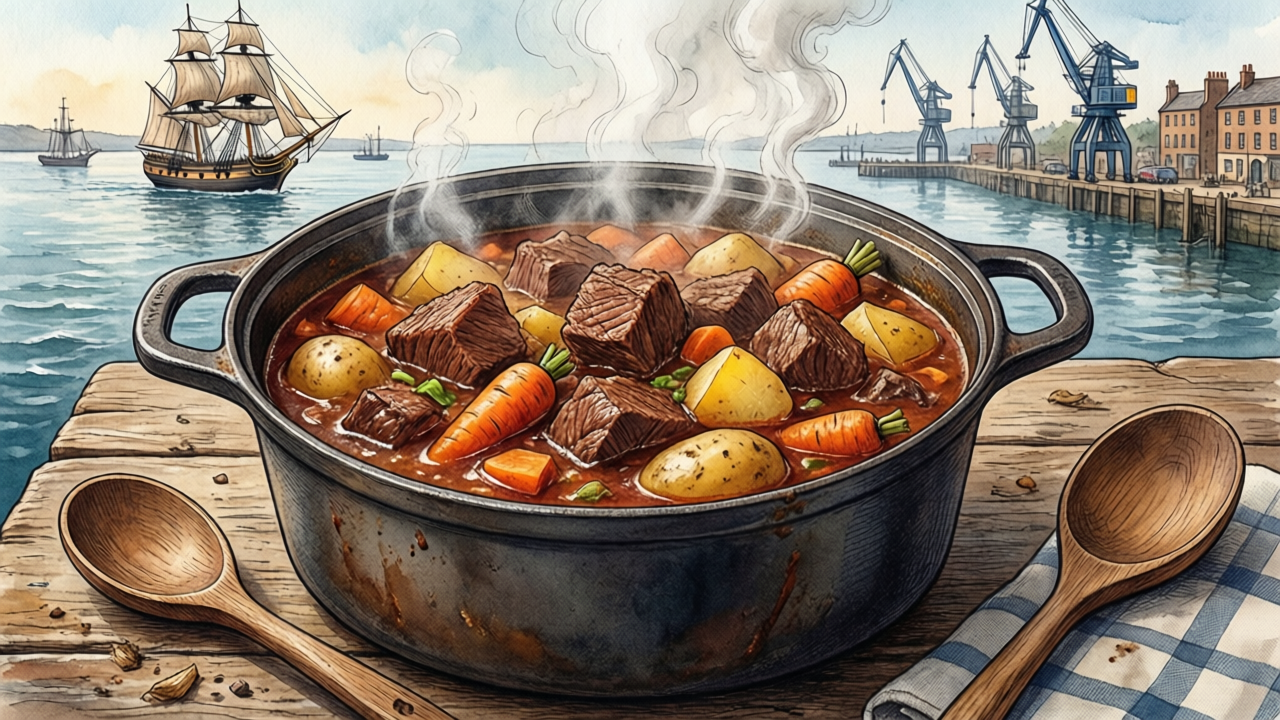
A 1785 description calls lobs-couse “a dish much eaten at sea, composed of salt beef, ship’s biscuit, and onions, well peppered and stewed together”. The ship’s biscuit line is one we have chosen not to develop. Everything else in that sentence is still the dish: beef, onions, potatoes, pepper, a long and patient stew. Every other city in Britain is named by a river, a king or a football club. This one was named by a cheap hash in a pot, which is either the most democratic nickname in the country or the most efficient.
Ingredients
- 800g beef chuck or braising steak, cut into 3cm chunks (the 1797 original says “cut into very small pieces”; we are not maintaining that standard)
- 2 onions, sliced
- 4 carrots, cut into thick rounds
- 900g potatoes, scrubbed and cut into chunks
- 2 tablespoons oil, plus a knob of butter
- 2 tablespoons plain flour
- 1 teaspoon Marmite
- 1 bay leaf and a few sprigs of thyme
- 600ml beef stock, plus water to top up
- Salt and lots of black pepper (the 1785 source insists it be “well peppered”)
- To serve: pickled cabbage, because the pot and the plate are separate jurisdictions
Method
- Heat the oil and half the butter in a large heavy pot. Brown the beef in batches, without crowding the pot. Crowding turns browning into weeping, and this stew has done enough of that over the centuries.
- Lower the heat, add the onions to the same pot, and sweat them for eight or ten minutes. The onions go in after everything else has finished in it, as onions ever since the 1790s: same pot, same outcome, ditto.
- Stir in the flour and the Marmite and cook for a minute. You will not taste the Marmite. That is its entire job — depth that never names itself, the onions-for-ditto of the cupboard.
- Pour in a splash of the stock and scrape the bottom of the pot. The sticking is the history; every port stew in the world is built on the flavour of something that stuck.
- Return the beef, add the rest of the stock, the bay and the thyme, and bring it to the barest simmer with the lid on. Forty-five minutes, gentle. A hard boil makes beef stringy and the whole pot sulky, and nobody ever improved a stew by rushing it at sea, because at sea rushing was the reason for the stew.
- Add the carrots and the potatoes — scrubbed rather than peeled. The 1797 description specifies potatoes “peeled, or rather scraped, raw”, which makes it the only document in culinary history to overrule its own verb mid-recipe, and it’s right: scrape them. Top up with water until the stew is just covered. Another hour to an hour and fifteen, until a piece of potato gives way without an argument.
- Take it off the heat and let it rest ten minutes. It also reheats like a dream, which is how you know the design is sound: scouse on day two is the scouse the workhouse always intended.
- Serve with pickled cabbage and, if the household needs convincing, a chunk of white bread. A Liverpool Echo survey in 2018 found the essential ingredients to be potatoes, carrots, onion and a chunk of meat — the cabbage never made the list because the survey was about the pot, not the plate.
Vegetarians: pulse 400g chestnut mushrooms with a drained tin of butter beans and take up the same position at step one, with smoked paprika in for the pepper and vegetable stock in place of beef. The 2018 survey established “a chunk of meat” as the fourth essential, but it has never once tested a chunk in a laboratory, and this city has always been generous with new arrivals to the pot.
And that’s how a stew becomes a city. The lob fell off the lobscouse, the shortened word named an accent, the accent named a people, and the whole chain rests on a pot of beef, potato, carrot and onion simmering quietly in the corner while everyone argues about music. No other British dish has ever promoted itself that far by getting shorter. Onions for ditto — the stew never needed the repeat.