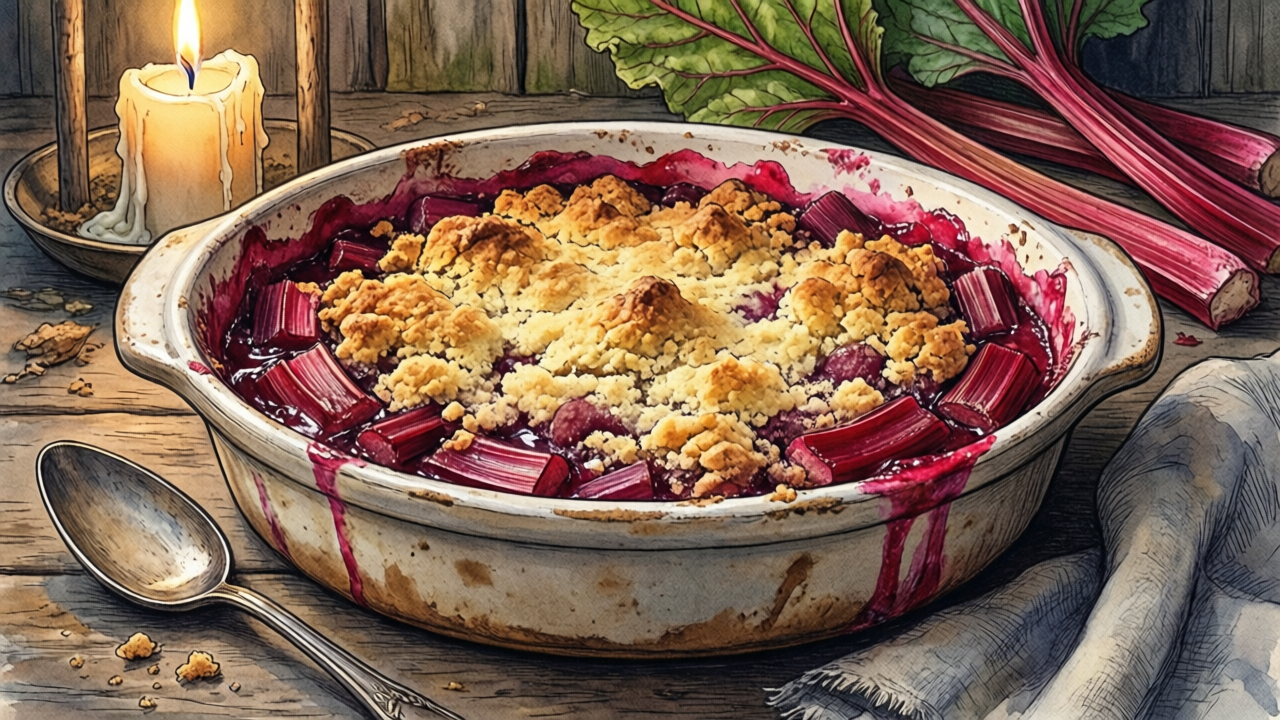
In a long low shed somewhere between Wakefield, Morley and Rothwell, the crowns are going in this week: rhubarb plants left unharvested for two years to stock their roots with carbohydrate, given a good frost, then carried indoors into heated, windowless buildings where they will spend the winter growing in complete darkness. By January the pickers will be pulling the stalks by candle, because any strong light stops the growth. The stalks reach about two feet, go crimson without ever seeing the sun, and taste sweet, because the plant has quietly converted its own stored starch into glucose. This is not a metaphor, and it is not a Victorian moral lesson. It is a commercial crop, and the sheds are full right now.
The patch of ground this happens on is nine square miles, and at its peak before the war it supplied some ninety per cent of the world’s winter forced rhubarb: up to two hundred tons a day, from up to two hundred growers, with the Great Northern Railway running a dedicated rhubarb express out of Ardsley every weeknight from Christmas to Easter, into Spitalfields and Covent Garden in time for Christmas, and on to Paris as well. Britain has a train that existed for a vegetable. When the crop finally got its Protected Designation of Origin in 2010, the legal boundary of the Rhubarb Triangle was written into EU law as a list of roundabouts — “at junction 26 take the M62 south to junction 25, head east along A644 toward Dewsbury” — which is how European legislation says “you know where it is when you’re from there.” The name itself only entered the Oxford English Dictionary via a 1965 geography textbook for business studies. Britain’s greatest crop entered the record via the commerce syllabus.
It had a grander early life. Rhubarb arrived overland along the Silk Road, reached fourteenth-century Europe through Aleppo and Smyrna, and cost several times the price of cinnamon, opium and saffron — expensive enough that Marco Polo went looking for where it actually grew, like a man tracing the provenance of an expensive whisky. Its name means “barbarian from the banks of the River Rha”, the Rha being the Volga, so the plant has been insulted by its own label for six hundred years. Britain only started eating it in the eighteenth century, when sugar got cheap enough: the nation’s classification system for plants has always run through the confectionery budget. It is botanically a vegetable, it is cooked like a fruit, the Americans nickname it the pie plant, and the leaves are poisonous — the only part of the plant with a body count.
So: a crop that spends two years banking sunlight and ten weeks insisting sunlight does not exist. The appropriate tribute is the crumble — a dish that buries that fruit under a lid of sugar and flour, bakes it until it has opinions, and then stands back while it is destroyed with custard.
Ingredients
- 500g rhubarb, fresh or frozen (if the fresh shelf has gone quiet, the freezer aisle has it; frozen takes the oven better than anyone who has ever argued with it)
- 75g caster sugar, plus 2 tbsp water
- 2 tbsp stem ginger from the jar, chopped — or a level teaspoon of ground ginger if the jar is out of stock
- 120g plain flour
- 100g cold butter, cubed (a plant-based block does the same job, and the crumble will not ask questions)
- 80g demerara or muscovado sugar
- A pinch of salt
- To serve: pouring custard, or cream
Method
- Take the stalks in both hands and snap them, twisting as you go — the same motion a picker uses in a dark shed in January. It’s faster than a knife and the stalks, which spent the winter alone in the dark with no hobbies, offer almost no resistance.
- Every leaf goes in the bin, without discussion. The leaves are poisonous, and twice in the last century Britain printed advice recommending them as food. In the First World War someone suggested the leaves as a vegetable, people obeyed, and the same advice was rediscovered in the Second and obediently obeyed again, with results. Two wars, one lesson, both times: leaves out, stalks in. That is the entire safety briefing.
- Cut the stalks into 2cm fingers and put them in a baking dish with the caster sugar and the water. Forced rhubarb genuinely needs less sugar than field-grown — the shed has already done part of the sweetening for you — but this is Britain, and we do not let physics have the final say on dessert.
- Scatter the chopped stem ginger over the fruit. Ginger is the pairing that stuck: the American custom is strawberry, and some purists have called that union “a rather unhappy marriage” in print, which is the harshest thing the British have ever said about a fruit without mentioning the weather.
- For the topping, rub the flour, butter, demerara sugar and salt together with your fingertips until you get rubble rather than sand. Sand is what a biscuit becomes when it has filed the paperwork to be interesting; rubble has flakes, and flakes are the whole point.
- Throw the rubble over the dish. Do not press it down, do not smooth it, do not pattern it. The crumble is the one British dish that is measurably improved by being flung on in a hurry — the flattest topping is the one that steams instead of crisps, and the dish is under no obligation to look good.
- Bake at 180°C (160°C fan) for 35 to 40 minutes, until the top is gold and the corners are bubbling like a shed full of secrets. Do not open the door every five minutes. The rhubarb spent ten weeks in total darkness to end up this sweet; it can survive twenty minutes with an oven looking at it.
- Rest it for ten minutes before serving. Filling straight from the oven burns the palate with the full force of its own affection, and the British method for serving anything hot is to make people wait, then apologise that it is too hot.
Pour the custard over — the pouring kind, because the pot kind is a lifestyle decision and not a technical one — or run the cream over in a single confident line and say nothing. There is a heritage variety called ‘Hawke’s Champagne’ which contains no champagne and is not anybody’s property; two hundred years old, named the way a pub names a beer: confidently, and with nobody checking.
And if it’s already dark outside by four o’clock when you eat it, that’s not an inconvenience — that’s the Yorkshire method. Nine square miles of it, happening right now: the best work done in a windowless shed, by candlelight, for a harvest nobody sees coming. The rhubarb never once saw the sun and came out sweeter for the experience. You are doing the same job with an oven and a jar of stem ginger — you simply have better lighting, and far fewer excuses.