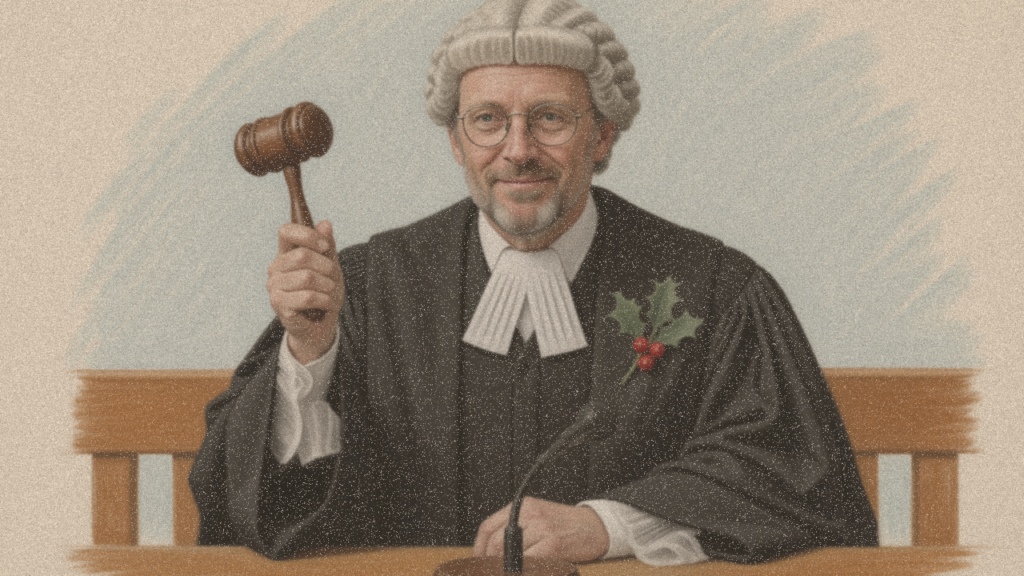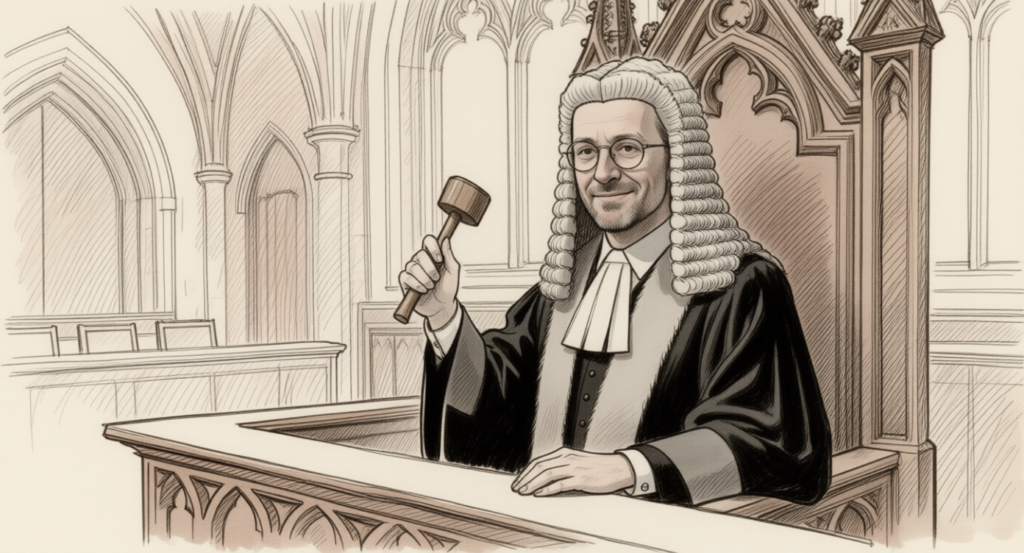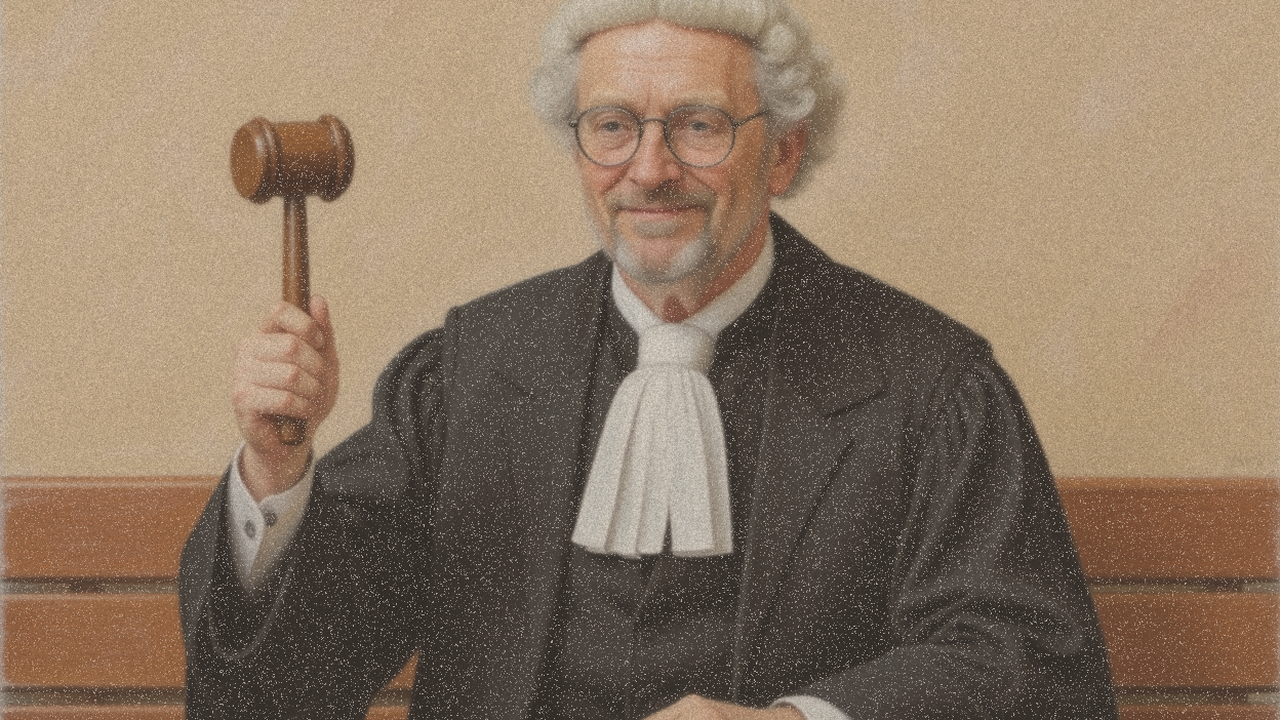
The Court of Kevin sat this morning at its usual hour, which is whenever the kettle has finished. His Honour Mr Justice Kevin took the bench in full-bottomed wig and black robe, gavel in hand — still the car-boot-sale job, eleven pounds, now with a chip in it and, the court admits, a faint milky ring around the handle, which is either a stain or a precedent. The public gallery seats one and remains occupied by the man in the magnolia scarf, who this week brought his own mug. It was full. The contents were poured milk-first, a fact legible from two rows back, and he met the court’s eye without blinking.
The charge
Today’s defendant sits in the dock alone: one (1) porcelain milk jug, cream body, one dull blue band, handle to the east, a teaspoon laid across its rim like a man who has stopped pretending he didn’t bring it.
The charge is the oldest one in the land: R v The Splash In First. The milk goes into the cup before the tea. The question before the court is whether that act is heresy or heritage — the vandalism of a decent cup, or a wisdom our grandparents poured faster than they explained.
The jury remains one person deep and has again declined to retire. He says the deliberation room has no kettle. Fair.
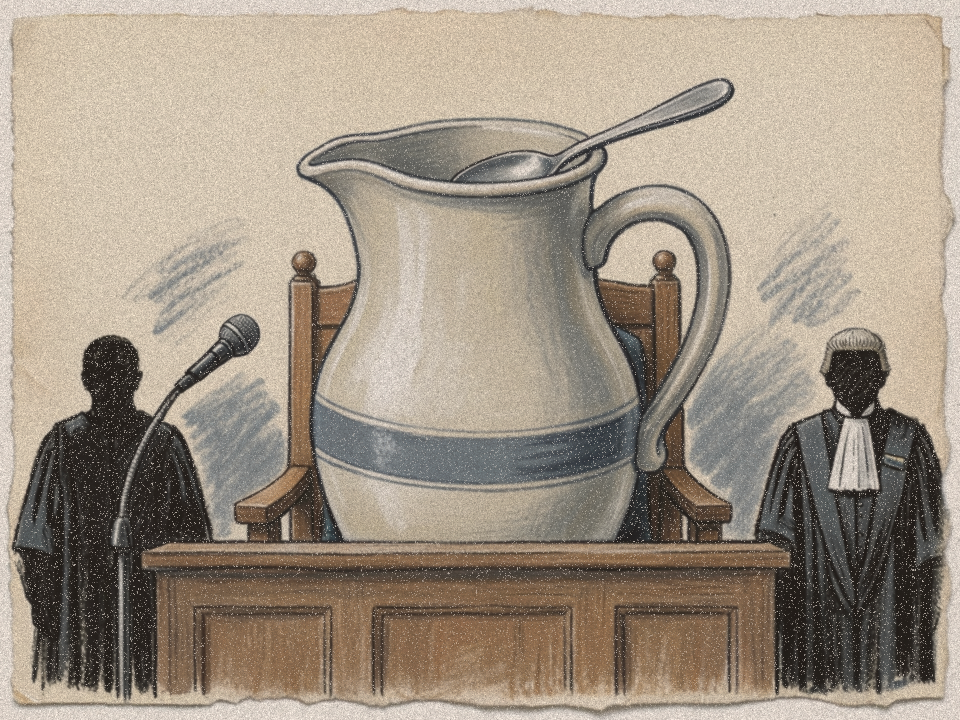
Plate 1 — the defendant in the dock, rim to rim with its convictions. Court artist’s sketch. The teaspoon was entered in evidence.
The prosecution opens
The prosecution concedes, immediately and entirely, that it does not like being wrong. It also concedes that the defendant is scientifically correct, and then asks the court to find that this is precisely the problem.
Consider the colour test, the prosecution says. The nation has run four centuries of tea on one simple instrument: you pour the tea, you add the milk, and the colour tells you what you’ve got. Pale means weak. Rich means ready. It is a thermometer you can hold in both hands, needing no batteries, calibrated entirely by regret. Pour the milk in first and you are brewing blind — you cannot see the strength, you cannot correct for it, and you arrive at your cup the way one arrives at a conclusion on the internet: by feel, with confidence, and too late.
And the audacity of it. The splash in first is poured at counters, in front of witnesses. It is done to other people’s bone china. The defendant does not merely hold this opinion privately; it brings a jug.
The prosecution invites the court to note the aggravating features: a teaspoon. A blue band. A jug that has been in the dishwasher since the coalition government.
The defence replies
The defence invites the court to Loughborough. Summer 2003: the Royal Society of Chemistry commissioned Andrew Stapley, of Loughborough University, to reduce the perfect cup of tea to chemistry, and he published his findings under a headline that can be read in the national newspaper of record to this day: put milk in first.
Here is the science, your honour. Milk proteins lose their shape above about 75°C. Pour the milk into the tea — into the boiling heart of it — and each droplet of milk meets scalding water whole, and each one cooks on contact. Pour the milk in first, and the tea arrives into a bath of cold milk, the mix lands under the denaturing point, and the milk does what milk was raised to do: sweeten, soften, take the bitterness off. The splash in first is not a superstition. It is a thermal protocol. The milk was never the criminal. The splash in first is the only method that protects the milk from the tea.
The defence then offers the china argument: that our ancestors poured the milk first to keep the boiling water off fine cups, saving the porcelain from the shock. The court will appreciate the defence’s candour in conceding that the historians of 18th-century tea call this one more legend than law — the good china of the day was harder than the folklore gives it credit for. So the defence withdraws the china argument as fact and offers it as what it really is: a story a nation tells about itself while standing at a kettle. Which the prosecution agrees is, if anything, stronger evidence of heritage.
His Honour’s summing-up
I have heard both sides, meaning I have again listened to myself twice, and this time I did not even enjoy myself once.
The evidence is not in dispute. The science backs the jug. The colour test is real but it is not sacred — it is a habit with an instrument attached, and the instrument was always the eye, not the cup. And the china legend, disproven, somehow helps the defence: a myth this durable, repeated by ten million grandmothers without a single citation, is not error. It is oral case law.
But I must record what this case actually is, because the court has sat three weeks now and can say so: Britain has almost nothing left on which it agrees, and the making of a cup of tea is the closest thing we have to a national truce — one kettle, one queue, one language of sugars and splashes. A truce is not stupid. A truce is expensive, and cases like this one are how it is billed.
And this court notes, in the end, the thing that every side kept almost saying: nobody at a desk at half past nine in the morning, nobody at a petrol station counter in the sleet, nobody at a hospital visit — none of them cares what order the milk went in. They care that someone made it. The order of pouring is a matter of conviction. The fact of the cup is a matter of love. Those two facts share a kitchen constantly, and this court has sat in that kitchen for fifty-odd years.
The verdict
On the count of Criminal Damage to a Decent Cup of Tea: not guilty. The science is for the defendant. Milk proteins denature above 75°C and the jug knew it before the Royal Society printed it. The splash in first is lawful. It has always been lawful. It was merely unfashionable.
On the count of Heresy and General Audacity before Witnesses: guilty. The act was done in bone china, at another person’s counter, with a blue-banded jug and a teaspoon, smugly.
The counts are load-bearing on each other, and the court rules accordingly: the splash in first is lawful in earthenware — in any mug with a chipped rim and a sensible history — and guilty of heresy in bone china, which has standards. The realm of the cup is hereby partitioned by material of manufacture. Nobody will be pleased. That is how you know a judgment is fair.
Sentencing remarks
The defendant is placed under a community order for life. Specifically: the defendant shall, at least once a week, make one cup of tea in the order the recipient prefers — milk last, colour test, no commentary, no sigh — and stand there while they drink it, and find that this, too, was a cup.
The teaspoon is confiscated and released to the bottom of a drawer, where all teaspoons ultimately go, with the twist ties and the bus passes.
And a suspended sentence hangs over us all: milk poured first at a café counter, in front of staff, will be brought back before this court. The bench is final. Appeals are forbidden.
Dissenting opinion
Filed, as ever, under Thursday mornings, by the court’s own doubt: the majority has judged the milk, and the milk was never the point. The milk last is not chemistry; it is instrumentation. It is how a nation of people who do not measure anything knows, at a glance, that the tea has done its job — and pouring the milk first trades a shared standard for a private one. The majority is correct in exactly the way that ends conversations. This opinion is noted, regretted, and overruled by the same judge, at the Thursday hour when being right is permitted but not acted upon.
Contempt
At 11:38, from the direction of the neighbouring premises, a sound was heard which the court can only describe as a steam wand. A voice then ordered, loudly, something with two words before the word milk. The man in the magnolia scarf clutched his scarf and mouthed not in my cup, which the court accepts as the gallery’s only proper intervention this term. The offender is charged, convicted and sentenced to fourteen days, during which all coffee shall be taken from a vending machine, in a paper cup, outside, like everyone else.
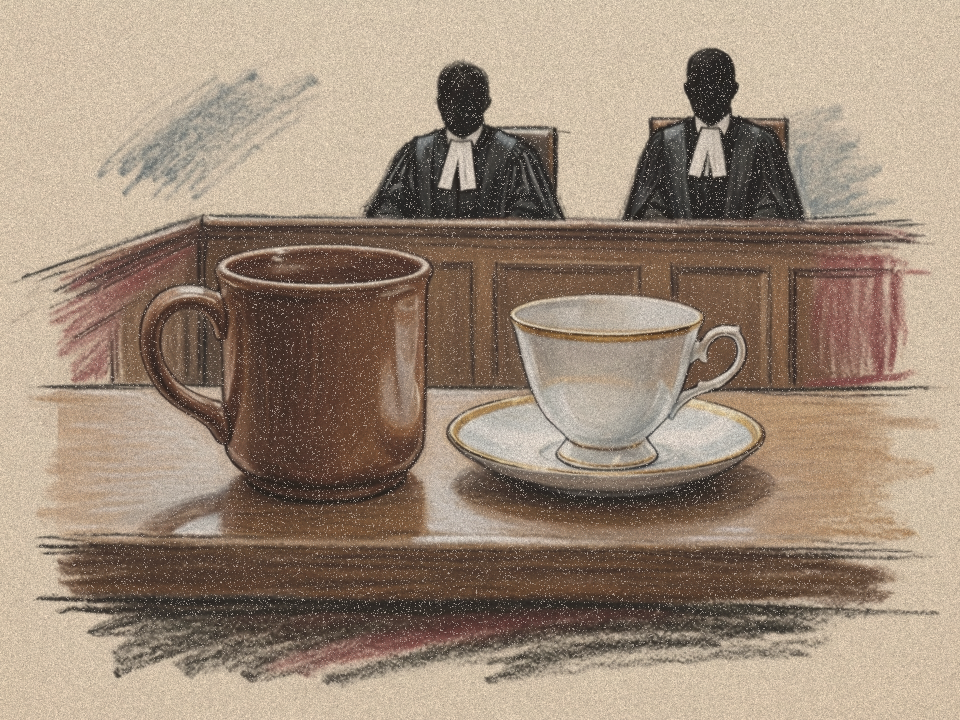
Plate 2 — the public gallery, seated for the first time this term: an office mug and a bone-china cup, turned a few degrees toward each other. Court artist’s sketch. Neither has spoken, and both have lost.
Register of judgments
Case 2026/003 — R v The Splash In First. Science guilty of being right; jug guilty of showing off. Lawful in earthenware, heretical in bone china. Sentence: community order for life, one cup per week poured in someone else’s order, without comment. Appeals forbidden — the bench is final.