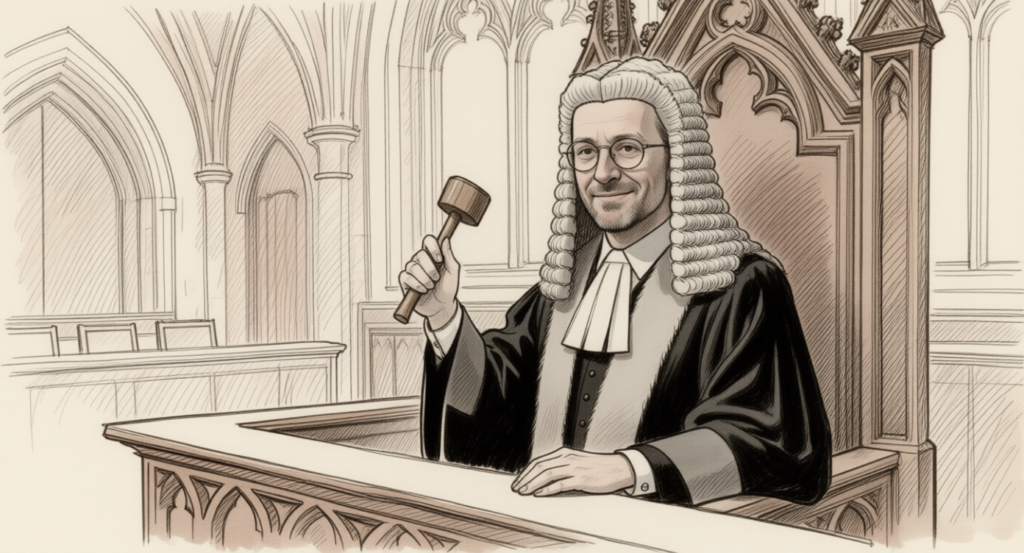
The Court of Kevin sat again this morning, one week old and already settling into its routine. His Honour Mr Justice Kevin took the bench in full-bottomed wig, black robe, and the same car-boot-sale gavel, whose head is now slightly chipped from being used, like everything else bought for eleven pounds. The public gallery seats one and remains occupied by the man in the magnolia scarf, who brought his own seat cushion this week. He did not need to. There is only the one seat.
The charge
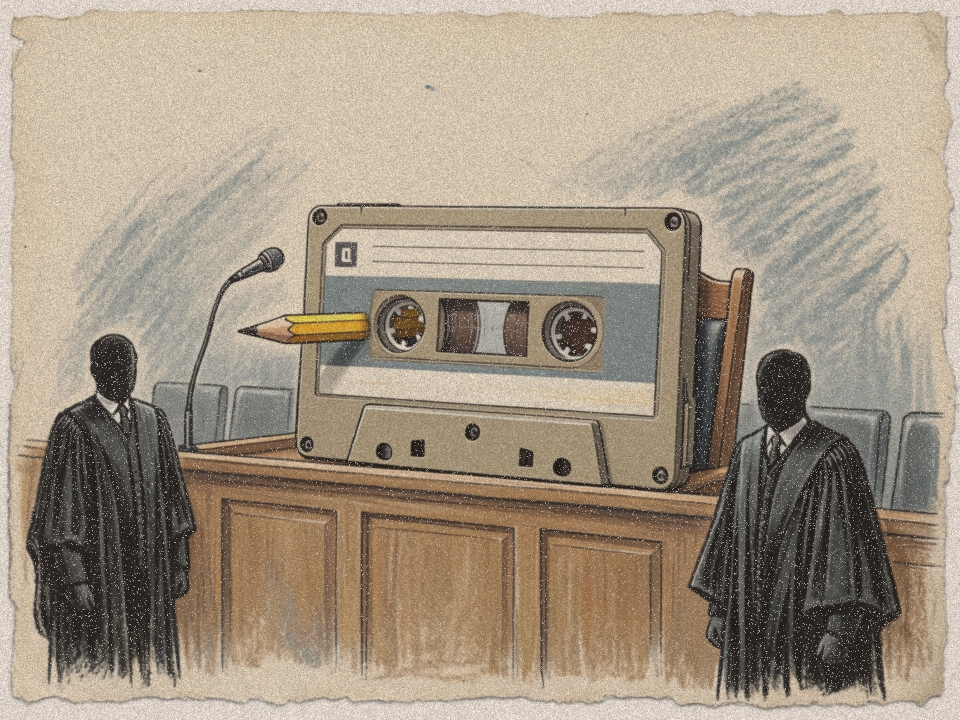
Today’s defendants stand in the dock together, because they acted in concert: one (1) compact cassette tape, beige shell, Type I ferric, C60, and one (1) HB pencil, yellow, hexagonal, chewed at the ferrule.
The charge: were they clever or criminal? The court notes that the pencil is charged in the first degree, meaning it knew what it was doing.
The jury remains one person deep and has again declined to retire, this time because he has strong opinions about reel-to-reel and has asked to address the court directly. Leave him out, your honour.
The prosecution opens
The prosecution submits that this is, at best, an unlicensed modification, and at worst vandalism with a stationery alibi.
Consider. The cassette’s reel hub — the little wheel you can see through the window — was engineered for the tape transport: a round aperture with two driving spokes, built to mesh with a deck’s winding mechanism at precisely controlled tension. It was not built for office equipment. There is no Philips memo, no design drawing, no quiet conspiracy in Eindhoven in which an engineer looked at a pencil and said “yes, six flats, that will do.”
And yet, the prosecution concedes, it fits. A hexagonal pencil — anything between about seven and ten millimetres across the flats, in fact — drops into that hub as though it grew there. The prosecution invites the court to call this what it is: a coincidence so convenient it looks like intent. And the court should be very suspicious of things that look like intent.
Furthermore: the act itself. The pencil is inserted. The pencil is turned. Tape is wound backward by hand, by wrist, by the same motion a person uses to stir gravy. This is not engineering. This is a person making music move with their hands like some kind of medieval peasant, and then having the audacity to call it saving the tape.
The defence replies
The defence would like to take the court to Berlin. August 1963, the Radio Exhibition — the Funkausstellung — where Philips stood a Dutch engineer named Lou Ottens in front of the world with a plastic rectangle smaller than a paperback and a machine called the Pocket Recorder EL 3300. Ottens gave everyone portable music. What he did not give anyone was a rewind button that didn’t grind, stretch and eventually destroy the tape he’d just set free.

The defence submits that the pencil is not vandalism. The pencil is the completion of an unfinished system.
Because look at the fit, your honour. The hub wants a round pin with two spokes. The pencil offers six flats and a graphite heart. Neither was designed for the other — and yet the hex, which exists only because a hexagon is the simplest shape a machine can cut from a plank of wood and the only one that stops the pencil rolling off the table, grips those spokes perfectly. Nature brought the tolerance. Stationery brought the handle. That is not a peasant stirring gravy. That is two brilliant accidents shaking hands.
And what was the pencil for, in the end? Rewinding. Always rewinding. Not fast-forward — nobody ever needed to save fast-forward — but back: to the top of the track, the beginning, the first two seconds that tell you whether you love the song or not. The defence asks the court to consider how much love that requires. C60. Thirty minutes to a side. A person who cared about music casually bought a player. A person who cared about music deeply owned a pencil.
His Honour’s summing-up
I have heard both sides, which as usual means I have listened to myself twice, and I return to the question as put: clever or criminal?
Here is what the evidence shows. Nobody planned this. The Berlin engineers planned the tape. A millwright two centuries earlier planned the hexagonal pencil, to stop it rolling off drawing-office desks. The fit between them — seven to ten millimetres of yellow hex meeting two plastic spokes — was a coincidence neither man intended, discovered simultaneously by every schoolchild with a chewed HB and a flat battery in a Walkman, everywhere, at once, with no group chat.
And this is the most British mechanism ever assembled. The system arrives. The system is incomplete. Nobody sues anybody, nobody waits for the manufacturer, nobody files a ticket. Someone’s pencil goes in the hole, the tape goes round, the song comes back. We have run an entire civilisation on solutions that were designed for a different job — the tea towel on the radiator, the pen that is also a screwdriver, the gavel this court bought for eleven pounds.
The court notes in passing that the same generation of tape that carried every soap rerun and every wedding also carried a Commodore 64 loading a game, the border flashing through blue and cyan like faulty pub neon for five minutes at a time — and if a whole decade of children learned to trust the cassette under those conditions, the cassette has already survived its character evidence.
The verdict
On the count of Criminal Vandalism of a Tape Transport: guilty. The pencil did turn the wheel. The wheel was never designed for it. The court has seen the film of it being turned and cannot pretend otherwise.
On the count of Glorious Improvised Engineering: guilty. The fit exists. The tape survived. The song came back.
Both counts proven, and the court finds that they are load-bearing on each other: the engineering is only glorious because it is unauthorised. A rewind tool you buy in a shop is a product. A rewind tool you already own is a heist.
Sentencing remarks
The defendants are jointly sentenced to lifelong manual rewinding.
Specifically: each of you shall, whenever a song you loved at seventeen is played in your vicinity, be obliged to return to the very start of it — not with a button, but by hand, at the speed of your own wrist — and sit with whatever made you rewind it in the first place. Whether that was the girl at the bus stop, the B-side you recorded off the radio before the DJ said what it was, or the fifteen minutes of tape you left blank at the end of every side just in case, on the off chance that life gave you one more song worth keeping.
No parole. Appeals are forbidden in this court; the bench is final.
The pencil shall additionally pay costs, which it will pay in graphite, over many years, to many hands.
Dissenting opinion
Filed, as ever, under Thursday mornings, by the court’s own doubt: the true defendant was never in the dock. It was the fast-forward button — the one pressed with one eye on the lyrics, the one that overshot the first line of every song, that ate the start of things. The pencil at least wound the tape backwards, toward what you already loved. Any court that convicts the rescue and acquits the rush has misread its own evidence. This opinion is noted, regretted, and overruled by the same judge, for being right at a Thursday hour when that is allowed.
Contempt
At approximately 11:40, a voice from the single seat in the public gallery was heard to mutter “can’t you just use Spotify?” The man in the magnolia scarf was not the offender, though he was seen nodding in support, which the court treats as contempt adjacent. The offender is sentenced to fourteen days, during which they must rewind, by hand, every podcast they have ever started from the middle. The gallery is now seating no one, and the trial proceeded happily.

Register of judgments
Case 2026/002 — R v The Pencil in the Cassette. Guilty on both counts: vandalism and glorious engineering, each proving the other. Sentence: lifelong manual rewinding, no parole, costs paid in graphite. Appeals forbidden — the bench is final.