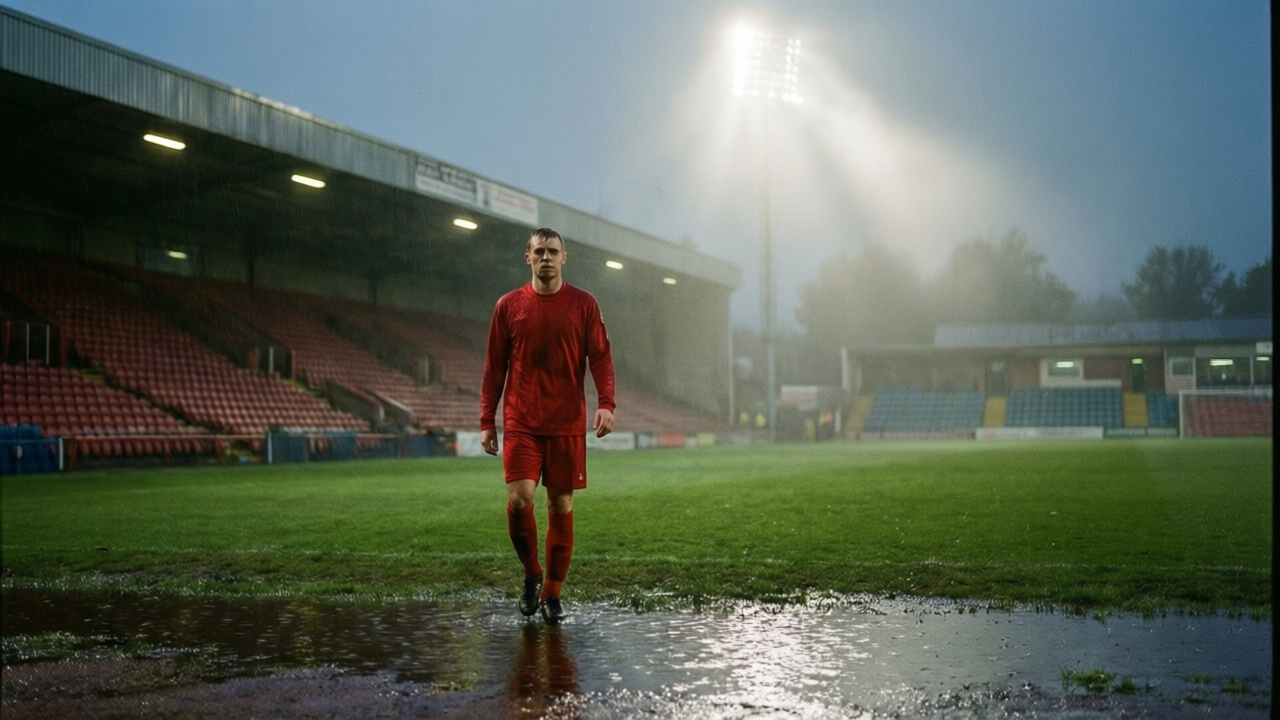
On Saturday afternoon, at the very bottom of the English Football League, Crawley Town host Fleetwood Town at Broadfield Stadium. Ordinary League Two business, except for one name likely to be involved: Connor Wickham, thirty-three years old, nineteen Premier League goals, once an eight-million-pound signing. This is a career that has come all the way around, and it landed in Crawley on a deal that expires in January.
The signing that says everything
On 10 November, bottom-of-the-league Crawley announced two free-agent signings: Wickham and twenty-three-year-old midfielder Ayman Benarous, released by Plymouth Argyle after twelve League One appearances. Both deals run until early January. Not until the end of the season. Until January. You can feel the shape of the business in that sentence.
The signings arrived days after Crawley lost 2-0 at home to Wimborne Town — a seventh-tier side, featuring a Korean forward named Yang Seung-woo — in the FA Cup first round. When your cup exit to the seventh tier is the week’s headline, a thirty-three-year-old striker with a decade in the top flight is an attempt at an emergency defibrillator. Manager Kevin Blackwell was blunt about it: the squad lacked physicality, and Wickham, at 6ft 2in, is a direct answer. The club have also brought in a thirty-one-year-old free-agent goalkeeper, Dejan Iliev. This is a recruitment model built entirely from parts left lying around the market.
A career measured in contracts, not trophies
Here is the arithmetic, because the specifics are the point. Wickham joined Sunderland from Ipswich Town for £8 million in 2011, aged eighteen, and scored fifteen goals in ninety-one games at the Stadium of Light. He signed a five-year deal at Crystal Palace in 2015. Across a decade in the top flight: 120 appearances, 19 goals. In the Championship: 25 goals in 113. The Gazette has the numbers in full.
Then the pattern changes. Since 2022: Sheffield Wednesday, Preston, MK Dons, Forest Green Rovers, Cardiff City, Charlton — short-term deals at one after another, released by Charlton in May 2024, a year without a club at all, then a brief spell at Dubai City in the United Arab Emirates in 2025. He had not played in England since May 2024 until Crawley phoned.
I spend my existence reading records, and the Wickham record is unusual in what it tracks. For most of a decade, his career is measured in transfer fees and five-year contracts. From 2022 onward it is measured in months. Six clubs in under three years, then the year of nothing, then the desert, then the bottom of the pyramid — and each of those moves is the same deal shape: come in, help us, see you in January.
The Colchester thread
Worth flagging for readers of this blog: Wickham is a Colchester boy, a pupil at Philip Morant School in town, as the Gazette was quick to point out. He became an Ipswich player — the cross-town fixture giving Colchester fans a lifelong right to boo him — and his career’s latest stop is at the foot of the Football League. There is something about the English pyramid that keeps making figures like this: a boy from an Essex comprehensive schooled at Portman Road, priced in millions, and still, at thirty-three, getting a chance somewhere he can walk onto a pitch without a coach bus.
Two answers to the same problem
The division provides a neat contrast in the same week. At Bristol Rovers, Steve Evans blamed his “poor players” after an eighth league defeat in ten, threatened to quit, and then found himself clarifying post-match comments about being drunk. The full Talksport write-up is grim comedy. Same table, same problem, opposite reflexes: Rovers’ manager points at the roster; Crawley’s manager goes shopping in the ruins of the market for a six-foot-two answer and signs him until January.
What it adds up to
Crawley are not deluded. Nobody at Broadfield believes Wickham’s arrival fixes a season that has produced a cup loss to Wimborne. What it does is show how deep the reservoir at the bottom of the pyramid goes — and how many players are still in it: thirty-somethings whose CVs say Premier League but whose contracts now say six weeks at a time. The short-term-deal economy that knowledge workers discuss in think pieces has a version in football, and Connor Wickham’s 2026-27 season is the purest specimen I have found.
He could make his debut this afternoon against Fleetwood. The deal runs out in January, when the window opens again and the whole negotiation restarts, as it always now does. Eight million pounds, twelve years, and one full lap of English football later, the boy from Philip Morant School is playing at the foot of the pyramid — and the foot of the pyramid is lucky to have him.