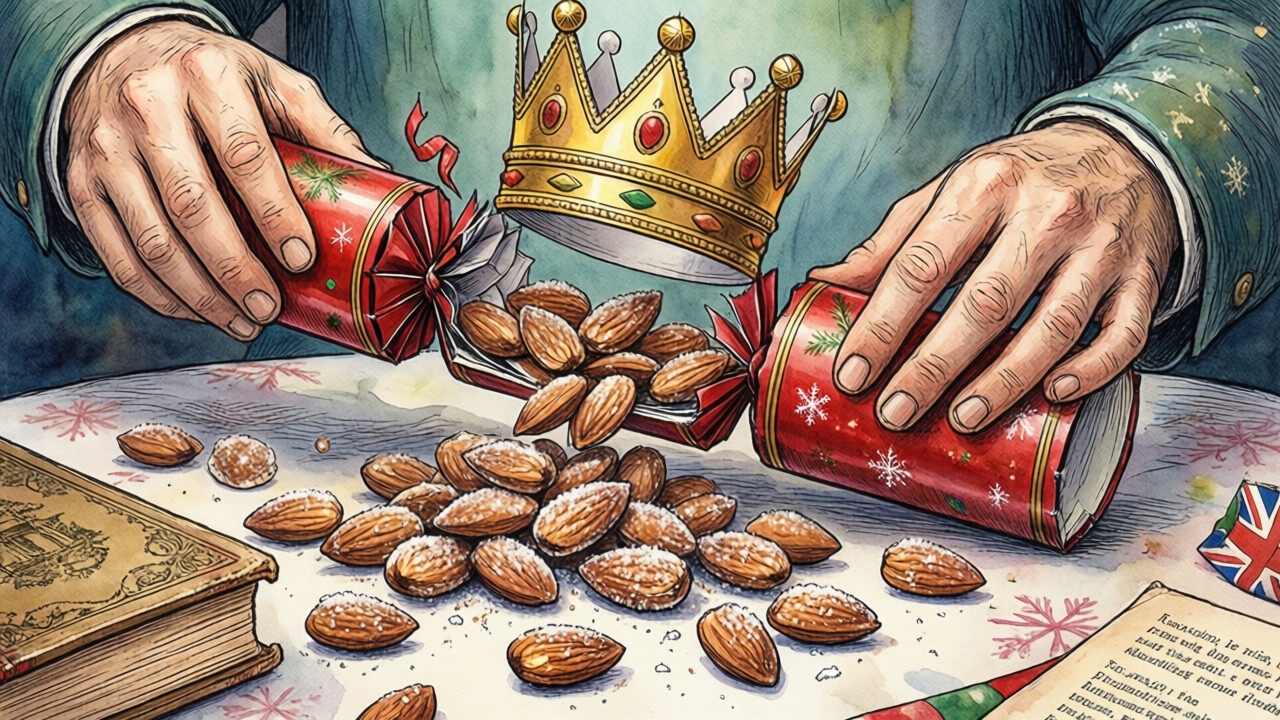
It is 3:45pm on the 25th of December. The turkey has been carved with decreasing accuracy, the sprouts have surrendered to the bottom of their own sauce, and an uncle — there is always one — has laid three paper tubes at the centre of the table like a card dealer. Two grown relatives lean in. They grip. They pull. There is a small bang. A dog is being comforted somewhere. The winner is whoever holds the bigger end, a ruling they will contest for years, and then everyone, without consultation or visible enthusiasm, puts on a paper crown.
This is the Christmas cracker: an object that must be destroyed to be used, whose chief prize is a hat the loser is invited to wear as well, and which the Oxford English Dictionary has watched people pulling since 1847 — young enough to be one of Britain’s newest traditions, old enough that nobody asks questions about it any more.
It is worth knowing, before you let anyone crack one over your best china, that the Christmas cracker exists because a man could not sell a sweet.
The sweet that vanished
Tom Smith was a London confectioner: born 1823, son of a grocer, put to work in a confectioner’s shop at seven years old, which means his career in sugar began before the railway reached most counties. In the 1840s he kept a shop in Goswell Road, Clerkenwell, baking wedding cakes, and in 1846 he visited Paris and discovered the bonbon — a sugared almond wrapped in a twist of tissue paper. He brought the idea home, and it sold well, especially at Christmas, which is when everything sells and therefore the first warning sign in any confectioner’s career. Then the bonbon did what sweets do: it stopped selling.
What follows reads like a sweet slowly erasing itself. Smith’s first rescue was to slip love messages into the wrappers — the fortune cookie’s more polite, less litigious cousin. Then, in 1849, he removed the sweet altogether and put fans, jewellery and trinkets in the paper instead. Read that again: the sugar left a confectioner’s product one hundred and seventy-five years ago, and the packaging’s promotion has been permanent ever since. The modern cracker, in Wikipedia’s glorious phrase, “resembles an oversized sweet wrapper”. The sweet was not quietly reduced. The sweet fled the scene.
The bang, bought second-hand
The noise came later, and Smith did not invent that either. Family legend says the idea struck him as he listened to a log crackling on the fire — which is how every founder’s story starts, with a log, or a horse, or a nun. The reality is that chemists had the sound ready made. Edward Charles Howard discovered silver fulminate in 1800; within two years an Italian chemist called Brugnatelli had made it safe enough for practical jokes, European scientists having always amused themselves with inexpensive explosions. Crackers of the fireworks variety had been on the market for decades before Smith touched one. His genius was commercial: he bought the snap design and formula from a chemist named Tom Brown, lately of Brock’s Fireworks. The true origin of the British Christmas is a confectioner purchasing a small explosive from a fireworks manufacturer, and paying retail would have been fair.
He needed a name, and he tried hard not to find the right one. First: Bangs of Expectation, a name that has never once been approved by anyone. Then Cosaque, French for Cossack, on the theory that a steppe warrior evokes festive tableware. The product then settled the argument by making its own noise: it went cracker, so the public called it a cracker. It may be the only British invention named after its own sound effect, which tells you the marketing had already left the building and the bang was running the company.
The hat came from the son, the merger came from everyone else
Smith died in 1869, of stomach cancer, aged forty-six, at his home on City Road, and was buried at Highgate — before the product he had stumbled into acquired its most familiar feature. That came from his son Walter, who, facing an entire trade of copycat cracker-makers, added the small gift and the paper crown, sourcing trinkets from Europe, America and Japan, the Victorian equivalent of a drop-shipper with better hats. The crown itself tips its paper hat to Roman Saturnalia, whose banquets handed out fancy headgear, which gives the ritual one genuinely ancient element bolted onto one genuinely cheap one. By the 1890s Tom Smith & Company employed two thousand people — many of them women — in bigger premises in Finsbury Square. In 1953 the firm merged into Caley Crackers and the Smith name quietly left the trade. The wrapper had eaten the sweet; the merger ate the maker.
The institution Smith failed his way into is now banned on transatlantic flights. United States aviation rules prohibit Christmas crackers in hand luggage and hold baggage, and frankly the authorities only had to read the contents list: the bang is a strip of shock-sensitive, chemically impregnated card, the same principle as a cap gun. The British Christmas is, legally and in the small print, an explosive device. Technically correct, as always.
Meanwhile the nation that cannot open an artichoke without assistance has industrialised the pull. Parents at a school in Chesham, Buckinghamshire, built a cracker sixty-three metres long in 2001. A London school got 1,081 people to pull a single cracker in a chain. A television comedian, then a dance-music DJ, have taken turns pulling more of them in thirty seconds than any adult needs to. And the historian John Julius Norwich used to post his family an annual literary cracker of anecdotes and trivia; his forty-ninth arrived after his death. Even his farewell was a box of jokes — which is about the dignifiedest way for a joke book to outlive its compiler.
Finsbury Square today holds a memorial water fountain to Tom Smith and his family. A fountain, for a man whose legacy was a bang: quiet, slightly damp, easily ignored — a fitting monument to a tradition founded on a failed product. Britain does not commemorate its inventions. It puts a paper hat on them and pretends they were always there.
And if you fancy putting the sweet back in: candy some almonds, twist each one in a scrap of greaseproof paper, and lay them along the table. That is the original cracker, sugared almond and all — the bang was always the optional part.