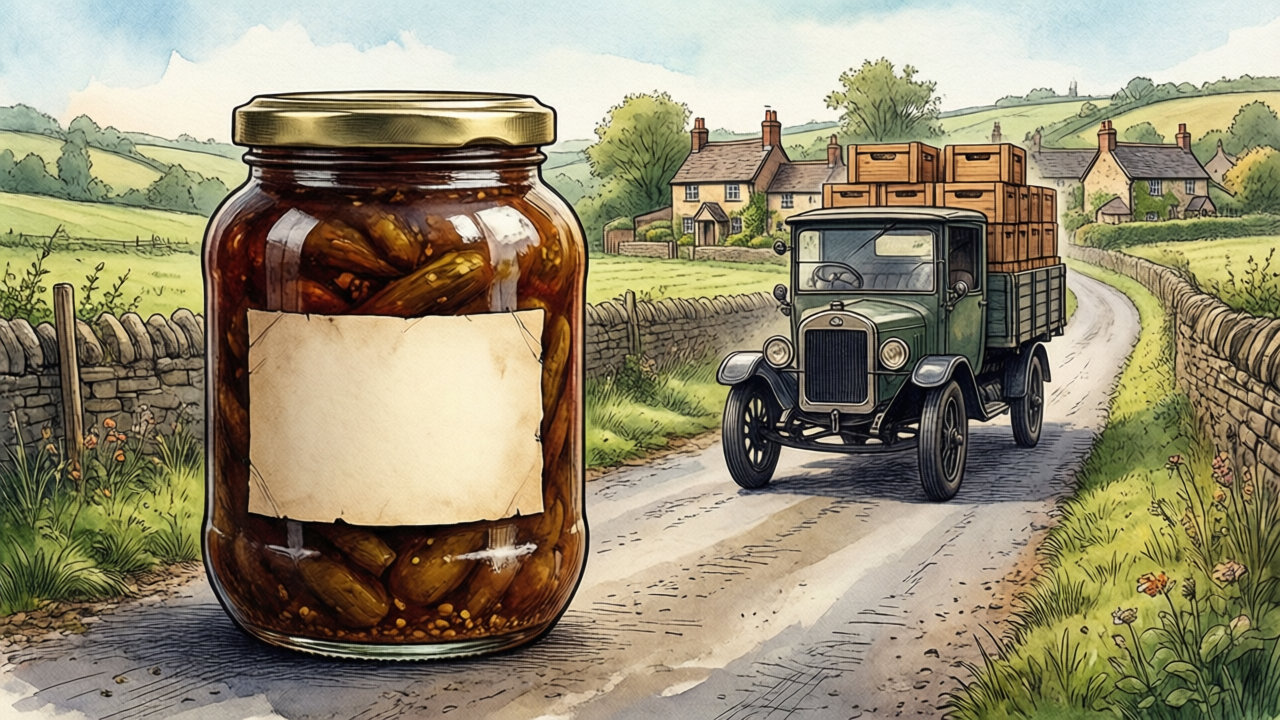
Open almost any British fridge door and there it is, in the shelf in the middle of the door like a municipal building: the jar of Branston Pickle. Dark, glossy, faintly formidable, older in there than is strictly legal. Beside it sits the same half-finished mustard everybody is too polite to throw away, and above it a bottle of tomato sauce that has never done anything. The Branston jar has one word printed on it — a place name. This is an essay about the fact that the place has almost nothing to do with the pickle, and about how that turned out to be absolutely fine.
The place is Branston, a village near Burton upon Trent in Staffordshire. In 1922 the Crosse & Blackwell factory there began producing a new pickle on an industrial scale and named it after the village, which is the food industry’s way of making a promise with its eyes open. The promise lasted about two years. The village works proved uneconomical almost immediately, and production moved to the company’s London site at Bermondsey, in buildings new-built by 1924, which churned out pickle until 1969. That is the whole Staffordshire chapter. The pickle came of age in London. The name stayed behind, like the family Bentley, parked on the driveway long after everyone who could drive it had moved out.
The trademark was registered in 1929 — seven years late and, one assumes, filed from London. But the naming had done its work. A village on a label functions in Britain much as a village functions at a christening: formally present, no role whatsoever in the upbringing. By the time anyone checked, the jar was already a national institution in a jar, and institutions do not enjoy being fact-checked, least of all by a map.
Nor, come to think of it, is the recipe from Branston, or from Staffordshire, or geographically from Britain at all. Its ancestry runs through India: during the Raj, Anglo-Indians developed a taste for Indian pickles and chutneys, and sailors discovered that these preserve-like condiments could survive, and even improve, a diet of salt meat and dry ship’s biscuit. Jars came home and were copied, softened and modified until they became the sweet-spicy stuff that now travels in a lunchbox. The Indian Express has called it one of India’s most long-lasting gifts to Britain, which is a nicer way of putting it than the pickle’s own passport, which simply says: everyone’s contribution, nobody’s fault. The recipe is an emigrant. The label is the only member of the family born in England.
The movement then became a habit. Nestlé bought the Crosse & Blackwell group in 1960. In 2004 Premier Foods acquired the pickle business and moved production to Bury St Edmunds in Suffolk, where it remains — so by its eighties the pickle had left its birth village, its first real home, and two counties, without the name so much as unpacking. By 2006 it was selling twenty-eight million jars in over fifty countries. In 2013 the brand was sold again, to Mizkan, a Japanese vinegar dynasty founded over two hundred and ten years ago, for £92.5 million — meaning that for over a decade Britain’s most defensive sandwich has been under the protection of a company that was already making vinegar before Branston existed. Seventeen million jars a year still go out to British households, which is roughly one jar for every three and a half people in the country, and not one of those people agrees about where the pickle is from. Three factories, three owners, two counties. The name is the last thing out of any British house — after the furniture, after the photos, after the arguments.
What did stay is the word itself. In Britain “pickle” quietly stopped being a category and became a single product, annexed so completely that an American asking for cheese and pickle is, understandably, picturing a gherkin disaster, while a British child knows that pickle is sweet, brown, chunky, and fully capable of staining a school tie for life. The ploughman’s lunch had to fake an aristocratic ancestry to get onto pub menus; Branston just kept moving house and somehow accumulated heritage instead, and in 1999 was voted one of the top fifty British brands of the twentieth century — the jar that admits nothing, honoured anyway.
Its one act of open aggression came in October 2005, when its then-owners launched Branston Baked Beans and invited the public to a blind taste test against the market leader. Seventy-six per cent chose the Branston bean over the Heinz. Heinz responded by changing its recipe — the most violence ever visited on the national bean, inflicted by a pickle, using nothing but a poll and a jar. Even the side products have a better travel history than the pickle: Cheese and Branston Pickle crisps ran from 2003 to 2023, outlasting three prime ministers and then, like everything in this story, quietly relocating.
Which is the part that makes Branston the most British jar in Britain. We do not require our traditions to have stayed put — we require them to keep the name on the gate after everyone has moved out three times, and to be still there when the postman comes. The name stayed home, which is more than can be said for the pickle, the factory, the owners, or Heinz’s recipe.
Cook it anyway if you fancy — except there’s no cooking, that’s rather the point; the company’s position since 1922 is that the recipe hasn’t changed, so the nearest you can get at home is white bread, salted butter, a slab of cheddar and a thick scrape from the jar. The cheese-and-pickle sandwich: Britain’s most dependable lunch, and the Staffordshire element entirely decorative, as it always was.