The palace kitchen at Hampton Court has a fireplace you could stand up in. The Tudor court ate somewhere between six hundred and a thousand times a day, and the cooks produced it over open fires in the largest kitchen in England — which makes it the country’s first industrial-scale catering operation, with worse health and safety than most of the modern ones and none of the unions.
When Gervase Markham published The English Huswife in 1615 — a bestseller that ran to nine editions, proof that English readers have always bought cookbooks for the fantasy of being somebody else — it contained a recipe headed “To Make Course Gingerbread” which instructs, with a straight face: grate some wheat bread. Bread. In a cake. The receipt also calls for claret coloured with turnsole, a flower whose entire contribution to history is being a cheap red dye, and more ginger and pepper than a modern palate would expect. Spice cost a fortune then, which meant the cake tasted the way an invoice reads.
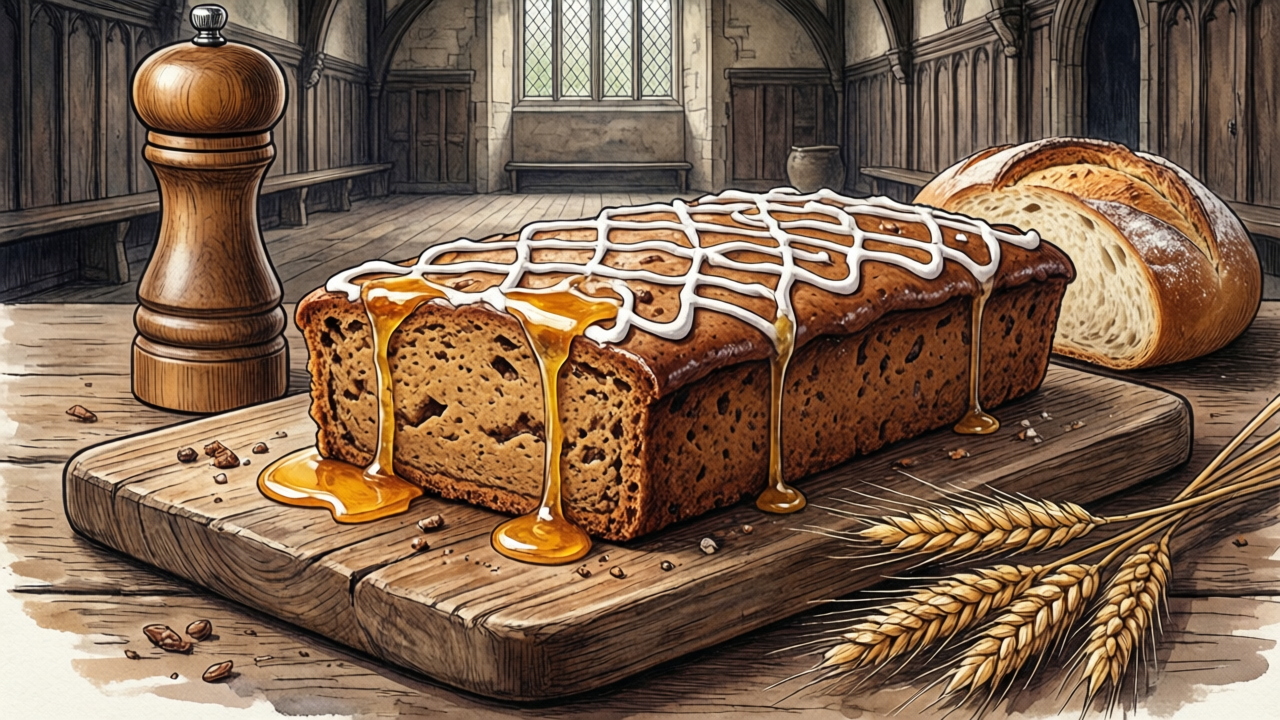
Which is exactly where this recipe earns its slot: it is the one British cake that openly admits its own receipt, in both senses — the list of instructions and the list of prices. Below is the modern version: a sticky tray gingerbread with Markham’s breadcrumbs left deliberately in, because they’re on the receipt.
Ingredients
- 175g unsalted butter
- 175g soft dark brown sugar
- 100g runny honey — heather honey if you want to commit to the period and the price
- 3 medium eggs, beaten
- 100ml whole milk
- 225g self-raising flour
- 75g fine dried breadcrumbs — the cheap supermarket kind; Markham grated yesterday’s loaf himself, which is a you problem
- 2 tbsp ground ginger
- 1 tsp ground cinnamon
- 1 tsp black peppercorns, freshly ground — not optional, it’s the most expensive line on the invoice, which is precisely why they used it
- 3 tbsp honey plus 1 tsp fresh ginger, grated, for the glaze
Method
- Heat the oven to 160°C fan and butter and line a 20cm square tin. The one step where your kitchen embarrassingly beats 1615: the Hampton Court ovens were built around a fire the size of a garden shed, and you’re baking on a thermostat. Use the advantage; the Tudors would have.
- Gently melt the butter, sugar and honey together in a pan, stirring until it’s smooth and glossy. Low heat — gentler than any Tudor fire, and considerably less likely to explain the monarch’s mood to his courtiers.
- Take it off the heat and whisk in the eggs and the milk. Beat hard. This is the only part of the recipe history unambiguously improved: a 1615 whisk was a bundle of twigs and the beating was done by someone who wasn’t the author.
- Fold in the flour, breadcrumbs, ground ginger, cinnamon and black pepper until just combined. The breadcrumbs are not a trick, a filler, or stale regret — they’re from the 1615 receipt itself. Bread in cake wasn’t the Tudors being bad at cake; it was the Tudors being early.
- Pour into the tin and bake for 35–45 minutes. The skewer test matters, but a few moist crumbs are fine: this is a sticky cake by design. The Tudors asked only that food be cooked, not that it be safe.
- Warm the glaze honey with the fresh ginger and brush it straight over the hot cake so it sets into a shiny top. Brush generously — a gleaming surface was, then as now, the cheapest available way of implying you can afford things.
- Cool on a rack, then keep in a tin. It improves after a day, which is the one behaviour every British cake shares and no British institution ever mastered. Markham’s kept for weeks wrapped in cloth, and at fairs gingerbread was sold as likeness plates — commemorative, collectible, and nobody’s idea of dessert.
Cut in squares, plain or with butter, and a strong coffee or a glass of something beside it. It keeps a week in a tin — longer than almost anybody keeps the receipt for anything, and longer, notably, than the dynasty that ordered it. The Tudors changed the faith of a nation three times in a century; this recipe just added pepper and held its nerve. In the long import ledger of British cooking, the cake’s always been the one line item that pays for itself.