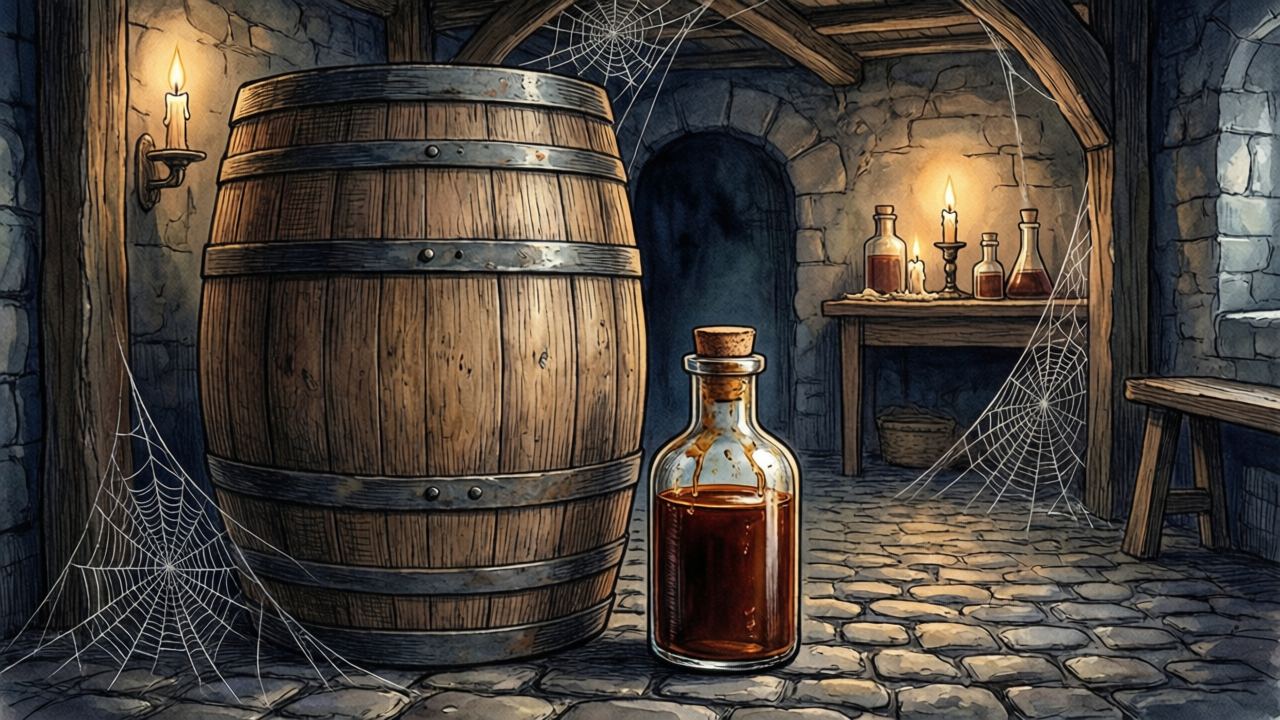
Somewhere under Worcester, around 1837, two chemists brewed a sauce, thought it was horrible, and forgot about it. That is, by the company’s own telling, the founding success of the most exported brown condiment on Earth. John Wheeley Lea and William Henry Perrins had a shop on Broad Street — chemists and druggists, the sort of Victorian shop that would sell you a cough mixture and a bottle of sauce off the same counter, because the Victorians had not yet decided medicine and dinner were different industries — and somewhere in the lore there is a barrel of unhinged liquid standing in a cellar, being ignored so productively that it turned into a global brand.
The official origin story goes like this: a nobleman recently returned from India — company lore likes to name him Lord Sandys, of Ombersley Court— handed the pair a recipe to recreate. They mixed it up, tasted it, found it undrinkable, and abandoned it in the cellar. Months later, somebody finally went looking for it and discovered that neglect had done what no recipe could: the wretched mixture had mellowed into something delicious. The packaging originally claimed the sauce came “from the recipe of a nobleman in the county,” which is a beautiful piece of nineteenth-century copywriting — it commits to a lord, a county, and absolutely nothing else. Food historians have poked at the Lord Sandys version and found the evidence thin, but honestly, a myth whose central claim is “we forgot and it got better” is already so British that correcting it feels like vandalism.
What is not myth is the date. Lea & Perrins began selling the sauce in 1837 — the first to put Worcestershire on the label and mean it, commercially speaking — and it is still made in Worcester today, in the factory on Midland Road that Lea and Perrins built themselves. Lea & Perrins still promise that the sauce is left to mature for eighteen months, which means the single most important step in the manufacturing process is still the accidental one: the forgetting. Every batch now has to spend a year and a half being productively ignored. This is the only condiment in the world whose quality control is a diary clash.
The sauce also had ancestors, though the brand gently declined to mention them. Bottled brown condiments were a Georgian obsession — mushroom ketchup had been lurching around English pantries for decades, and the words “Worcestershire” and “sauce” had been circling each other in recipe books long before anyone bottled the combination and slapped their names on the glass. Lea and Perrins’ true genius may not have been the recipe at all. It may have been the label. A recipe is public domain; a forgotten barrel, once named, is a business.
Within a few decades the cellar had company. By 1872 the company was placing notices in colonial newspapers warning that its sauce was being forged as far away as New Zealand — the Hawke’s Bay Times ran one, which means a Victorian Worcester chemist was issuing fraud warnings to people who would have needed a ship, a map and several months to even find the counterfeiters. The copycats had understood the market before the company did: if a sauce is worth forging, it has won. The company’s reply was the phrase now printed on every bottle, “The Original and Genuine,” a claim it had to fight for in court in the early 1900s — and won. Think about the shape of that victory: the world-famous taste of a sauce was legally certified by proving that other sauces were also that sauce, just worse at paperwork.
Then there’s the name itself. Worcestershire is the most confidently mispronounced word in the English language: the county says “Wuss-ter,” the sauce says “Wuss-ter-sher,” and somewhere in between sits the full four-syllable version, which nobody has said aloud since a vicar. The town and the sauce share a postcode and refuse to share a pronunciation, which is the most honest relationship in British food. And the sauce has never once admitted what is in it to a vegetarian: it contains anchovies. Every ham sandwich, every cheese toastie, every pint of bloody Mary in the land is quietly non-vegetarian, and the label says so in small print, the way a great British institution admits everything and apologises for nothing.
So here’s to the forgotten barrel — the patron saint of every dish left too long, every pan remembered two days late, every great British recipe that got better because nobody was around to interfere. The lesson is not that neglect is a virtue. The lesson is that the sauce forgives, matures, and comes back better, and that if you leave anything alone long enough in a Worcester cellar, someone will eventually build a factory around it and call it heritage.
Cook it anyway if you fancy: a decent quick approximation is mushroom or tomato ketchup, a splash of malt vinegar, a mashed anchovy or two, and a spoon of sugar — give it a week in a cupboard, which is the professional eighteen months reduced to the length of a British grudge.