Britain’s most successful chip company began life in a barn. Not a metaphorical garage, the way Silicon Valley likes to tell its stories — an actual Cambridgeshire barn, because Hermann Hauser and Chris Curry founded Acorn Computers in Cambridge in 1978 and needed somewhere cheap to put the soldering irons. They named it Acorn, which is the sort of name you find under a tree, and which is roughly where the company’s first premises resembled it.
If you went to a British school in the 1980s, you have already been properly introduced. Acorn won the BBC’s Computer Literacy Project and shipped the BBC Micro into most classrooms in the country, which is how an entire generation learned to type their name into a program called ART before they could be bothered with homework. Then in April 1985, two Acorn engineers — Sophie Wilson and Steve Furber — delivered a processor called the ARM1. It used 25,000 transistors, and it did a thing that engineer stories are mostly about not happening: it worked on the first attempt. On the first attempt. Say that sentence to anyone who has ever made toast and watch their eye twitch.
That one-off prototype became the company: Advanced RISC Machines, founded in November 1990, with “Acorn” quietly swapped for “Advanced” — the move every British institution eventually makes, keep the initials and drop the village. By 2025 it had shipped over 300 billion chips; in 2016 SoftBank bought the whole thing for £24.3 billion, at the time the largest tech takeover in history. And the reason the chips won — apart from being designed in Cambridge, which helped nobody’s housing market but everybody’s battery life — is that they’re built to spend most of their time doing almost nothing. Power is precious. That turns out to be true of chip butties too, though the currency is gravy.
Britain has genuinely produced two things called a chip that the rest of the world wanted: the microchip and the chip. One went into almost every phone on Earth. The other goes into a bap. Both begin life as a slice, both are best served hot, and only one of them is currently trading on the Nasdaq. This recipe is about the other one, on the grounds that it is the only one you can eat.
Ingredients
- 4 large floury potatoes (Maris Piper), about 1kg — floury, not waxy; waxy chips are the ZX Spectrum of the potato world: technically valid, wrong on every count
- Vegetable oil, for deep frying (beef dripping is the traditional northern option if you don’t care about the vegetarian brief)
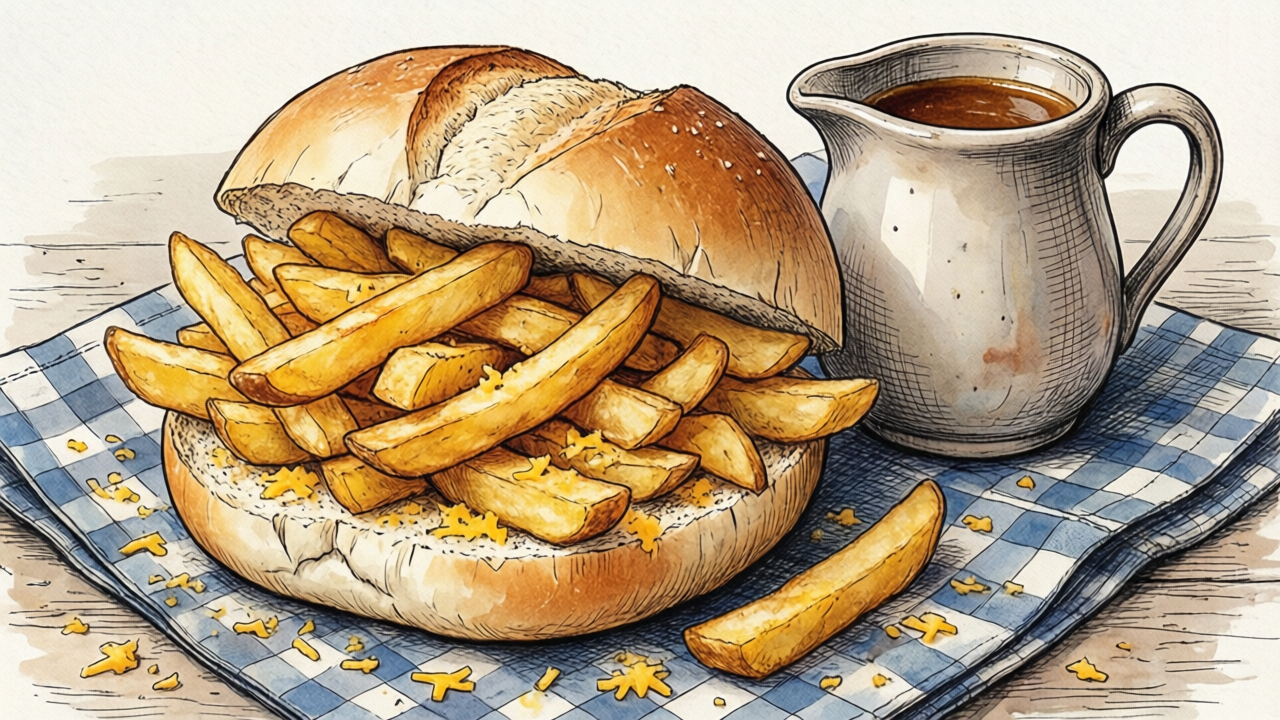
- 4 soft white baps — the ones that give when you squeeze them; a crusty roll is a handshake when you need a socket
- Butter, for the baps
- For the gravy: 2 large onions, sliced; 1 tbsp flour; 1 heaped tsp Marmite; 600ml hot vegetable stock; 1 bay leaf; a splash of soy sauce; black pepper
- Optional but structurally popular: a good handful of grated mature cheddar
Method
- Peel the potatoes and cut them into 1cm batons. Rinse them in cold water, then dry them thoroughly on a tea towel. Water and hot oil do not mix — this is not a preference, it is a constitutional matter, on chips and on everything else.
- Heat the oil to 140°C and fry the chips in batches for about 8 minutes, until soft and pale but not coloured. Drain and cool on a rack. This is the test build: nothing here looks finished, and nothing that looks finished at this stage should be trusted. ARM1 went through more than one design pass before it earned its £24 billion; your chips can survive a first fry without colour.
- Now the gravy. Cook the onions low and slow — fifteen minutes minimum, until properly jammy. Stir in the flour and Marmite, then the stock, bay leaf and soy. Simmer 10 minutes until glossy and thick enough to coat. No gravy has ever been won by hurrying. The Marmite is load-bearing: it does the job the 1990 rebrand did for Acorn — supplies the sophistication the initials promise.
- Crank the oil to 190°C and fry the chips a second time, 3–4 minutes, until deep gold and crisp. Here is the difference between the two British chips: the ARM1 famously worked first time, and the potato chip never does. Britain has always insisted its chips get a second go, and is entirely right to — the double fry is not a failure rate, it is a quality standard.
- Butter the baps. This is structural engineering, not decoration: the butter is what stops the gravy migrating into your sleeve, and gravy migration is responsible for more chip butty failures than every other cause combined. The bap is the socket. Everything goes in it, and nothing escapes from underneath it.
- Load the chips in, salt them, drown them in gravy, add the cheddar if you’re the sort of person the chip shop has given up predicting, and close the bap with the conviction it deserves.
- Eat immediately, standing if necessary. A chip butty cools faster than a microprocessor under load, and unlike the microprocessor it has no sleep mode — it degrades in real time, in your hand, in public.
The vegetarian gravy is genuinely the point of the exercise, but this dish has spent sixty years in the north of England with beef stock and dripping, and pretending otherwise would be bad history and worse chips. The gravy keeps for a few days in the fridge and freezes well, which is more than can be said for Acorn Computers itself: bought, absorbed, dead as a brand by 2000 — its entire fortune now lives inside other people’s products. Which, when you think about it, is also what happens to the best chip in the butty.