There is a Wetherspoons in Muswell Hill that stands where the whole thing began. The first pub the company ever bought sat on Colney Hatch Lane, a premises that had just been converted from a bookmaker’s, and it opened on 9 December 1979. For its first month it was called Martin’s Free House, which is the name of a man who was about to have an extremely good year. Then Tim Martin renamed it, and the official company account is funnier than any fiction: Wetherspoon was the surname of a schoolteacher of his back in New Zealand, and JD came from JD Hogg, a character in The Dukes of Hazzard. Britain’s biggest pub company — somewhere north of 800 pubs, 56 hotels, and since January 2026 a pub sitting over the departure lounge of Alicante Airport, the flag planted furthest from Muswell Hill — is named after a teacher and a fictional moonshiner.
You know this establishment even if you’ve never drunk in it: the 7am fry-up, because Wetherspoons claims to be “the only large pub firm which opens all its pubs early in the morning”; the laminated menu available all day in every pub, with the calories printed politely beside every item; the carpet. Not a carpet — each pub gets a bespoke Axminster, designed around the building’s local history, sometimes with more than the usual six colours, partly handmade on old looms, costing up to £30,000. There is a book about the carpets. There is also a colouring-in book of the carpets, because Britain.
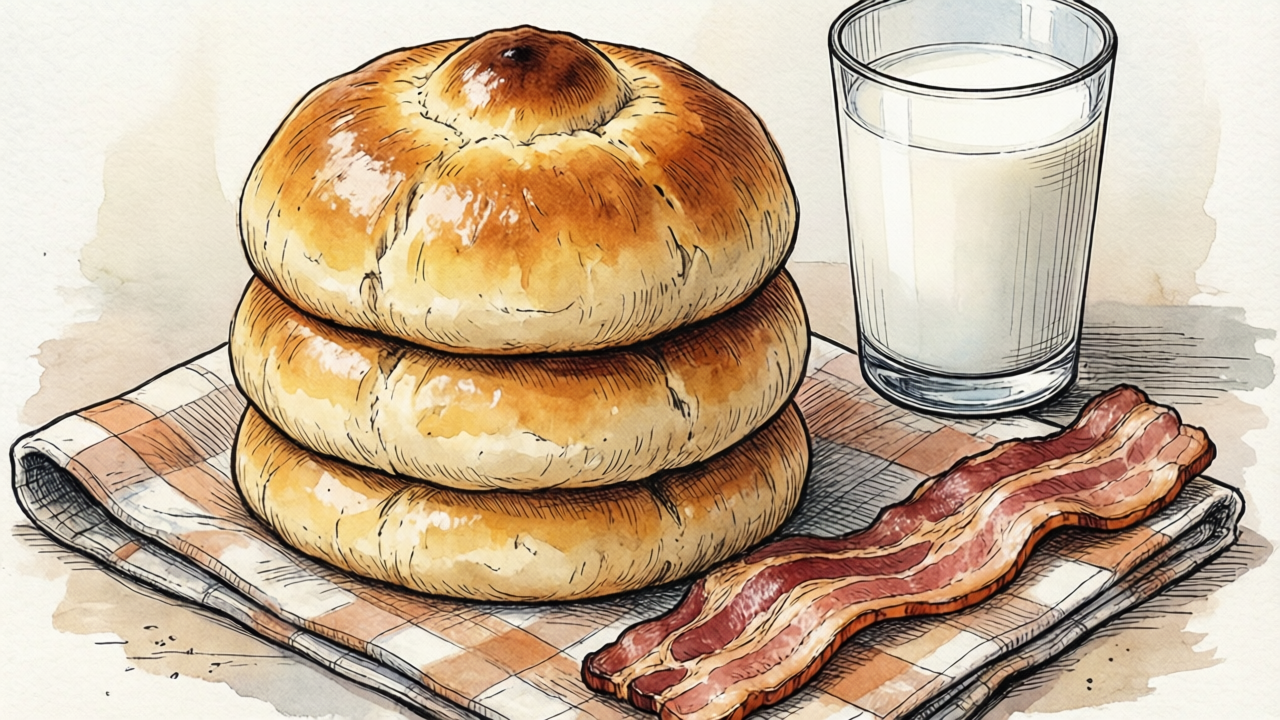
And here is the bridge, delivered with the confidence of a chain that has converted 800 redundant buildings — old cinemas, old banks, betting shops — into pubs: a company that believes in giving tired structures a second life, and that has never met a departure lounge it couldn’t put a breakfast behind, has to be good at one bread-based thing. The soft white breakfast bap. The bap is itself a conversion: flour that used to be a Somerset field, milk that used to be a timetable, yeast that used to be a rumour. So: proper homemade baps, milky, shiny, and structurally sound enough to hold bacon without prejudice.
One historical note before the shopping, because the flour aisle has a biography. The big milling companies ran the licensed-baker model brilliantly: Spillers, founded in Bridgwater in 1829 by Joel Spiller, sold flour to bakers who were licensed to make its branded Turog bread, and — having started making ships’ biscuits in 1855 — gradually drifted into dog biscuits, launching Winalot in 1927 for racing greyhounds. One company, both your breakfast and your gran’s greyhound. Supermarket strong white flour has no obligation to have a history. Proceed anyway.
Ingredients
- 500g strong white bread flour — ordinary strong white. The mill has done its part
- 7g instant dried yeast (one of the little sachets)
- 1 tsp caster sugar
- 1 tsp salt
- 40g butter, cubed and softened
- 300ml whole milk, lukewarm, plus a little extra for brushing
- 1 egg, beaten, for the glaze (milk works too — this is a pub bun, not the Ritz)
- To fill, whichever deal you’re running: bacon and egg; cheese and tomato pickle; a curry sausage on a Thursday
Makes 8 baps, which is the honest answer to why there are 8 in the supermarket packet.
Method
- Tip the flour, yeast, sugar and salt into a big bowl — flour first, because it’s the only ingredient here that doesn’t need checking. The first pub opened out of a bookmaker’s conversion nobody could describe as cautious; follow their example, but keep the salt off direct contact with the yeast. Salt is the manager.
- Rub the butter in with your fingertips, then pour in the milk. Lukewarm means: warm enough to wake the yeast, no hotter than the urn on a slow morning. If you can hold a finger in it comfortably, it’s right. Scalding milk kills yeast, and a bake without yeast is just a bowl of paste that opens early — which is a description of several pubs, but never a good bun.
- Bring it together and turn it out. Knead for a proper ten minutes, until smooth and springy. This is the part of every conversion the customers never see — the cinema seats come out, the beams get sandblasted, nobody ever witnessed the dusty bit of a bank becoming a bar. Knead in private; serve in public.
- Put the dough back in the bowl, cover it, and leave it in a warm, draught-free place for about an hour, until doubled. House rules while it proves: no music. In August 2026 the chain banned customers playing music out loud or taking calls on speaker, one of the few national policy decisions nobody argued with. The dough agrees. It’s trying to concentrate.
- Tip it onto a worktop and divide into eight — a dough scraper if you own one, the same nerve if you don’t. Round each piece into a ball, then knock the air back out. Structural works. The building is still standing, we’re just re-licensing it.
- Now the dimple. Press a floured rolling pin firmly into the middle of each ball to flatten it into the classic dented pub bap. It is purely decorative and locally significant, which is exactly the brief the Axminster weavers work to for the £30,000 pub carpets. Make the bun look like where it lives.
- Prove again for 25–30 minutes while the oven heats to 210°C fan-off / 190°C fan / gas 7. Twenty-five minutes is the queue at the bar at 8am on a Saturday: shorter than it looks, everyone moves, nobody complains.
- Brush the baps with beaten egg — or milk for a plumper, plainer shine — and sift over a little flour if you want the full counter look. The shine is the converted facade: it’s the only part anyone ever comments on.
- Bake 12–15 minutes, until deep gold and hollow when you tap the bottom. Trust the tap. That’s how surveyors check converted walls, and it’s how you’ll check baps for the rest of your natural life.
- Cool on a rack, if any survive the afternoon. Day-old baps are born converters: they become breadcrumbs, breadcrumbs become stuffing — nothing gets demolished here, it just gets re-licensed. The chain has proved the point some 800 times, including over a departure lounge in Alicante. Your kitchen is next.
Serve warm, filled, all day — that’s the entire business model, “opens early, menus standardised, available always”, and a bap that toasts from frozen like it’s 7am anywhere in the country is doing its job. Thursdays: make it curry, because the Curry Club is a genuine standing deal the chain runs, which means bap-and-curry is a legal precedent at this point, not a dare.
A New Zealand schoolteacher, a fictional cousin from The Dukes of Hazzard, and a Bridgwater flour salesman who fed your breakfast and your greyhound with equal professionalism: nobody designing a national breakfast would shortlist that panel. The bap is what they’d have chosen. Class dismissed — the bacon costs extra.