Picture the Saturday-morning DIY superstore. A man edges through the automatic doors carrying four metres of skirting board like a stretcher party. Somewhere in the depths, the timber-cutting saw is drawing a queue of six, all of them convinced they only need a small trim. Trolleys with one determinedly useless wheel congregate near the paint-matching counter, where a machine the size of a filing cabinet will reproduce any colour in the known universe for a price that surprises no one.
The whole institution began on 5 March 1969, when Richard Block and David Quayle opened a shop selling DIY supplies in a disused cinema on Portswood Road, Southampton. They called it Block & Quayle, then had the sense to shorten it to B&Q. That the first great British DIY store was a converted cinema is either a coincidence or the most honest business model in retail history: you used to go there to watch other people do things; now you go there to buy the parts and fail at them yourself.
B&Q’s own corporate history likes to point out that this was the same year two men walked on the moon, which is the sort of comparison that survives a company being bought twice and renamed after a bird. It is now the largest home improvement retailer in Europe, and it has sold you the dream, in flat-pack form, ever since. Which brings us to meatloaf, the only dinner that is genuinely flat-pack: it arrives as separate components, comes with optimistic instructions, needs exactly one tool you already own, and lives or dies entirely on its structural integrity.
Ingredients
- 500g beef mince and 250g pork mince (the pork keeps it from going dry; this is the part of the manual marked “do not skip”)
- 75g breadcrumbs and 100ml whole milk
- 1 large onion, grated, and a knob of butter
- 2 teaspoons Marmite
- 1 tablespoon Worcestershire sauce
- 1 tablespoon English mustard
- 1 egg
- For the glaze: 3 tablespoons tomato ketchup, 1 tablespoon soft brown sugar, 1 teaspoon Worcestershire sauce and 1 teaspoon wholegrain mustard
- Salt and black pepper
- Vegetarian version, same assembly manual: pulse 400g chestnut mushrooms with a drained tin of butter beans and 100g cooked red lentils, use vegetable stock instead of the Worcestershire, and add an extra teaspoon of Marmite. No one inspecting the finished loaf will file a complaint.
Method
- Combine the breadcrumbs and milk in a small bowl and leave them for five minutes. This mixture has a French name, panade, and it is essentially PVA glue in food form: invisible, cheap, and the entire structure becomes a theoretical exercise without it.
- Melt the butter in a pan, cook the grated onion on a low heat until soft and sweet, about ten minutes, then let it cool. Low heat, patience — the same virtues the saw queue demands of you, except this one actually ends well.
- Put both minsces, the panade, the cooled onion, Marmite, Worcestershire sauce, English mustard, egg, a small pinch of salt and a good grind of pepper into a large bowl and mix with your hands. This is the only step requiring a tool, and the tool is yours. The Allen family — William G. Allen, Hartford, Connecticut, 1910, industrialists behind the screw that swallows its own key — built a fortune on fasteners that hide their tool inside the product. Meatloaf declines to participate in that economy.
- Mix only until it comes together as one pink mass. Overwork it and it bakes like a badly laid garden path: dense, regrettable, and something you will still be cross about in August.
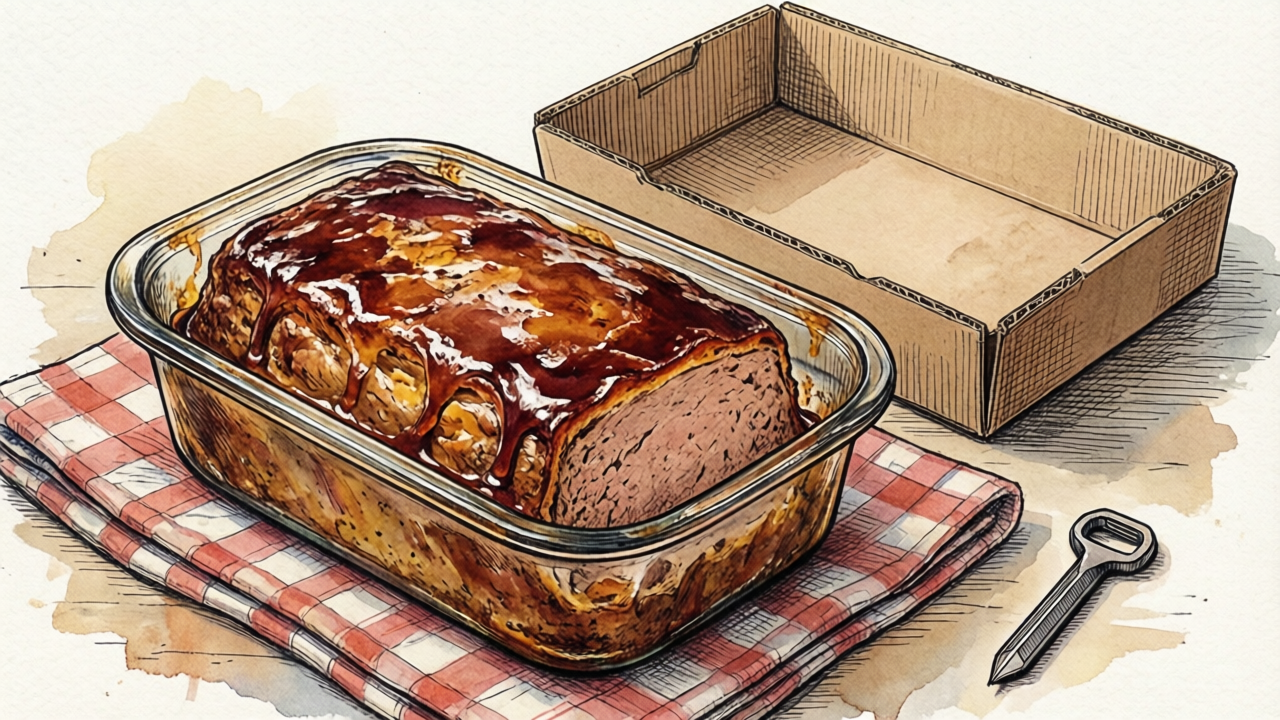
- Press the mixture firmly into a 2lb loaf tin, then lift the tin an inch and drop it flat onto the worktop two or three times. This knocks out air pockets, and any builder will tell you that air pockets are where all structural failures begin. It is also the single moment in British cooking that most resembles a health-and-safety inspection.
- Stir the glaze ingredients together and brush them all over the top. The paint counter will match this exact colour for sixteen pounds; here you have mixed it yourself from a cupboard three metres away, which is the entire DIY ethos in one teaspoon.
- Bake at 180°C, or 160°C if the fan is on, for 50–60 minutes, until the juices run clear and the loaf has just begun to pull away from the sides of the tin — which is also, notably, the moment a flat-pack begins to separate from your confidence, somewhere around panel six.
- Leave it in the tin for a full ten minutes before turning it out onto a plate. This is the step everyone skips, and it is directly responsible for more collapsed dinners than every wonky shelf in Britain. Ten minutes. Nobody ever rested a shelf either, and look where that got us.
- Slice thickly, in front of witnesses, and serve with mash and whatever green thing you can claim counts as produce from the garden centre end of the aisle.
Leftovers keep three days in the fridge and reheat without drama, which is a luxury no flat-pack table ever offered: at least this one survives being picked up twice. Assembly complete, no components left over and no parts unaccounted for — more than can be said for any Saturday you have ever spent at the furniture aisle. The old B&Q book promised, in its title, that you can do it. For once in British retail history, the book was right.