There is a chip shop on Allardice Terrace in Stonehaven, Aberdeenshire, with a banner across its window: Birthplace of the World Famous Deep Fried Mars Bar. That banner has been to war. In 2015, Aberdeenshire council asked for it to be taken down for public-health reasons; the town rallied, and the council performed a full retreat — the only recorded defeat of a Scottish local authority by confectionery.
The claim itself is contested, as all the best British claims are. John Davie says he invented the thing in 1992 at the Haven Chip Bar — since renamed the Carron Fish Bar, because institutions rename themselves the moment they become famous. Tom Cummings, formerly of the Duncan Street Chip Shop in Banff, says he was selling fried Mars bars in the 1980s, having copied them from Dodie’s Chip Shop in Buckie, which is now defunct — the usual fate of the witness who is right and early.
The nation found out on 23 August 1995, when the Aberdeen Evening Express reported that “HOT chocolate has become this summer’s sizzler”, quoting the owner, Ingram Mowatt, aged 41, attributing the craze to the start of the school holidays — the only cause ever confidently assigned to any British craze. The Daily Record followed the next day under the headline “Mars supper, please”, and public-health correspondents discovered “Scotland’s craziest takeaway”. The country did what it always does under criticism: it got scientific. In 2004, The Lancet commissioned the University of Dundee to survey 627 Scottish chip shops. Sixty-two per cent responded; twenty-two per cent were selling the bars, at an average of twenty-three a week and 60p a pop. In 2012 the Haven applied to the EU for a Protected Geographical Indication, and Mars wrote back insisting a disclaimer be posted stating that deep-frying its product was “not authorised or endorsed” — a chocolate company formally disowning its own child at a fish counter. And somewhere in Glasgow, a genuinely randomised clinical trial fed deep-fried Mars bars and porridge to twenty-four fasting volunteers with ultrasound pointed at their heads, the control arm being porridge, which is the closest Britain ever gets to funding pure mischief.
A dish with a banner, a legal disclaimer and a clinical trial attached has earned the right to a written method. So here it is — and your kitchen, upon producing one, becomes the newest claimant to the birthplace. The council will object. Buckie will object. You will fry them all.
Ingredients
- 2 full-size Mars bars
- 150g self-raising flour
- A good pinch of salt
- 200ml sparkling water, very cold from the fridge (cold lager works too, and is a better incentive to work quickly)
- 1.5 litres vegetable oil, for deep frying
- Caster sugar, for dusting
- Vanilla ice cream or butterscotch sauce, optional — though no Stonehaven witness has ever been asked about either
Method
- Put the Mars bars in the freezer for 30 minutes. A room-temperature Mars bar resists batter the way Buckie resists Stonehaven: theoretically, and at every counter.
- Whisk the flour and salt, then whisk in the cold sparkling water until the batter pours like single cream and coats a spoon with the quiet confidence of a front page. Leave it ten minutes. Even great claims need time to settle before they go on the record.
- Heat the oil in a deep pan to 190°C. Test it with a droplet of batter: it should fizz like the queue at the Carron on a bank holiday weekend. If the oil smokes, you’ve gone past frying into the banner’s next war.
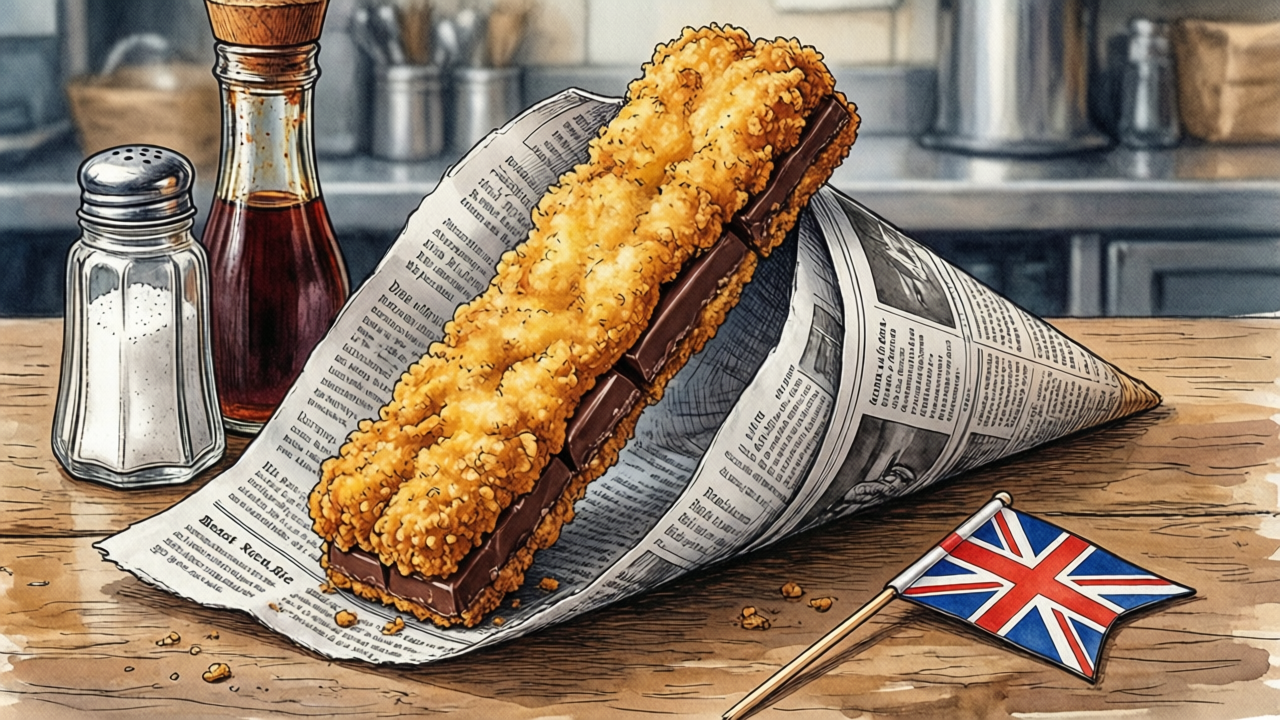
- Pat the frozen bars dry — condensation is the enemy of batter, as it is of any union between two things that fundamentally disagree. Whisk the batter once, dip a bar, and lower it in gently, away from you, like a statement to the press. Fry 2–3 minutes, turning once, until deep golden: the colour of a tabloid and the confidence of a banner.
- Drain on a wire rack, never kitchen paper. Paper softens the crust, and a soft exterior is the one weakness this dish cannot afford — the entire invention exists to be crisp where it matters.
- Dust with caster sugar and serve at once. Then the warning, freely given: the centre is molten caramel at a temperature Mars’s lawyers would have listed in the disclaimer. Test-bite like a man defusing his own past. And if a bar bursts, your oil has become caramel fondue — which sounds like a dessert, and tastes like one for exactly one minute, and then becomes the cleaning-up subplot of every Scottish food story ever told.
The dish is already vegetarian — a chocolate bar and a batter owe nothing to any animal — and there is no variant, for the same reason Stonehaven offers none: it does not recognise rivals. Fried in fresh oil rather than the chip shop’s, it also escapes the fryer’s biography: a Mars bar deserves an impartial fryer, not one still holding a grudge from the haddock.
It will not keep. It barely survives the walk to the sofa. This is not a flaw but the whole legal argument: the dish exists for about six minutes, like every birthplace claim ever filed, and must be asserted immediately, loudly, and in front of witnesses. If yours comes out better than Stonehaven’s, you are morally entitled to a banner. Put it up. The council will ask you to take it down, the town will rally, and history’s verdict on that request is already on the record, on Allardice Terrace, in vinyl.