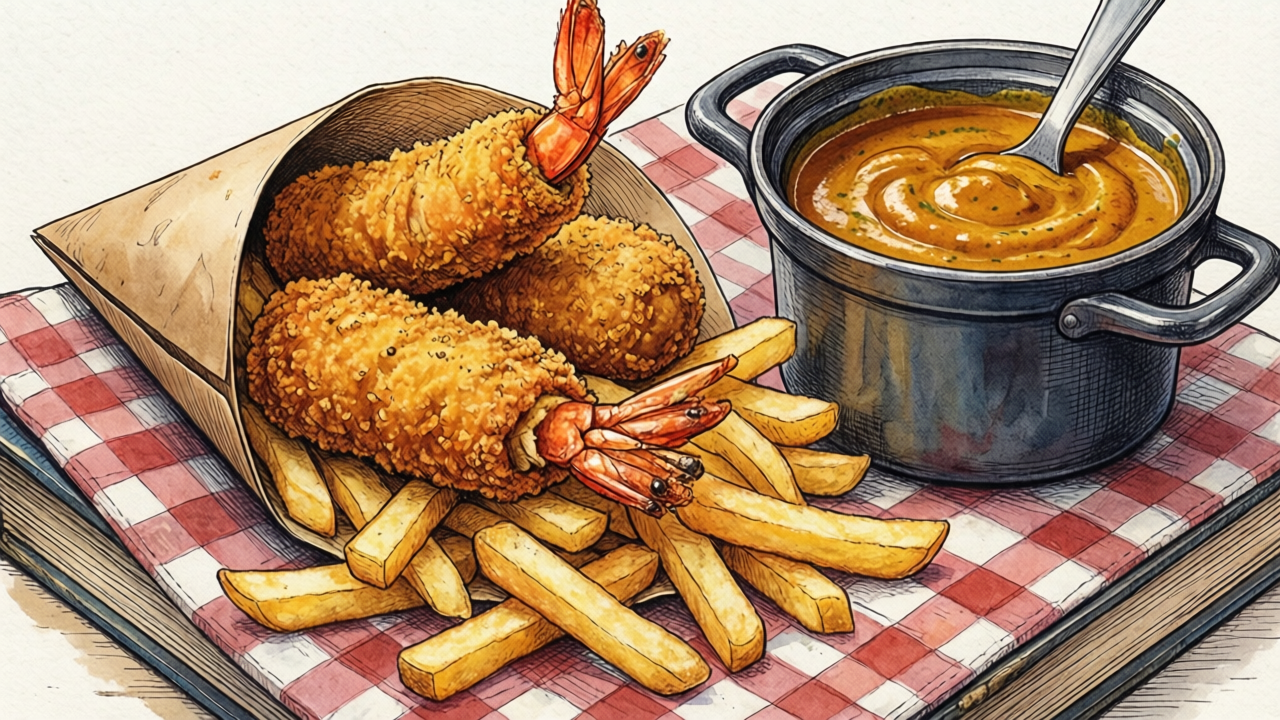
Every chip shop in Britain keeps one, and nobody has ever agreed on what to call it. It sits in the freezer chest beside the fryer like a discus thrown by someone who gave up mid-throw: the scampi puck. Legally — and this is the Food Labelling Regulations 1996, Schedule 1, being extremely specific — the words “scampi”, “Norway lobster”, “Dublin Bay prawn” and “langoustine” all belong to exactly one animal: Nephrops norvegicus. Four protected names, one creature: a slim pink thing with small blue eyes that lives in a tunnel it digs itself in the mud, which is a lot less romantic than “Dublin Bay” implies and the reason no postcard has ever featured one.
The grading system is the part nobody reads. According to the industry’s own ladder, “single wholetail” scampi means one langoustine tail, breaded — the posh version, most of which Britain exports to Spain and Italy, countries that eat the animal as an animal. “Wholetail” means up to three tails. And then there is the bottom rung, the one sold by the box under the fluorescent hum: “formed” or “reformed” — reconstituted tail meat, pressed back into shape. Britain catches nearly 59% of the world’s nephrops and has spent sixty years primarily eating a rumour of one. There is also a grammar casualty: in Italian, scampi is the plural — one scampo, many scampi. Britain adopted the plural as a singular, so the chip shop has been quietly rewriting Italian for generations, and no apology has ever been issued.
This recipe makes the formed version at home — Britain’s great culinary genre, in which the expensive thing is rebuilt from scratch for the people who were priced out of the expensive thing. The label on your tub will finally tell the truth: formed. Homemade. Contents known.
Ingredients
- 300g cod fillet, skinless (thick center-cut if you can find one)
- 200g undyed smoked haddock fillet — this is the flavour backbone; if the shop is out, use more cod plus a teaspoon of smoked paprika, though the law of the kitchen will notice
- 100g dry breadcrumbs, plus 50g to bind
- 1 small egg, beaten, plus 1 more for the coating
- Zest of half a lemon
- A small handful of flat-leaf parsley, chopped fine
- A pinch of nutmeg (yes, really; the 1970s are calling and they want their condiment back)
- Flour, for the first coat
- Panko breadcrumbs, for the last — the crispest lie available in the aisle
- Vegetable oil, for frying
- To serve: chips, curry sauce, mushy peas, brown sauce, or a bap — the traditional company of a formed product
Method
- Poach the cod and haddock gently in barely simmering milk or water, four to six minutes, until it flakes at a look rather than a summons. Aggressive heat is how you end up with fish paste, and fish paste is the grade below formed. Nobody has ever improved a puck by rushing it.
- Drain the fish and press it properly — every scrap of moisture you leave behind is a structural complaint filed later, at the frying stage. This is the unglamorous step. The freezer chest did not get its reputation for honesty by being careless about water.
- Flake the fish into a bowl, chopping half of it fine and leaving half in recognisable chunks. This is the whole difference between “formed” and “mystery”: reconstituted does not mean obliterated. The law wants the tail meat put back together, not interrogated until it stops making sense.
- Work in the egg, 50g of the dry breadcrumbs, lemon zest, parsley, nutmeg, salt and pepper. Season generously — a puck seasoned timidly is just warm fish in a bad mood, and the chip-shop puck’s one genuine genius was never restraint.
- Divide into eight and shape each into a fat oval, curved very slightly like the animal’s opinion of a tail. Weigh them if you like; a chip shop cannot afford variety, and neither can a fryer, because uneven pucks mean the small ones overcook while the large one is still cold at the heart — the classic outcome of a batch treated as individuals.
- Rest them on a plate in the fridge for twenty minutes. This is the setting step, the one everyone skips, like the wait at the counter itself: the queue is not wasting your time, it is letting the product hold its shape.
- Coat in three stations — flour, beaten egg, panko mixed with the remaining dry breadcrumbs. The crumb is the suit: it does not change what you are, but it is the reason anyone gets served. Press the panko on hard; a loose crumb is the one scandal a formed product cannot survive.
- Heat the oil to 180°C and fry two or three at a time, three to four minutes, turning once, until deep gold — the only colour chip shops have ever used, being the colour of “it’ll be all right”. Do not crowd the pan; a crowded fryer is the tannoy at half past six, all noise, cold results.
- Drain on a wire rack, not kitchen paper — paper is for things that can afford to go soft, and this puck has had enough softness in its life. Serve with chips and curry sauce, or stacked in a bap with brown sauce, which is the scampi supper at its most structurally ambitious.
Vegetarian variant: 400g thick cauliflower batons, blanched four minutes and drained harder than the fish, take the same three coats and the same fry. Legally this is not scampi — under Schedule 1 it isn’t any of the four protected names, and the industry has a phrase for products that give up on the animal entirely, which is the exact phrase for the cauliflower: seafood-style. Morally, it is the same puck with a different witness statement.
Whatever you fill them with, store your pucks in a tub with a homemade label: FORMED — RECONSTITUTED — 100% CONTENTS DECLARED. You will then be running the only chip shop counter in Britain where the label tells the truth, the animal got four legal names and got none used correctly, and the nation’s favourite seafood remains, as it has been since 1960s pubs first served one in a basket, a breaded question nobody is obliged to answer.