In November 1959, Britain got its first full-length motorway, and beside it its first service area. It was run by a company called Blue Boar, and the menu was honest by the standards of the day: tea and a pee. That was the complete list of human necessities. The restaurant followed in 1960, and the nation has been quietly acting on its amendment ever since.
The “first” comes with a footnote, because of course it does: Watford Gap was originally lorry-only. The first to open to all traffic was Newport Pagnell, twenty-three miles down the road — run by the Forte catering dynasty, who took motorway dining more seriously than it has ever been taken since. Its architect, Owen Williams, built a dining bridge across the motorway itself. Chefs cooked in front of you at a long bar. Two years later, Leicester Forest East had a restaurant designed by Terence Conran, staffed by waitresses in airline uniforms, serving cod in parsley sauce, with the fish arriving fresh from Grimsby daily. Britain’s most modern restaurants were sheds on bridges above the M1, and your grandparents found them underwhelming.
The romance did not last. The Seventies brought fried food, football hooliganism and what Dr David Lawrence — whose PhD was literally on the history and culture of motorway service areas — calls “tired English classic meals”, of which a spotted dick at the M1 is less a dessert than a deterrent. The Beatles, the Stones, Pink Floyd, Dusty Springfield and the Eagles all ate at Watford Gap, which remains the only chart position that matters. And today you get identical food courts run by Roadchef and Welcome Break: a box of high-street brands in a shed. Which is exactly the argument for making the motorway’s true national dish at home.
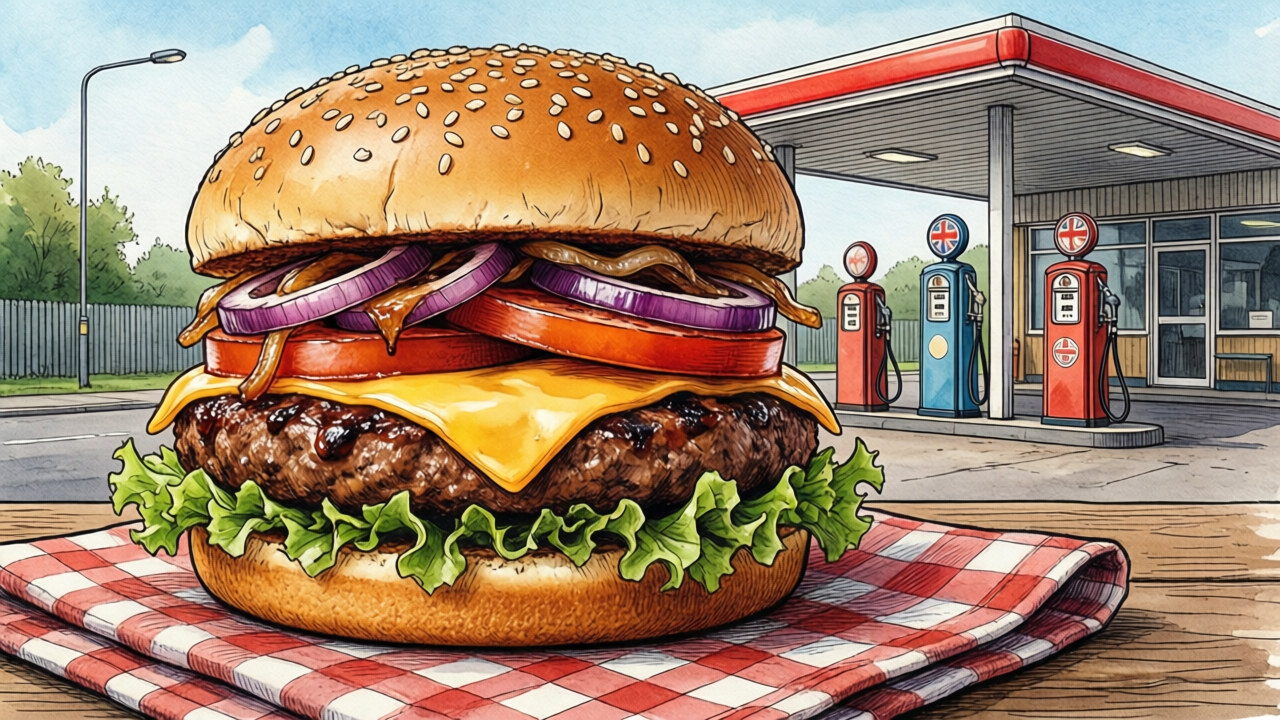
Because here is the thing. Fifties service-area doctrine sold tea and a pee. The servo burger is what happens when a country revises its list of necessities without publishing the amendment — criticised in every survey ever conducted, bought by millions anyway, and quietly the most stable relationship in British life.
Ingredients
- 4 soft white baps — the plain giving kind, not an overinflated artisan bun with a passport
- 500g beef mince, the fatty sort. Servo meat has never been lean, and fat is flavour, which is also the only good thing ever said about a servo
- 4 slices processed cheddar — the yellow ones in the plastic with the little plastics between. This is not a compromise, it is the specification
- 2 large onions, sliced
- Butter, for the onions and the baps
- Leaves from 1 heart of iceberg lettuce
- Gherkins, sliced — or 2 tbsp gherkin relish, if you’re honest about this
- Salt and black pepper
For the sauce, stir together: 3 tbsp mayonnaise, 2 tbsp tomato ketchup, 1 tbsp brown sauce, 1 tsp English mustard and a finely chopped gherkin. A whole box of brands in one bowl, doing its best.
Vegetarian patty: pulse 400g chestnut mushrooms with a drained tin of butter beans and a teaspoon of Marmite, then form four. Service areas have been pretending to serve vegetarians since the fresh-food counter appeared; at home we can do better than pretending.
Method
- Onions first. Butter, low heat, twenty minutes, until properly soft and golden. They arrive before the meal, like the tea did — Blue Boar understood running order from day one.
- Make the sauce. One bowl, every brand you recognise from the high street, working under one roof. This is the Nineties in a jug.
- Toast the cut faces of the baps in butter until gold. Structural note: the bap is the bridge. Newport Pagnell and Leicester Forest East both fed you above the motorway, and a burger is the same engineering — a bridge with a road running through the middle of it.
- Form the patties. Four, slightly wider than the baps because they shrink, with a thumb-dimple pressed in the centre. The dimple is load-bearing: the patty is the traffic under the bridge, and traffic bulges.
- Properly hot pan. Patties on, salt and pepper on the outside only, three to four minutes a side. Cooking in front of the customer was Forte’s Sixties innovation, and with a griddle in an open kitchen your hob has now reached 1961. Nobody is going to clap.
- Cheese on, lid on. Drop a slice onto each flipped patty, splash a tablespoon of water into the pan and cover it. One minute of trapped steam and the slice is bonded to the meat and has opinions about your shirt.
- Build. Sauce on both cut faces — the necessities list has grown, and so has the paperwork. Then lettuce, patty, onions, gherkins, close, press down once gently out of respect for the form.
- Two minutes before the first bite. Nothing in service-area history has ever stood still voluntarily, so do it for the dish. The bap is now load-bearing on the scale of Newport Pagnell’s bridge; give it a minute and it holds.
- Serve with chips. Make them properly, or accept the small freezer bag — that is the Seventies position, and the Seventies never once let their reputation improve.
Four of these and you have a full tank. Tea and a pee got Britain onto the motorway in 1959; the third necessity joined the menu a year later and has never been formally challenged since. If you pull in at Watford Gap this week and buy one instead, do not feel silly. You would be keeping alive a sixty-six-year tradition of the Beatles, the Stones, Pink Floyd and the Eagles: eating it in a car park, at eleven at night, north of everywhere.