The preserves aisle is the only identity parade in Britain where every suspect insists on the same name. Eleven jars of marmalade, shoulder to shoulder: one declaring thirty grams of fruit per hundred, one thick-cut, one apparently containing a personal quantity of glucose syrup, one that is essentially a clementine’s dying wish. And none of them — not one, according to the dictionary — is marmalade.
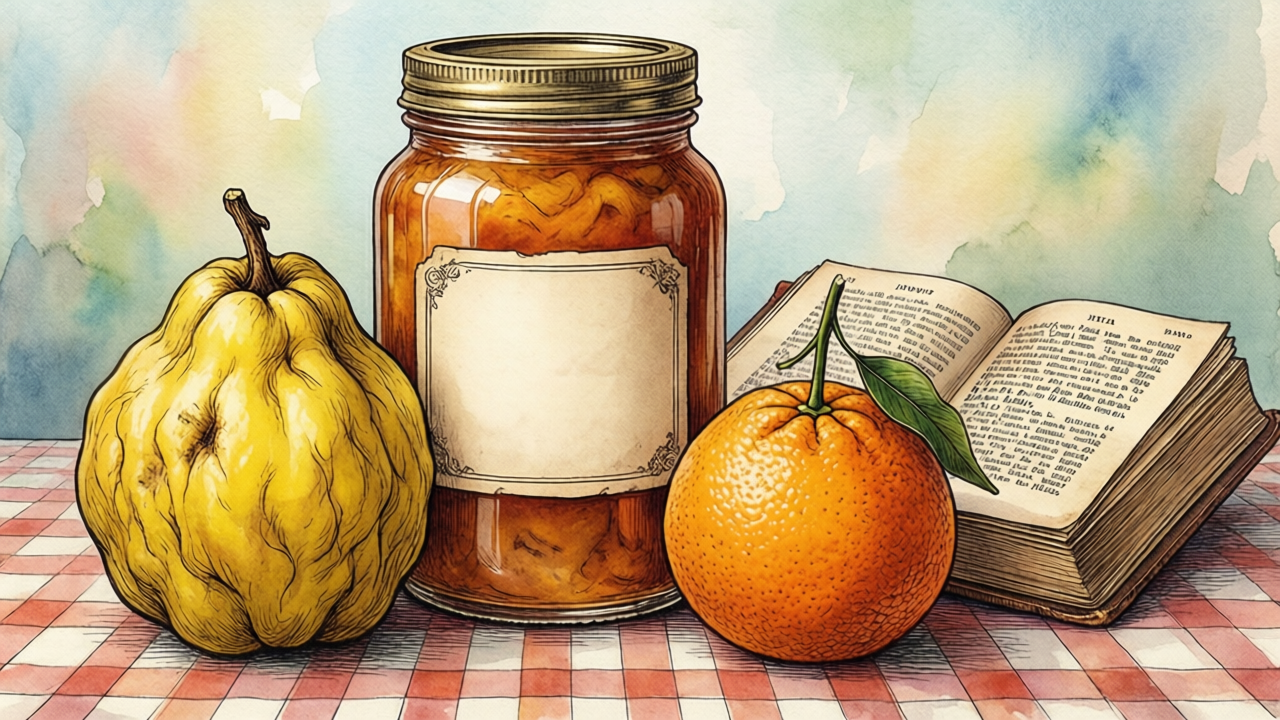
Put the word in the box: it confesses immediately. English borrowed marmalade from French marmelade, which borrowed it from Portuguese marmelada, which comes from marmelo — simply the Portuguese for quince — from Latin melimelum, from Greek melimēlon, “honey apple”. Marmalade, spelled honestly, means quince preserve. Every jar is a defendant whose own name testifies against it, which as legal strategies go, is wearing the stolen goods into court.
For most of its life the word told the truth. Marmalade arrived in England from Spain and Italy in the 1500s and it was quince — quince cheese, in fact, set firm enough to cut into slabs with a knife. The oldest document using the Portuguese word is Gil Vicente’s play Comédia de Rubena, 1521: temos tanta marmelada — “we have so much quince jelly”. The word’s first recorded line is a punchline about a quince; the quince has never had another speaking part since.
The oranges did not storm the aisle. They filed paperwork. One of the earliest orange recipes is in Eliza Cholmondeley’s 1677 cookery book, in the Cheshire record office — “Marmelet of Oranges”, a firm, dark paste you’d chip at, not spread. The first printed orange marmalade: Mary Kettilby, 1714, a “beaten marmalade” of boiled peel and pulp pounded to a paste. The quince was never overthrown so much as left off the guest list, one recipe at a time.
Scotland then changed the man’s profession. Scottish recipes added water, turning the paste into something spreadable; the Scots made it a breakfast food. Boswell and Samuel Johnson were served it at breakfast in Scotland in 1773 — two of the most quotable men in history given an opinion about toast, and the toast won. A food you cut became a food you smeared; every definition fight since is small print beneath that.
Then Dundee, and the affair of the legend: a ship sheltering from a storm, oranges sold to pay harbour dues, salvage turned into an industry. It’s a lovely story, and food historians have “decisively disproved” it — good phrasing, even against a myth. The documented truth is nearly as good: James Keiller and his mother Janet, a small sweet and preserves shop on Dundee’s Seagate, built “Dundee marmalade”, still made today. The city kept the reputation after losing the story, which cities do. The word meanwhile kept collecting false affidavits: Mary, Queen of Scots, it was claimed, took marmalade for seasickness while her maids whispered ma’am est malade — ma’am is ill. The word’s origins have nothing whatsoever to do with Mary; the word has enough to answer for without her.
The word itself was out freestyling: marmalade meant preserves of anything at all — mango, pineapple, apricot, even cocoa. For three centuries the word wasn’t a description, it was a mood — any fruit roughed up by sugar could join the club, with no door policy, no register, and no chairperson.
Until the paperwork came back from Brussels. In 1979 the EEC’s jam directive ruled that marmalade must be a gelled mixture of sugar and citrus: 20 per cent citrus minimum, 7.5 of it from the endocarp — the part of the orange nobody has ever ordered at a restaurant. And that strict, citrus-only definition is credited to British lobbying. Britain asked Europe to legislate a definition for a word Britain itself had spent three centuries flinging at whatever fruit it pleased. The Jaffa Cake had to go to a VAT tribunal to prove what it was; the marmalade never went anywhere — it had the law rewritten around it, then acted surprised when the law took it literally.
The twist came this June. Austria and Germany wiggled a derogation through in 2004, letting fruit jam be sold as Marmelade at farmers’ markets, and in 2024 the EU conceded what everyone outside Britain had always known: that in most European languages the marmalade word means any jam. From 14 June 2026, member states may sell strawberry jam labelled marmalade — and the citrus purists’ prize, the very product the 1979 definition was built to protect, was renamed on the labels: citrus marmalade. That is the sound of a bureaucracy getting its revenge by typography. And Britain, having left the room in 2020, kept the narrow law on its statute book — standing in the corridor holding the definition it spent forty years fighting for, while that definition’s own etymology files a counter-affidavit naming a quince.
The quince never got to court. It gave the product its name, was removed from it by regulation, and was never formally asked to leave — the only fruit in Europe evicted from a word that literally means it. The label, therefore, is evidence against the product: the only item in the entire supermarket contradicted by its own dictionary, five centuries in and never once sentenced. Only the bear has ever been honest about the whole business. A marmalade sandwich carried in a hat, in case of emergencies, is not a recipe. It’s an alibi.
Make it anyway, if you fancy: boil a Seville orange and a lemon until the peel pulls apart without snapping, simmer the pips in a muslin bag — that’s where the set lives — weigh the pulp and stir in an equal weight of sugar, then boil hard until a cold spoon shows a wrinkle. Seville oranges appear in the shops in January, which is their only seasonal opinion. Or make the one the word meant: quinces, cooked long, cooked dark, cut with a knife. Nobody’s checking. As of 14 June 2026, legally, nobody in Europe is — and Britain is still filling in the form to object.