You are standing on a northbound platform at 8:52 on a Tuesday. The heat arrives first, like a telegram announcing the train before the train has announced itself. The tannoy crackles: the delay to this service is being delayed because of a previous train — a statement as circular as a Circle Line ticket, delivered in the calm voice of a person who has explained the concept of time to pigeons before. Fourteen people at the exact front of the platform move eleven centimetres in unison. The doors open. You are now part of a system.
The system is the oldest of its kind on Earth: the Metropolitan Railway opened on the 10 January 1863, hauling steam carriages through open-cut trenches and teaching Londoners that the phrase “underground railway” contains two valid interpretations, one of which smelled of coal. There are 272 stations now, and the map that makes them feel manageable is itself a British masterpiece: Harry Beck, a part-time engineering draughtsman, looked at the geographically accurate mess of the network in 1931 and concluded that nobody actually needed accurate geography. Straight lines, forty-five-degree angles, one colour per line. The pocket map went on sale in 1933, every metro system on the planet copied it, and Beck was paid five guineas for the diagram — which is roughly what a Zone 1 single costs if you’re feeling nostalgic and bad at maths.
And then there’s the phrase. Mind the gap was first issued on the Underground in 1968: three words of caution that escaped the platform edge and became the national motto, printed on tea towels, quoted by politicians who have never minded anything, least of all a gap. Because the truth about the Underground is that it solved the map. It never once solved the gap. And that, dear reader, is why we’re making a sausage butty.
The Tube and the sausage butty share an identical design brief: something long, something round, and a gap that nobody in authority has ever fully reconciled. Both work best diagrammatically rather than geographically. Both fall apart at rush hour. And both end with you staring at the space where the thing was supposed to be, deciding whether to complain or just get the next one.
Ingredients
- 2 large pork sausages — as much meat as your budget allows; check the label the way you check a departure board: hopeful, but expecting a replacement bus
- 2 soft baps — the kind that dent when you look at them wrong
- 2 large brown onions
- 25g butter, plus a splash of vegetable oil
- 1 tsp dark brown sugar
- 1 tsp Marmite (no swap needed — it’s in the same aisle as the peanut butter, sulking)
- English mustard
- Brown sauce, optional: the great interchange, where everyone changes over whether they admit it or not
- Salt and black pepper
The Elizabeth Line variant (vegetarian): take a 200g block of halloumi, slice it into two slabs and press them flat — same pan, same heat, same bun. Expensive, controversial, arrives years late, but this extension actually reaches the end of the bun.
Method
- Peel and thinly slice the onions. Melt the butter in a heavy pan, add the onions, the brown sugar and the Marmite, and cook them low and slow for around 30 minutes, until they’ve gone dark, jammy and uncharacteristically honest. Cook them like a signal failure: slowly, at 7am, and without apology. Rushed onions are just hot onions; you want onions that have formed a settled opinion.
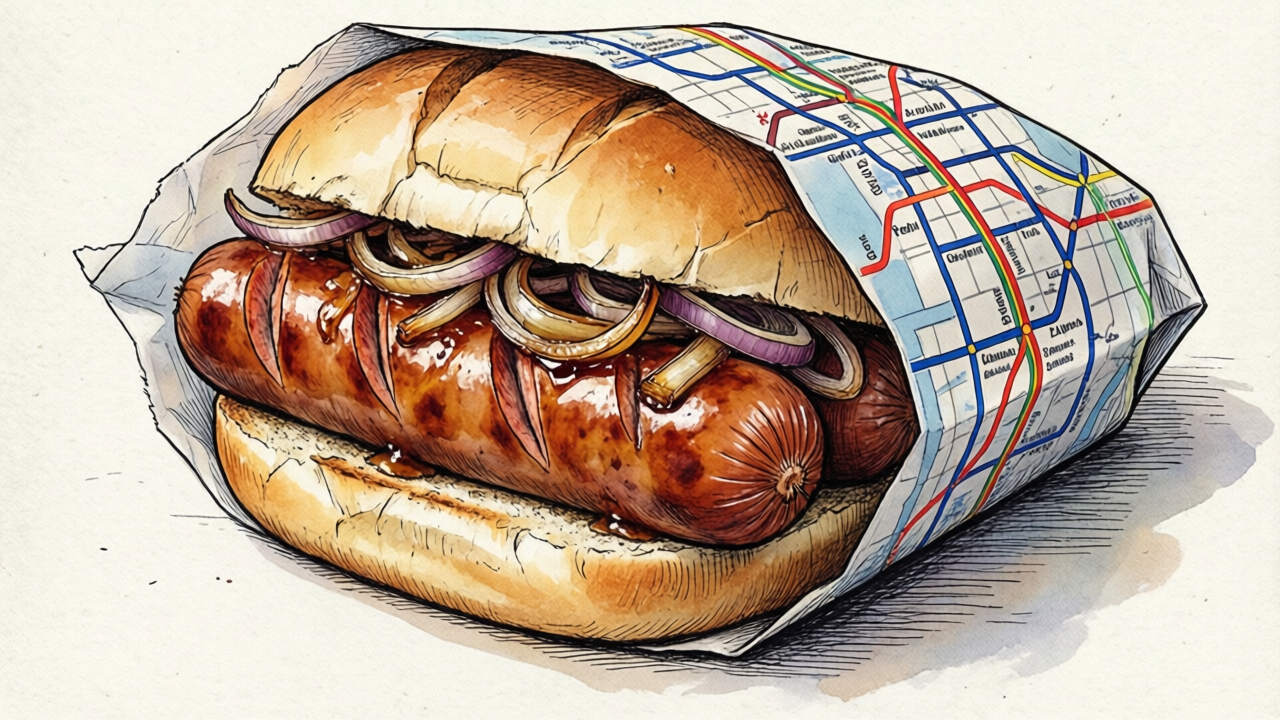
- Take a sharp knife and split each sausage along its length — through the skin, not all the way through the meat — then open it out and press it flat. This is the Northern Line extension: the single sausage intervention that has actually reached its terminus. A flattened sausage reaches the end of the bun. A round sausage never has, not once, not since 1863.
- Heat a splash of oil in a heavy frying pan over medium-high heat. Lay the sausages in cut-side down, in a single layer. Do not crowd the pan; a crowded pan is like a crowded platform — everyone ends up late and nobody can say why. The oil is spitting because of a previous sausage.
- Cook 3–4 minutes until the cut face is deep brown, then turn, and give the other side 2 minutes. Season with pepper. Take the sausages off a minute before you think they’re done, as a precaution — the only part of the entire network where the precaution is the right thing.
- Meanwhile, split the baps and toast the cut faces under a grill or in a dry pan for a minute, until they hold a fingerprint of colour. Toasting the inside is how the bun survives a return journey: a raw soft bap is Zone 1 — charming, but no structural integrity beyond the ticket barrier.
- Spread English mustard on both cut faces of both baps. Both halves, no exceptions — mustard on one side only is how the Northern Line works, and we don’t do that here.
- Assemble diagrammatically, not geographically: sausage flat across the base, Marmite onions piled over it in a tidy interchange, brown sauce if you’re that sort of person. The stacking order is the route; the geometry is irrelevant. Beck deleted the actual River Thames to make the map make sense — you are permitted to ignore how it looks.
- Wrap each butty in paper — greaseproof, baking, kitchen, newspaper if you’re committing to the bit — and eat within ten minutes. The service window is the last-train window: miss it and you’re eating tomorrow’s butty on a completely different line.
Best eaten standing up, near something, at speed, which is the only way both this and the Underground have ever really worked. And mind the gap — don’t agonise over the one between the sausage and the end of the bun. The network has been minding that same gap since 1968, and the gap has outlasted everyone who promised to fix it.