Two strangers collide trolleys in a supermarket aisle, and the next six seconds are the most choreographed thing you will see outside a panto. Sorry. No, sorry. No, I’m sorry. Sorry about that. Four apologies, zero progress, and neither party is permitted to leave until the other one feels genuinely absolved. The deadlock of mutual regret. It is worth noting that Britons say “sorry” roughly eight times a day, according to a survey of more than a thousand people, and a 2025 poll nudged that up to nine — about 3,285 sorries a year between them — while a 2015 YouGov found 31 per cent of us think we apologise too much, which is itself an apology about apologising, and therefore exactly the right number.
The ritual has a structure, and Kate Fox wrote it down. Watching the English (2004), the anthropologist’s great field guide to our operating system, maps the escalating sorry: first the plain “sorry”, then the more committed “sorry about that”, and finally what Fox calls the absurd form — “sorry, terribly sorry, don’t worry, it’s fine.” By stage three, nobody remembers the original incident. We have progressed to apologising for apologising. Three stages, each longer than the last, none of them load-bearing.
What nobody tells you is that the British apology has a paper trail, and it is made of fish. In 1530 the prior of Llanthony, in Gloucester, baked eels and carp into a pie as a gift for Henry VIII. For centuries, the town of Great Yarmouth was required to bake a hundred herring into two dozen pies and send them to the Crown every Lent — a present no king ever recorded being thrilled about. Someone sent a fish pie to the Prince of Wales as late as 1752. John Murrell was publishing eel-and-carp pie recipes built on scraps in 1615, and by 1889 Jessup Whitehead’s Steward’s Handbook had the method pinned: poach the fish, drain it, cover it in cream, bake. We have been performing the full three-stage apology as a casserole for four hundred years.
Because a fish pie is what an apology looks like when you can cook. The fish has done nothing wrong. There was never a problem. And yet the fish is being covered in potato as we speak.
Ingredients
- 600g cod fillet, cut into thick slices
- 400g smoked haddock fillet (the pink dyed kind is fine — the disguise has already begun)
- 200g peeled raw king prawns, defrosted if frozen
- 4 eggs, plus more eggs for later, this being an egg-adjacent series
- 2 leeks, trimmed and sliced, or one large onion
- About 700ml whole milk, split between poaching and sauce
- 1 bay leaf and a few black peppercorns, for the poach
- 50g butter plus 50g plain flour, for the sauce
- A good handful of flat parsley, chopped, and grated nutmeg
- 1kg floury potatoes (Maris Piper), peeled and cut
- 100ml milk and 50g butter, for the mash
- 75g mature cheddar, grated — most of it for the sauce, a little held back
- Black pepper. Salt with restraint: the smoked fish has already confessed to plenty
Method
- Hard-boil the eggs — eight to nine minutes, then cold water, then quarter them. They have done nothing wrong either, and they are going into the pie with the fish anyway. That is how a group apology works: nobody is individually accused, everybody is collectively buried.
- Boil the potatoes until a knife slides through without comment. Drain, mash with the butter and milk, and keep it loose — looser than the recipe books allow. The mash’s job is the cover-up, and a thick, dry mash reads as a confession.
- Melt a knob of butter and sweat the leeks over low heat for ten minutes, until soft and completely colourless. This is the “sorry” that starts the whole thing: low, gentle, and impossible to skip.
- Poach the fish: milk, bay leaf and peppercorns in a wide pan, barely simmering, six to eight minutes for the cod and haddock, until they’ve just gone opaque. Lift the fish out and keep every drop of the milk. Poaching rather than frying — gentle heat for the party about to be covered up.
- Make the sauce in the same pan: melt 50g butter, stir in 50g flour, cook it two minutes, then add the poaching milk and the rest of the milk gradually. Simmer until it thickens properly. Off the heat, stir in most of the cheddar, the parsley, a grating of nutmeg and black pepper. Take the pan off the heat before the cheese goes in: cheese, like an apology, curdles if it goes in too hot.
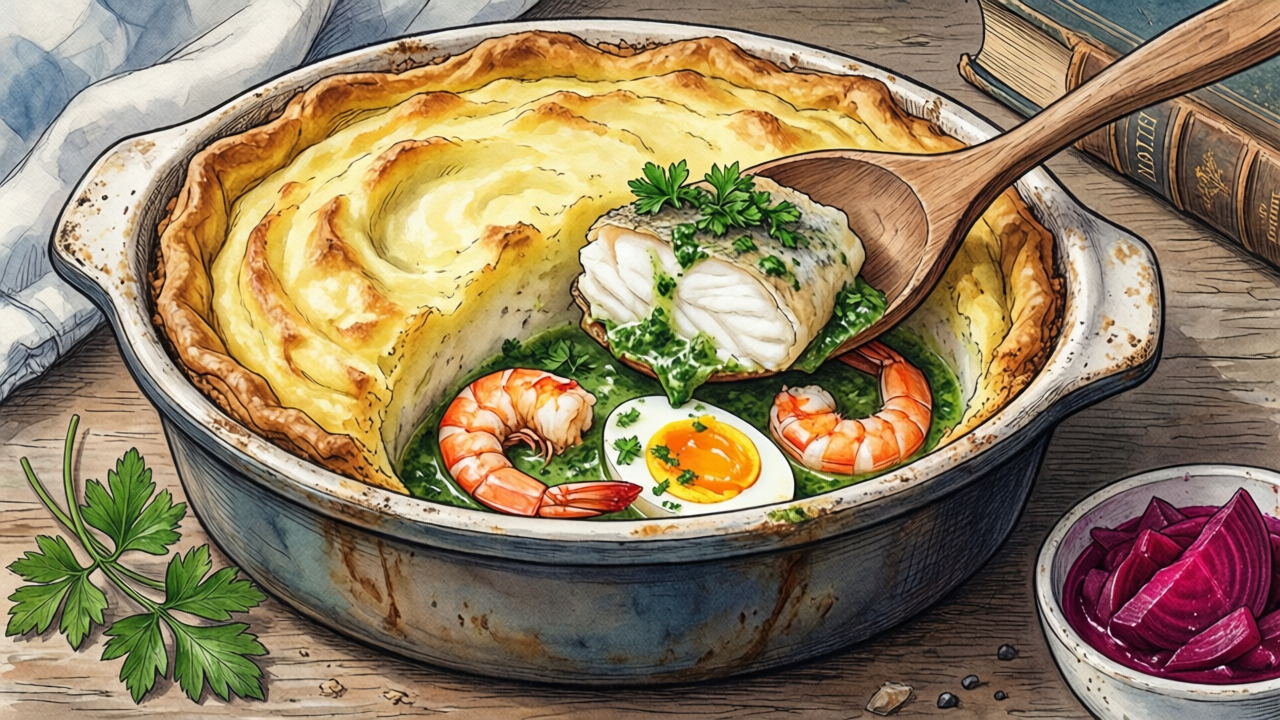
- Assemble: fish in the baking dish in a single polite layer, prawns scattered over, quartered eggs tucked between, leeks on top, sauce poured all over. Do not tidy it. The prawns went in last and only need the sauce’s residual heat — the smallest “sorry” in the room arrives late and takes credit for everything.
- Cover the whole thing with the mash, level and leave it, and do not let a single flake of fish show anywhere. This is stage three of the Fox escalation — the “no really, it’s fine, don’t worry about it” that follows seven sorries and successfully convinces everyone that the incident was always a potato.
- Scatter the remaining cheese on top and bake at 200C (fan 180C) for 25–30 minutes, until the top is golden and the edges are bubbling unattended. The corners brown first: the blush of the dish, appearing wherever the heat is.
- Rest it ten minutes before serving. Everyone agrees, without saying so, never to mention any of it again.
Serve with brown bread and pickled beetroot, because an apology is never complete without a witness. It keeps two or three days in the fridge and improves on the second day, like an apology you’ve slept on. And if you’d prefer the gesture with no offence attached — no fish harmed, no hard feelings, mash obliged to cover anyway — swap the cod, haddock and prawns for 500g of cauliflower in thick florets, parboiled four minutes and drained hard, with an extra knob of butter in the sauce. The mash never asks what is underneath.
Four centuries of sending fish pies to the Crown, and not one recorded “thank you” from a king. The British apology, like this pie, is completely load-bearing at one end and never acknowledged at the other. Eat it hot, with the confidence that tonight you have said sorry enough for everyone.