It’s All Hallows’ Eve, and the oldest recorded version of tonight’s custom isn’t a ghost, a witch, or a supermarket aisle that started in September. It’s a child at a door. The earliest written sighting of “souling” — poor folk and children going door to door at Hallowmas, singing for cakes — is from 1511, and by 1593 Shakespeare was using it as shorthand for begging when he wrote of “pulling like a beggar at Hallowmas” in The Two Gentlemen of Verona. The deal was simple: you hand over a small spiced cake, and the child promises a prayer for the soul of your dead. That’s it. That’s the whole transaction. A biscuit for a prayer.
The custom is everywhere once you know what to look for. Thomas Blount’s dictionary Glossographia of 1674 recorded the soul-mass-cakes being handed out. In 1686, John Aubrey described a Shropshire farmhouse board piled with flat round cakes, set out for all comers — the seventeenth-century equivalent of putting a bowl in the hall and praying nobody gets greedy. In Solihull, a dole of soul cakes founded by one John Collet in 1565 was still being distributed on All Souls’ Day in 1826, summoned by the ringing of the church bell: the longest-running standing order in the history of England, and the only one whose terms were ever “please remember the dead.” Souling held on in ordinary British life until the 1930s, and never fully died in Sheffield and parts of Cheshire, which is what places like that do.
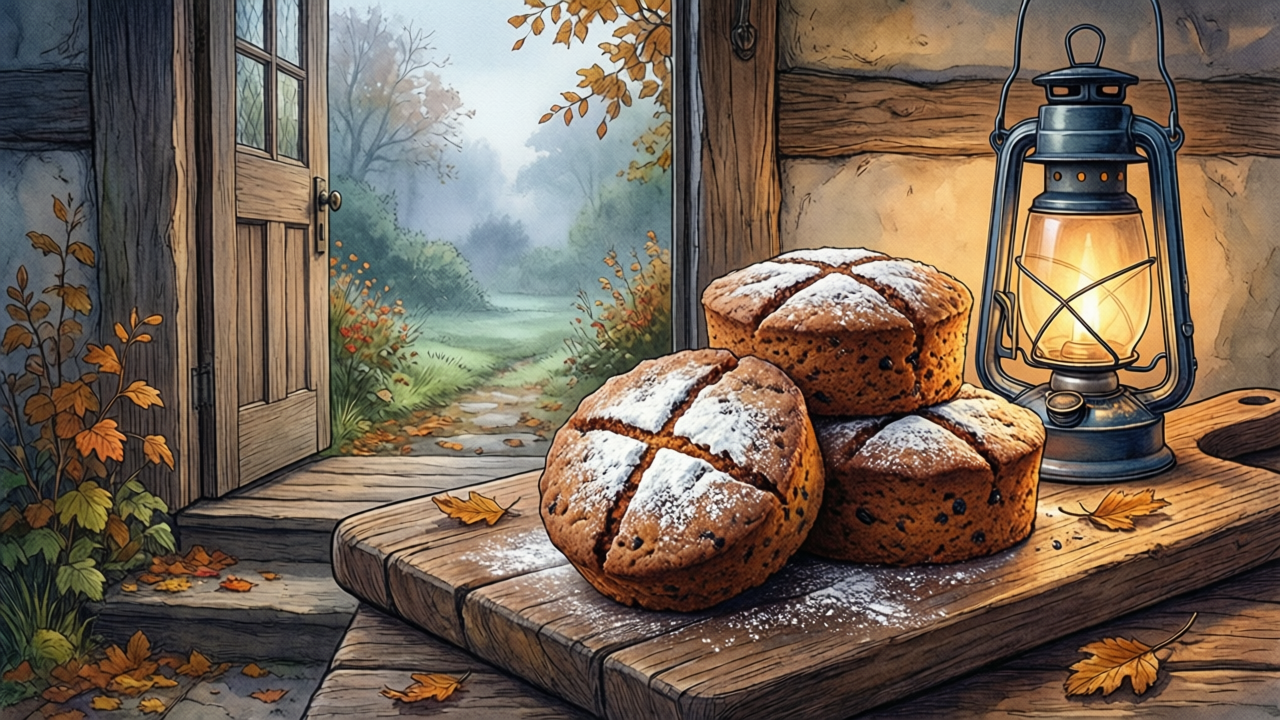
The cakes were marked with a cross before baking — not decoration, but labelling. The cross meant this is alms: goods sold, prayer owed, receipt attached. So let’s be clear about the American thing. Trick or treat is not a foreign import. The phrase first appeared in print in an Alberta newspaper in November 1927, but the mechanism is pure British: Britain invented the doorstep transaction, exported it, and it came back remastered with better confectionery and no theology. The prayer fell out of circulation sometime in the last century. The cake stayed.
So here is the original currency, worth baking tonight, because a spiced currant cake that once bought a prayer costs almost nothing to produce and makes an excellent cuppa friend.
Ingredients
- 225g plain flour
- 110g butter, cold, cubed (margarine works; the Victorians weren’t fussy)
- 60g caster sugar, plus a little extra for sprinkling
- 50g light muscovado sugar
- 2 teaspoons mixed spice, plus 1 teaspoon ground cinnamon
- Grater of nutmeg (about half a teaspoon, freshly grated — the good kind, from the whole-nut aisle, which exists in all three supermarkets and which nobody uses)
- 1 egg, beaten, plus 2–3 tablespoons milk
- 80g currants (sultanas if that’s what’s in the cupboard; the soulers were not picky eaters)
- Pinch of salt
Method
- Heat the oven to 190°C and line two baking trays. Set out more than you think you need — Aubrey’s Shropshire housewives piled theirs on a board for all comers, which is the 1686 version of putting a bowl by the door and hoping for the best.
- Rub the butter into the flour with your fingers, off any machine. The souling trade was entirely hand-to-mouth for four centuries before the appliance industry got involved, and the dough wants fingertips, not a mixer.
- Stir in both sugars, the mixed spice, the cinnamon, the nutmeg and the salt. The spice is the advertising budget: nobody walked across a parish boundary for plain flour, and the shop that could be smelled from the lane was the shop that got its prayers said.
- Add the currants, counted roughly. Every household overestimated the souls and nobody ever audited the board, a financial arrangement modern Britain would recognise instantly.
- Bind with the beaten egg and enough milk for a stiff dough. Rest it in the fridge for half an hour while you think about someone. Even medieval soulers understood batching: the queue at the door on All Souls’ Day does not move, and the baker who works alone has one job and it is the oven.
- Roll out to about 5mm and cut rounds with a 6cm cutter — or just pinch into balls and flatten, which is what every tired household before 1920 did. Then mark each one: a shallow cross scored with a knife, or a cross dusted in flour. This is the receipt. It says the cake is alms, a prayer is owed against it, keep the slip.
- Bake for 12–15 minutes until just set and matte on top. Set, not hard. Purgatory, in the original theology, was temporary — and so should the crunch be. A soul cake baked to a brick is bad doctrine and worse shortbread.
- Warm is best; they keep three or four days in a tin, which is roughly the Allhallowtide service window: Halloween through to All Souls’. Shakespeare’s Hallowmas beggars would recognise the calendar immediately and the supermarket not at all.
Hand them out tonight. The modern exchange rate is brutal — a child will now pay in thanks, or in a chocolate coin, or in a phone photograph of your front path, none of which buys a prayer — but that is currency inflation, not contract law, and the contract still holds. Sheffield and Cheshire have been honouring it since 1511 without once renegotiating the terms, and they are not about to start because a costume shop got ideas. Make the cakes. Leave the door unlocked in spirit. The cross on top is still the only receipt in Britain that promises something back.