It’s 00:48. You are awake for reasons that will not stand up to questioning. And then, out of the hiss, that perky little piano piece — Sailing By, under a minute long, existing for one officially stated purpose: to give you time to tune the dial. Then a calm voice begins reading out the weather at sea. Viking. North Utsire. South Utsire. Thirty-one sea areas, read clockwise around the British Isles, in the same running order since the chart was adopted in 1949 — and the existence of a North and South Utsire implies an East and West Utsire, a question the Met Office has been quietly refusing to answer for over seventy years.
The whole broadcast is, at bottom, a Victorian memorial to a shipwreck. In October 1859 the steam clipper Royal Charter went ashore in a storm off Anglesey with the loss of some 450 people, and Vice-Admiral Robert FitzRoy — captain of the Beagle, founder of the Met Office, the first professional forecaster there has ever been — responded with a storm warning service in February 1861, carried by telegraph. It went to Morse code from January 1924, and has been read aloud by the BBC since 4 July 1925, whose centenary was earlier this year. When the Met Office renamed the Finisterre sea area “FitzRoy” in 2002 — a change made so the UK area wouldn’t be confused with France and Spain’s own Finisterre — the country treated it like a national event. It was. Minor weather-area renaming is the only act of British institutions that reliably unites the nation, which tells you everything about why this dish has been on the menu.
Because Cullen skink comes from a town that lives inside the forecast. Cullen, on the Moray coast, looks out across the Moray Firth at the boundary of the Cromarty and Forties sea areas — it is, as far as the shipping forecast is concerned, a sea-front property. The forecast is what the sea says about the land. Skink is the land’s reply, and the reply is: thanks, we’ll be taking the haddock.
Ingredients
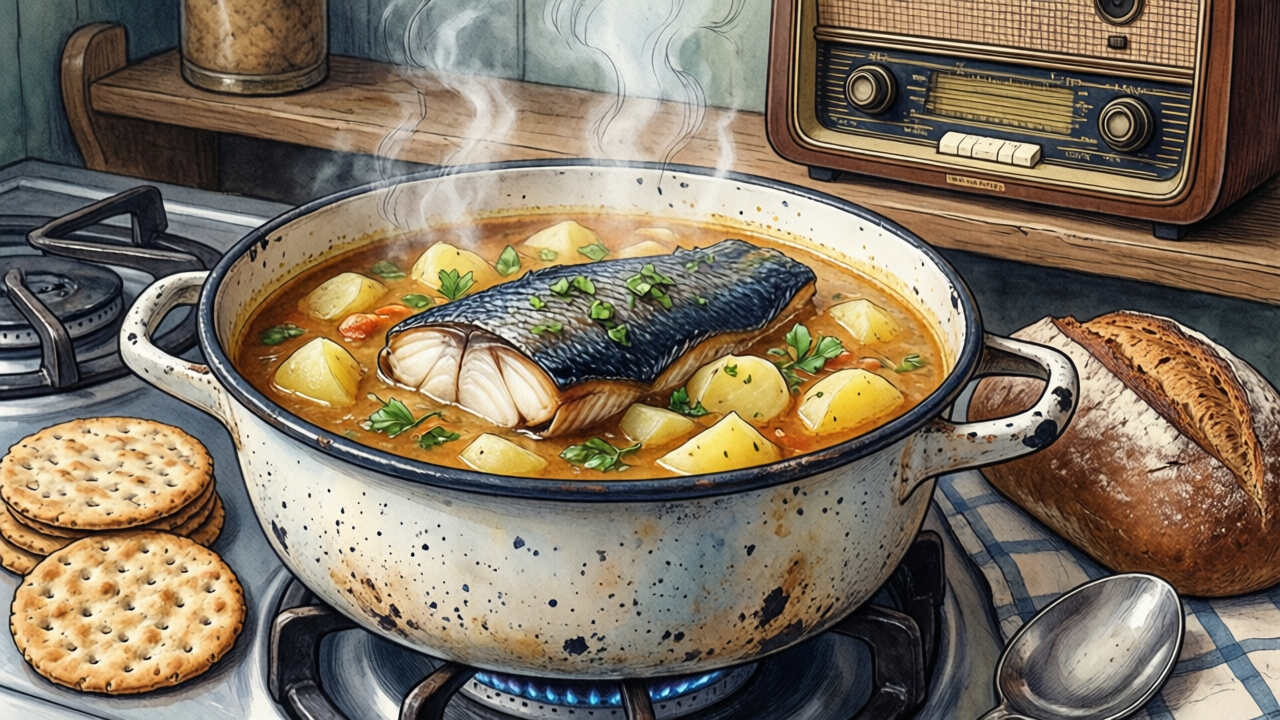
- 450g undyed smoked haddock — finnan haddie if the fish counter is feeling traditional. If the fillet is bright orange, it’s dyed: the smoke was bought from a catalogue
- 400ml whole milk, plus 100ml double cream
- 500g potatoes such as Maris Piper, peeled and diced about 2cm
- 1 onion, halved
- 1 bay leaf and a few black peppercorns
- 50g butter, divided
- Chives or flat-leaf parsley, snipped
- Salt and white pepper
- Oatcakes and buttered brown bread, to serve — crumbled through, the Scottish way
Serves 4, which is roughly the crew of a Moray drifter and a coincidence that comforts nobody.
Method
- The gale warning, as ever, comes first. There is one for this dish, and it concerns milk: milk decides to boil over approximately four seconds before you’re ready. It is a law of nature, on par with FitzRoy. Put a heavy pan on a low heat and make your peace with it.
- The synopsis: melt half the butter, drop in the onion halves, bay leaf and peppercorns, and soften them gently until sweet, with no colour at all. The synopsis contains no drama. That is the entire point of a synopsis.
- Read the areas: pour in the milk, lay the haddock on top, and leave it at a bare simmer — barely moving, no rolling boil — for 8 to 10 minutes. The fish is a guest here, not an argument.
- The inspection service: lift the fish out, slip off the skin, and run your fingertips over the flesh for bones. This service was established in February 1861, it is still running, and its entire principle remains finding the trouble before the public does.
- Strain the milk into a jug and keep it. Do not drink it now. People who drink it now skip to step six, and every forecast read out of order has ended in grief.
- Simmer the diced potatoes in that strained milk for about 15 minutes, until just tender, stirring as you go in the proper direction — clockwise, Viking to Trafalgar. The Met Office hasn’t changed the running order since 1949. Neither have you.
- Thicken without admitting it: when the potatoes are tender, press half of them against the side of the pan with a wooden spoon. A skink has never known a flour roux; it thickens with its own potatoes, like a forecast that explains itself.
- Bring the fish back to the area: flake the haddock in, add the cream, the rest of the butter and a good grind of white pepper, and warm through without boiling. The fish is back in the area now, and the area should behave accordingly.
- Off the heat, season carefully — smoked haddock brings its own salt, so taste before you reach for the spoon again — and scatter over the chives. Serve in warmed bowls with oatcakes crumbled through and brown bread alongside.
One footnote for the record: skink is a Scots word for a shin, knuckle or hough of beef — from Middle Dutch schenke — and the soup was originally made of that, not fish. Cullen’s fishermen, sensibly, swapped the expensive beef for the plentiful haddock and simply kept the name. It is the most honest soup in Britain: it changed its main ingredient, declined to change its name, and nobody has ever minded. The Finisterre-to-FitzRoy of soups, thirty-seven years early.
It keeps a day in the fridge and reheats gently, no Sailing By required beforehand — the kettle’s whistle is tuning signal enough. Gale warnings: none. Visibility: very good. Sea state: your kitchen, smooth to slightly thick, easing off through the evening. And as the announcer says before Radio 4 goes dark for the night: good night.