It is October in a Herefordshire orchard, and the air smells like the floor of a brewery. Ladders lean into the branches at the angle of a man who has leaned into them since six in the morning. Picking bags bulge, the scamps rattle, and somewhere behind you a horse-drawn wagon is being loaded with apples that will never be eaten, because these are cider apples: bitter, sharp, agrarian, and frankly inedible. The harvest has its own payroll, and it has always paid in the product. Farm labourers in the west of England were given small cider as part of their wages — up to six pints a day, rising to twenty or more at harvest time, which is the only pay rise in British history where the raise arrived already fermented. The cider travelled into the field in a small wooden cask called a castrell, which is a word you are now obliged to use at least once, ideally in a pub.
The apple’s claim on the national paperwork goes back further than anyone finds comfortable. By 1341, seventy-four of the eighty parishes in West Sussex were paying their tithe to the Church in cider — the only tax in history anyone has ever enjoyed paying. The fifteenth-century Wycliffe translation of the Bible rendered “strong drink” as sidir, cider, earning it the nickname the Cider Bible; it still sits in the chained library at Hereford Cathedral, which is the closest the drink has ever come to being scripture, and given the harvest ration, arguably the closest it needed to get. And during the reign of Charles II it is reputed that more cider houses than ale houses were licensed in London — a claim the modern cider industry repeats with the exact confidence of a man at a pub quiz who happens to be right.
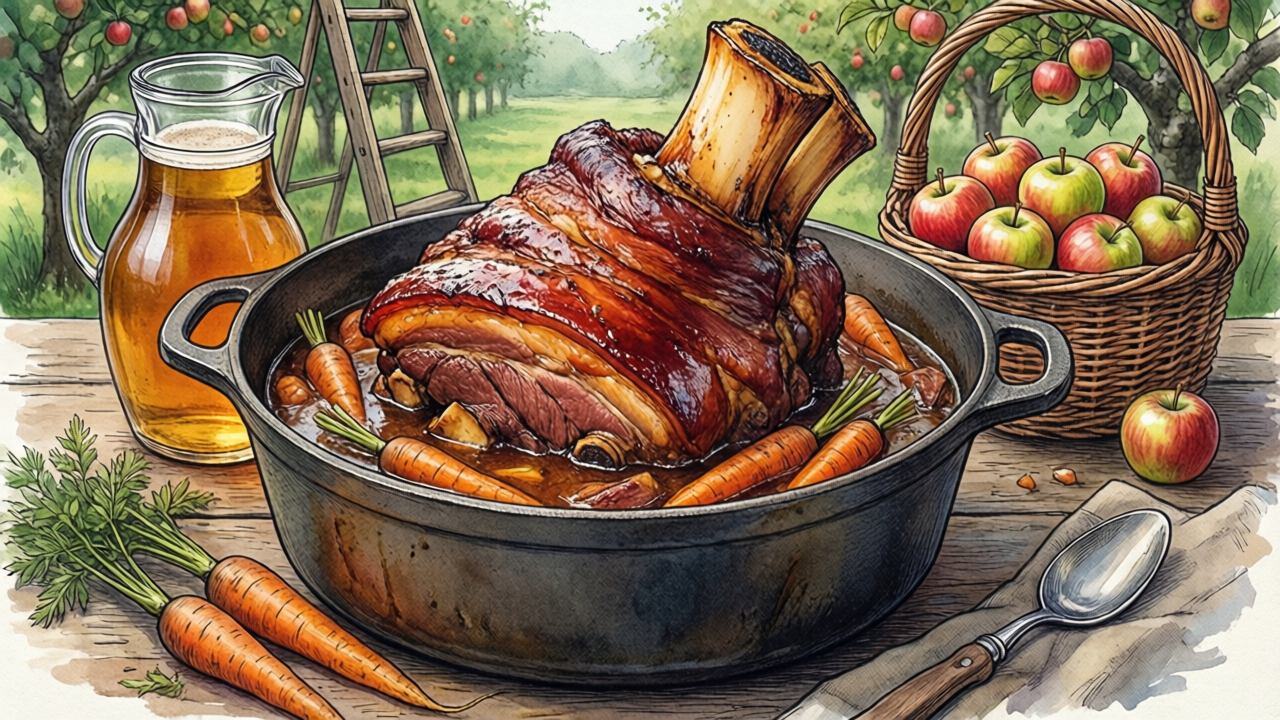
An orchard is a British institution that pays its workers in its own product and leaves the last apple on the tree for the birds, and this recipe does for a pork shoulder exactly what the orchard does: nothing quickly, nothing cheaply, and everything paid in cider. The dish is a slow cider braise — pork shoulder cooked for hours in dry cider with onions, carrots, thyme and black treacle, until it gives up entirely and needs a fork to be reintroduced to polite society.
Ingredients
- 1.5kg boneless pork shoulder joint, netted (the butcher will do this; it is the only work anyone here will be made to do)
- 750ml dry cider — one full bottle. Woodpecker, Strongbow, whatever has a horse or an orchard on the label. Sweet cider works but makes the sauce candy-sweet; a labourer was paid in small cider, not in a cocktail
- 2 large onions, sliced
- 4 carrots, cut into chunks the size of a labourer’s thumb
- 2 tbsp plain flour
- 1 tbsp black treacle (soft dark brown sugar in a pinch — but the treacle is the harvest)
- 500ml chicken or vegetable stock
- A few sprigs of thyme and 2 bay leaves
- Lard or butter, for searing
- Mash, red cabbage and English mustard, to serve — the mustard is load-bearing
Method
- Season the pork generously and sear it in hot lard in a large casserole, on all sides, until it is properly browned. The press never asked the apple’s opinion and the pan will not ask the pork’s either. This is the one step where heat does the talking.
- Lift the pork out and put the onions in the same pot, on a lower heat, for ten patient minutes until soft and gold. Small cider was always the unglamorous one — weaker, drunk more widely, and doing most of the actual work. This is the onion’s shift.
- Stir in the flour and cook it for a minute, then pour in the entire bottle of cider, the treacle and enough stock to come halfway up the meat. This is where you pay the day’s ration. Six pints a day was the going rate; the pan gets a bottle and that is a generous employer by any standard of the period.
- Scrape the bottom of the pot — all those brown harvest filings are the tithe and must not be wasted. Add the thyme and bay, return the pork and its juices, and put the lid on. The cider makers kept their casks topped up to keep the vinegar bacteria off the surface; you are doing the same job on a smaller estate.
- Cook in the oven at 150°C (140°C fan, gas mark 2) for two and a half to three hours. This part is harvest-time work and cannot be rushed. The labourers’ ration went up to twenty pints in the orchard not because anyone drank faster, but because the day got longer. Let the day get longer. The pork is done when a fork slides in with no consultation and no minutes.
- Lift the pork out, rest it fifteen minutes under foil — which is the castrell of the kitchen: a small cover under which something valuable is transported to the table — then thicken the sauce if needed and reduce it hard until it coats the back of a spoon like the harvest season coats a Herefordshire October.
- Slice or shred the pork — either way it has stopped holding grudges — pour the glaze over it, and serve on mash with the cider-braised carrots, red cabbage on the side and mustard sharp enough to remind everyone this is dinner, not dessert.
Leftovers shred into sandwiches with red cabbage and mustard, which is the equivalent of the last apple left on the tree for the birds: technically a tradition, actually a kindness. The sauce keeps three or four days in the fridge, and the braise freezes well, which the orchard year always planned for and the ration never did. By 1341, seventy-four of eighty West Sussex parishes paid their tithe in cider. The tax has changed since. The apple hasn’t.