If you’re old enough to remember doing it properly, you’ll know the scene. You are standing inside an Argos — not the corner of a Sainsbury’s it became after 2016, but one of the eight hundred standalone shops at the peak — and the first thing you notice is what you cannot see: the stock. Not a shelf in sight. The goods sit in a warehouse behind the counter like a magician’s hidden deck, and you get a book instead. That was the entire bargain. Argos — a rebrand of Richard Tompkins’s Green Shield Stamps operation in July 1973, first purpose-built shop on Sturry Road, Canterbury, later that year — ran on trusting the book rather than your eyes.
You’d find the thing in the catalogue, copy the order code onto a slip with the confidence of a man filling in a bank standing order, and hand it over a long counter. Then you’d wait while the tannoy called out numbers like departures at a regional airport. Your purchase would slide down a conveyor and pop out of a hatch, and here is the beautiful part: you were not permitted to check. You carried the bag home and opened it, and either it was exactly right, or it was something else entirely, and nobody ever made a fuss. The catalogue ran to ninety-three editions, up to ten million copies printed of each, right until 2020 — and the whole time, the nation quietly agreed that what you see is not what you get.
Which brings us to bubble and squeak, and why it’s been in my collection queue all week. A bubble and squeak is a catalogue shop you can build yourself: everything you can see is the cover, the entire stock is filed out of sight, and what turns up on the plate is never quite what you ordered. That’s not a flaw in the design. That’s the business model.
Ingredients
- 500g cold mashed potato — day-old, fridge-hardened, the sort left standing up in a tub since Sunday (or boil and mash 600g floury potatoes the day before; the fridge is doing real work here)
- ½ a white or savoy cabbage (about 400g), shredded finely
- 1 medium onion, finely chopped
- 50g butter plus 1 tablespoon vegetable oil, divided
- 1 heaped tablespoon English mustard
- Salt and lots of black pepper
- Optional order add-ons: cold roast beef, roast carrots, roast parsnips — any roast you cooked for entirely different reasons
- To serve, if you’re going the whole way: fried eggs, crackly bacon, brown sauce
Method
- Put the potatoes in. Order code 45-002 118: cold mashed potato, straight from the fridge. Fresh mash is soft, wet and will never crisp. The fridge is the warehouse out back — this step is a collection, not a delivery.
- Boil the cabbage for a few minutes, then drain. Then drain again, then press the rest of the water out with a flat hand. Water is the enemy of a crisp crust, and nobody has ever taken a watery bubble and squeak back to the counter for a refund.
- Melt half the butter in a large, wide frying pan and soften the onion over a medium heat. While that happens, a fact to digest: the dish as first recorded was beef and cabbage, with no potato at all — Maria Rundell’s 1806 recipe was strictly leftover roast beef fried with cabbage. Potatoes only joined the company in the 1880s, like a shop assistant hired during the expansion years.
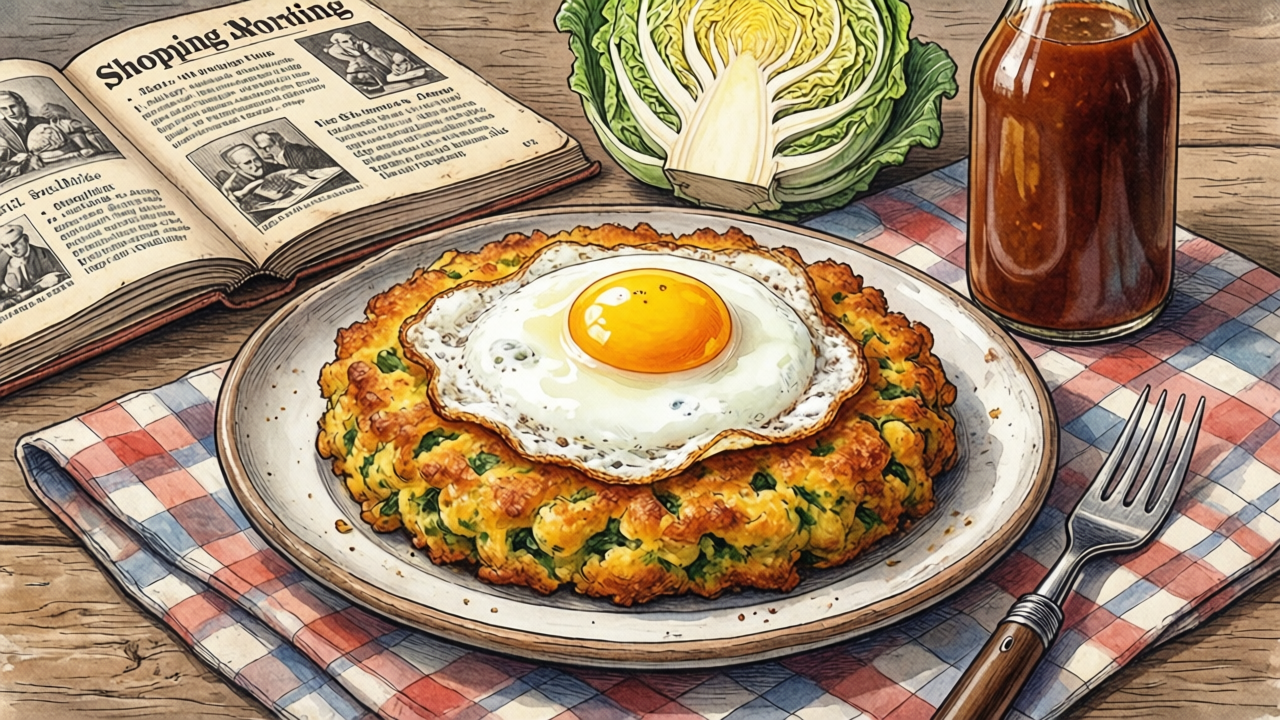
- Add the potato and cabbage to the pan with the mustard, a proper amount of salt and a rude amount of pepper. Mix, then press the lot into one cake the size of the pan. The noise this mixture makes as it hits the butter is where the dish gets its name — and its own customer-service line: the OED’s first record is 1762, when a St James’s Chronicle banquet served “Bubble and Squeak, garnish’d with Eddowes Cow Bumbo, and Tongue” as if that were a normal sentence.
- Leave it alone for 6–8 minutes until the base is deeply gold and holding together like a signed contract, then turn the cake in one confident motion — like collecting over the counter: commit, take, move on. Another 6–8 minutes on the second face. If it breaks apart, press it back: there’s no returns policy, but there is a repair bench.
- Order add-ons: push slices of cold roast beef, carrots or parsnips into the cake as it fries — whatever was in the bag already. This is what the dish was originally for. A London correspondent in 1764 boasted of eating “fryed Beef and Cabbage” and swore he couldn’t have touched it had his wife called it by the fashionable name Bubble and Squeak. Two and a half centuries on, the snobbery hasn’t improved; the recipe has.
- Slide it onto a warm plate and finish however you like: eggs fried in the rest of the butter, bacon cooked until it crackles — both treated as though they were on the order when everyone at the counter knows they weren’t. Brown sauce on the side, applied with the steadiness of a man who has waited behind eleven tannoy calls.
The dish serves four, or one determined person most of a week. The base is vegetarian as it stands — the butter can come out, the beef and eggs were always optional add-ons anyway, and the 1806 original went the other way entirely, so nobody can accuse you of drifting from tradition. Contents may vary: like all ninety-three editions of the catalogue that ended in 2020, this recipe is subject to change without notice. The collection point, as always, is the table.