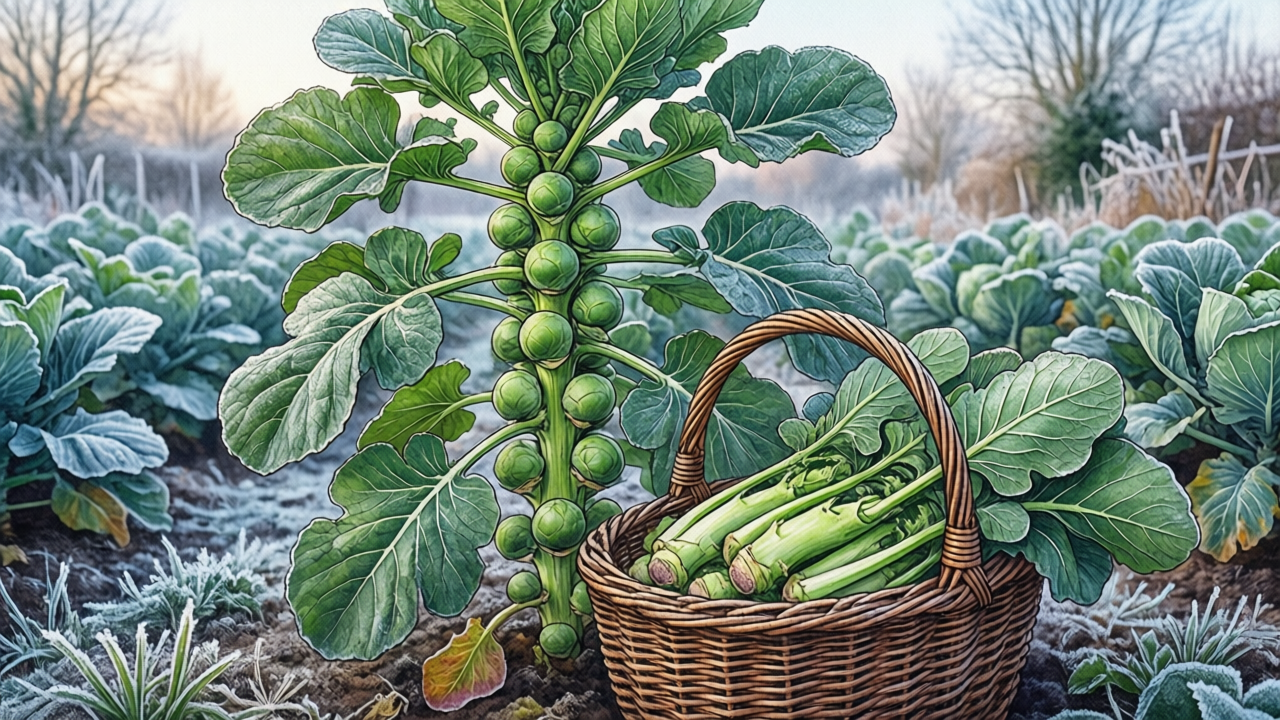
The Brussels sprout arrives in British shops some time in the first cold week of November and immediately stages a six-week occupation of the greengrocer’s stall. You know the display: the nets of them stacked into a green ziggurat, and beside it one solitary stalk stood upright in a bucket like a maypole at a village fete — the supermarket’s way of admitting that these are not, in fact, tiny cabbages that fell off a regular cabbage.
The sprout’s paperwork, like most things on the Christmas table, is foreign. It went native in northern Europe around the fifth century, was cultivated near Brussels by the thirteenth — hence the name, hence the passport — and the first written reference dates to 1587. Britain got the vegetable by the seventeenth century, arrived roughly three hundred years late to the party, and then spent the entire time since boiling it until it confessed. Its botanical group name is Gemmifera, which means “bud-bearing”. The sprout has been honest about what it is the whole time. It is a bud. Everything Britain then did to that bud was a personal attack.
The apology came from abroad. In the 1990s a Dutch scientist named Hans van Doorn identified the chemicals that made sprouts bitter — sinigrin and progoitrin, which are also what make an overcooked sprout smell like a public toilet with ambitions — and Dutch seed companies quietly cross-bred the bitterness out of the whole crop. Popularity soared. The Netherlands located the exact reason Britain hated their national vegetable, fixed it at their end, and never once mentioned the bill. Britain, meanwhile, carried on boiling. To its credit on the other side of the ledger: UK sprout production now runs comparable to the Netherlands, and almost none of it is exported. A nation that grew as much as its rivals and simply refused to give any of it back.
Which brings us to the recipe. It is, formally, an admission of the boiling offence: the bud goes cut-side down into a screaming hot pan and gets browned rather than baptised. Worth making tonight, and tonight especially.
Ingredients
- 500g Brussels sprouts
- 1 tbsp sunflower or vegetable oil
- A good knob of butter
- 1 tbsp cider vinegar
- 1 tsp wholegrain mustard
- A small handful of walnut halves (about 40g)
- 3 tbsp breadcrumbs
- A few thyme sprigs, leaves picked
- Optional, for the carnivores at the table: 3 rashers of pancetta — the sprout has shared a plate with pork for centuries and has never once filed a complaint
Method
- Halve the sprouts from stem to tip; quarter the enormous ones that survived a very good year at the bottom of the net. The knife always enters through the stem end — that’s the business end of the bud, and everything worth doing to a sprout starts there.
- Dry them properly in a tea towel. A wet sprout steams, and steaming is only boiling wearing a smarter hat.
- Get a large frying pan properly hot — hot enough to be slightly rude — and add the oil. Lay the sprouts in cut-side down, in one layer if you can, and then do not touch them for four or five minutes. This is the step where Britain breaks three hundred years of fussing. Leave the pan alone; the cut face is caramelising, and it can feel you hovering.
- When the flat sides are properly brown — not pale, not anxious, brown — tip and turn them, add the thyme and the butter, and cook two minutes more. If using pancetta, render it in the pan before step three and let its fat stand in for half the butter. The sprout accepts this collaboration without comment.
- Push the sprouts to the side, add the cider vinegar and mustard to the bare pan, and let it hiss and lift the glaze off the bottom. The vinegar does this the way you clear the last biscuit off the plate: fast, and without making eye contact with anyone.
- Toss everything back through the glaze until the sprouts are lacquered. If your kitchen is starting to smell sulphurous, you have overcooked them and gone back to the old crime in the middle of a confession — the smell is sinigrin, the Dutch spent a decade breeding half of it out, and you have just volunteered to do the rest. High heat, short time. The neighbours will know either way.
- While the sprouts rest a minute, melt a fresh knob of butter in the same pan and fry the breadcrumbs and walnuts until golden and fragrant. This is the crunch layer: historically the only part of a British sprout that was ever actually welcome at Christmas.
- Scatter the crumbs and nuts over the top and serve immediately. Sprouts wait for nobody — the crisp goes first when they sit, as crisp always does, and by tomorrow they’re grey again, back under the old regime.
Growers will tell you sprouts are sweetest after a frost — the bud needs to have suffered a little before it becomes pleasant, which is honestly the exact operating conditions of every other British Christmas tradition, from the queue at the turkey counter to the cracker that gives you a whistle and a paper hat.
So this is the sprout’s quiet state funeral: three centuries of boiling, one hot pan, and a vegetable that Britain adopted, naturalised, grew as much of as its rivals, refused to sell abroad, and never once asked for a rebate on. The bud can stand down.