Victorian London had an institution so committed to the grill that men carried their own meat to it. Not as a joke about thrift — as standard practice. A French visitor in the 1850s watched wealthy bankers walk into butcher’s shops on their own, buy mutton chops, and carry them ostentatiously to taverns in Fleet Street and Cheapside, where they insisted the tavern grill them. You supplied the chop. The house supplied the gridiron. Nobody thought this strange.
By 1879, young Charles Dickens — compiling a dictionary of the city — reported that the City “absolutely swarm[s] with chop-houses”, the expert grilling concentrated around Finch Lane and Cornhill, with the Cheshire Cheese in Wine Office Court, Fleet Street, famous for its rump-steak pudding on Saturday afternoons. A Punch article in 1850 noted that “at eleven o’clock close the majority of the coffee, chop-houses, and reading rooms” — and that some remained open all night, “but they are not of the moral”. An Islington restaurant’s 1884 price list offered chop or steak for 8d, sausage and mashed potatoes for two-and-a-halfpence, and beds for a shilling, because the chop-house and the flop-house were neighbours if not quite family.
The mixing was the point. In 1841, Blackwood’s Magazine marvelled that the governor of the Bank of England and a junior clerk would carry a chop to the same humble tavern and eat “with equal humility”. The century’s other great cut-related development went the other way: the police, founded by Robert Peel in 1829, were nicknamed peelers and bobbies after him, and wore mutton-chop whiskers — the only hairstyle in history named after a cut of meat, which is to say the face advertised the menu. The chop-house was Victorian London’s one institution where your bank balance came in with you and came out as a grill order: same gridiron, same eightpence, banker goes first. This recipe continues that policy. The mash never asks questions.
Ingredients
- 4 lamb chops from the best end, or thick pork loin chops — buy them yourself at the butcher’s or supermarket, as is your right and, in 1850, your custom (if you can find mutton at your butcher, mutton is the period-correct choice, and worth the detour)
- 1kg Maris Piper or other floury potatoes, peeled
- 100g butter, divided — half for the mash, half for the gridiron’s work
- A good splash of milk, hot
- A small splash of malt vinegar, for the mash (a chip-shop intrusion; the chop-house forgives it)
- 2 large onions, sliced
- 1 tbsp Marmite
- 300ml hot beef or vegetable stock
- 1 tsp plain flour
- 1 tbsp English mustard, plus a teaspoon of Worcestershire sauce (yes, the one from last Sunday — it matures, it forgives, it comes back better)
- Salt and black pepper
Method
- Take the chops out of the fridge half an hour before cooking. Cold chops on a hot gridiron is the Victorian timetable done wrong — the joint runs on its own clock, and the clock has already had its tea.
- Put the potatoes in cold salted water, bring to the boil, and simmer until a skewer slides through like a complaint through a Victorian bureaucracy: eventually, and without resistance.
- Meanwhile, soften the sliced onions in half the butter over low heat for a good fifteen minutes, until sweet and floppy. This part cannot be rushed. The chop-house took its time with everything — it closed at eleven, not before.
- Stir the Marmite, flour and Worcestershire sauce into the onions, then pour in the hot stock in stages, scraping up everything. Simmer until it coats a spoon: this is the gravy, and in chop-house logic it is the house’s contribution, like the gridiron — you brought the meat, the establishment owes you the rest.
- Drain the potatoes, shake the pot on the heat for a minute to drive off the water, then mash with the remaining butter, hot milk and the malt vinegar. Mash like the Islington restaurant ran its room: cheaply, generously, and without ceremony.
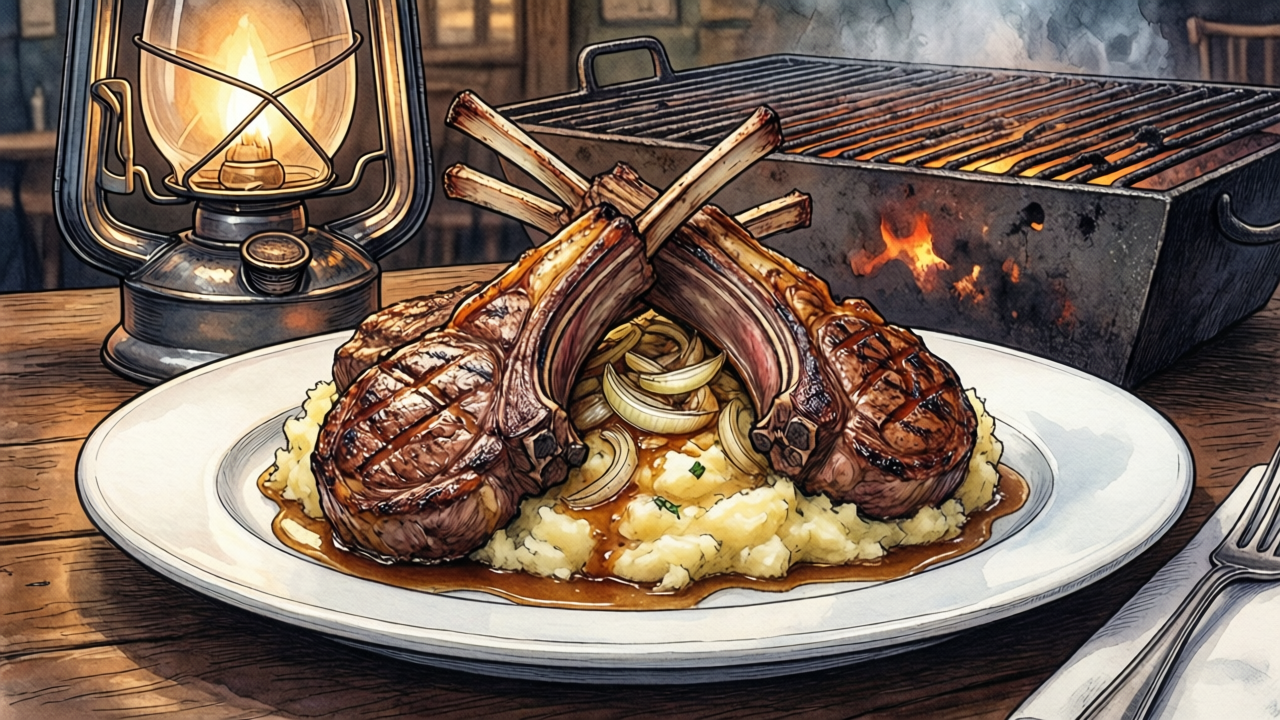
- Heat a heavy griddle or frying pan until it is genuinely hot — this is the one piece of chop-house technology, an enormous gridiron, and it performs exactly one job. Season the chops, add the remaining butter, and fry lamb chops three to four minutes a side for pink, longer for pork until just cooked through. The sizzle is the entire soundtrack of every 1850s report from the City. Nobody in a chop-house has ever whispered.
- Rest the chops on a warm plate for five minutes — a plate being the Victorian oven, and the rest being the part where the chop decides what it is. Mash onto four plates in quantities that suggest you have other customers waiting, lay the chops across the top like the governor of the Bank of England taking the same bench as the clerk, and drown everything in onions and gravy.
The vegetarian customer is entirely welcome, and history backs them up: the chop-house was never about the animal, it was about the grill and the crowd. Two thick slices of cauliflower, roasted then fried in the same butter, sit under the same mash and gravy without the house batting an eyelid — the customer changes, the grill policy does not.
Serve by eleven o’clock, being the hour at which the majority of chop-houses closed, per Punch, 1850. What happens afterwards is between you and the constable — and he’ll want a chop too. He’s called one.