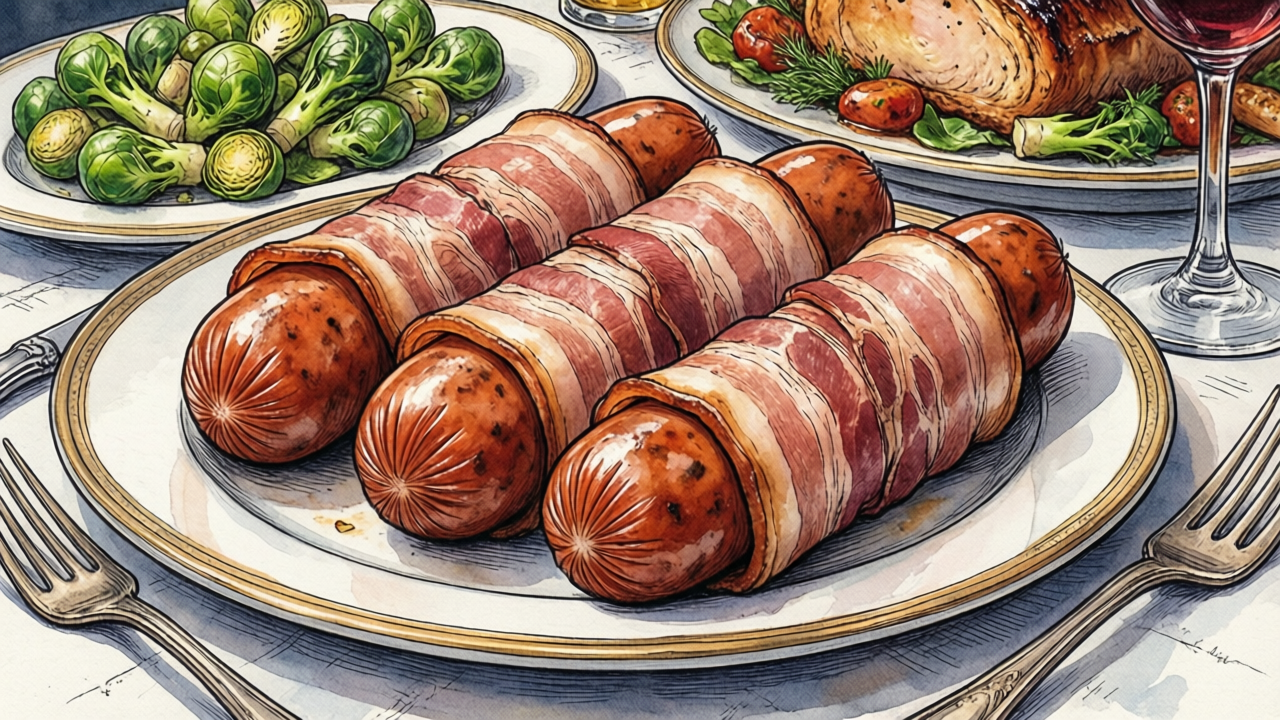
There is a moment in every British Christmas dinner — somewhere between the carving and the pudding — when nobody speaks, because every hand in the room is reaching for the same plate at the same time. The pigs in blankets. Small, fatty, bacon-wrapped sausages behaving like a main course with opinions. Nobody has ever witnessed a Briton take only one. The plate empties at a speed the turkey never managed, and the quiet war over the last one — each diner insisting it’s theirs, nobody actually taking it, the stalemate lasting until a child ends the dispute by sitting on it — is the closest most families ever come to honest negotiation.
Here is the thing about the nation’s favourite Christmas side: it wasn’t. Not originally, and certainly not pork. The Oxford English Dictionary’s first citation for “pig in a blanket” is 1882, and what it describes is an oyster wrapped in bacon. An oyster. The dish that currently exists as a crisp flavour was invented as shellfish in a suit. American cookbooks rushed to agree: Gertrude Strohm’s Universal Cookery Book of 1887 carries a recipe for “little pigs in blankets”, and those too are oysters in bacon. Then the name changed owners. By 1940 a US Army technical manual was listing “Pork Sausage Links (Pigs) in Blankets” — the moment the American army put pork in the blanket, and the British heard about it and said: right. Ours.
The two countries then chose different blankets and never filed a treaty. America’s pig became a hot dog in pastry, which is what you will be served if you order the dish in Ohio without asking questions. Britain’s blanket stayed bacon — chipolata in streaky, and in parts of Wales and the West Country a name even more martial than the dish deserves: kilted soldiers. In 2019 Tesco polled its shoppers and found more people planned to serve pigs in blankets than any other side, beating the Yorkshire pudding — beaten, that is to say, in the pudding’s own house, by a snack whose original recipe required a tide table. And in 2013 a company called Yorkshire Pudding invented National Pigs in Blankets Day, for 12 December. Either the enemy was honouring the troops, or this is the most polite psychological operation in retail history.
So the history of the dish is a simple ruling: the pig is negotiable, the blanket is the brand. Oysters were pigs for a century. This recipe obeys precedent — it is the bacon version, done properly, which takes about twenty-five minutes and will be eaten before the sprouts have finished being argued about.
Ingredients
- 12–16 cocktail chipolatas — the small ones. The dish is named for the size, and a pig in a blanket that needs a knife has misunderstood the assignment
- 12–16 rashers of streaky bacon, one per pig, thin-cut if you can find it
- 1 tbsp wholegrain or English mustard
- 1 tbsp runny honey
- Black pepper, freshly ground
Method
- Heat the oven to 200°C fan 180°C/gas 6, and put out a roasting tin with no oil in it. None. The entire philosophy of this dish is that one pig should baste the others, which is also how every British queue works: the people behind you supply what you’re missing.
- Lay out the bacon. If the rashers are long, halve them lengthways, because the blanket is meant to fit the pig. A blanket that doesn’t fit the pig is not bedding — it’s a tent, and this dish is a well-cut coat.
- Give each chipolata a thin scrape of mustard before wrapping. Nobody at the table will ever detect it; everybody at the table will be unable to explain the quality. The mustard is a pension: pay it in quietly, benefit later.
- Wrap one rasher snugly around each pig and set it seam-side down. The seam-down part is structural. The only pigs in blankets that unravel in the oven are the ones that were never wrapped with intent, a rule that has kept several other British institutions standing.
- Pack them into the tin touching each other, like the middle carriage at 5:15. They will render their fat evenly and nobody will be in a hurry to get anywhere, which is the correct atmosphere for the job.
- Roast for 20–25 minutes, until the bacon has seized up and the edges have started to crisp. Colour is the entire product claim; give them an extra few minutes if they look pale, which is the only note on this menu that has ever been refused.
- Brush them with the honey for the final five minutes and a grinding of black pepper over everything. Honey goes on late, never early: sugar applied at the start is how you get a burnt coat on a cold pig, and this recipe is not a first attempt — it is the accumulated experience of every attempt.
- Turn them out onto a wire rack for two minutes, if you and the people around you have the discipline, which you don’t. A rack, not kitchen paper — paper gives you a soft blanket, and there is no point in being present at this dish if the blanket goes soft.
Serve beside the roast — if you ran yesterday’s timetable, these are the interlopers running through it — with stuffing, gravy, and a face that says you expect to be thanked. Vegetarian version: a vegetarian sausage in a plant-based streaky from the chilled aisle, or a wide ribbon of roasted carrot with a grind of smoked paprika. The blanket changes material; the structure survives intact. History says the pig was always the flexible part — until roughly 1940, the pig was an oyster.
And that is the whole trick, honestly: nobody in the entire history of this dish can tell you what originally went inside it. Everyone can tell you about the blanket. When a food’s flavour gets printed onto pyjamas — and pigs in blankets flavour now exists on pyjamas, and chocolate, and vape liquid, a product spectrum no British dish this young has climbed — the wrapping has already won. Wrap something properly and history forgets what you wrapped. The turkeys of the world get the carve; the pigs in blankets get the reprint.