It is half past twelve, and there is one oven. Into that single shelf all four components of a three-hundred-year-old negotiation must be fitted: the potatoes due in at ten to one, the Yorkshire puddings unannounced and due to arrive whenever they feel like it, and the joint running on its own clock, as it has always run on its own clock. Lunch will be ready when lunch is ready. That sentence is not an excuse — it is the national motto, and the timetable behind it is the only one Britain has ever actually obeyed.
Roast beef became the national dish through a song rather than an act of parliament, which is the most British possible order of precedence. In 1731 Henry Fielding — not yet the famous novelist, then a man with a London farce to fill — wrote The Roast Beef of Old England, in which mighty roast beef “ennobled our brains and enriched our blood”. A nation’s entire diet declared medicinal, in verse, and nobody argued. By the eighteenth century the French had noticed too: les rosbifs. The dish was so completely British it acquired a foreign-language nickname before mass tourism allowed anyone to go and check.
The Yorkshire puddings were invented in the north to stop fat going to waste. In 1737, The Whole Duty of a Woman published a receipt for “a dripping pudding”: pancake batter in a pan shoved under a roasting shoulder of mutton to catch what fell. A decade later Hannah Glasse printed the same trick under the name “Yorkshire pudding” — which is how a southern writer gave a northern economy the brand name. Because nothing in this meal was ever designed as decoration. Every component began as a way of using one fire properly, which is exactly why the timing is so demanding. It was never four dishes. It is one system sharing one heat source.
So here is the Sunday roast, full trimmings, written as what it has always been: a scheduling problem with beef at the centre of it.
Ingredients
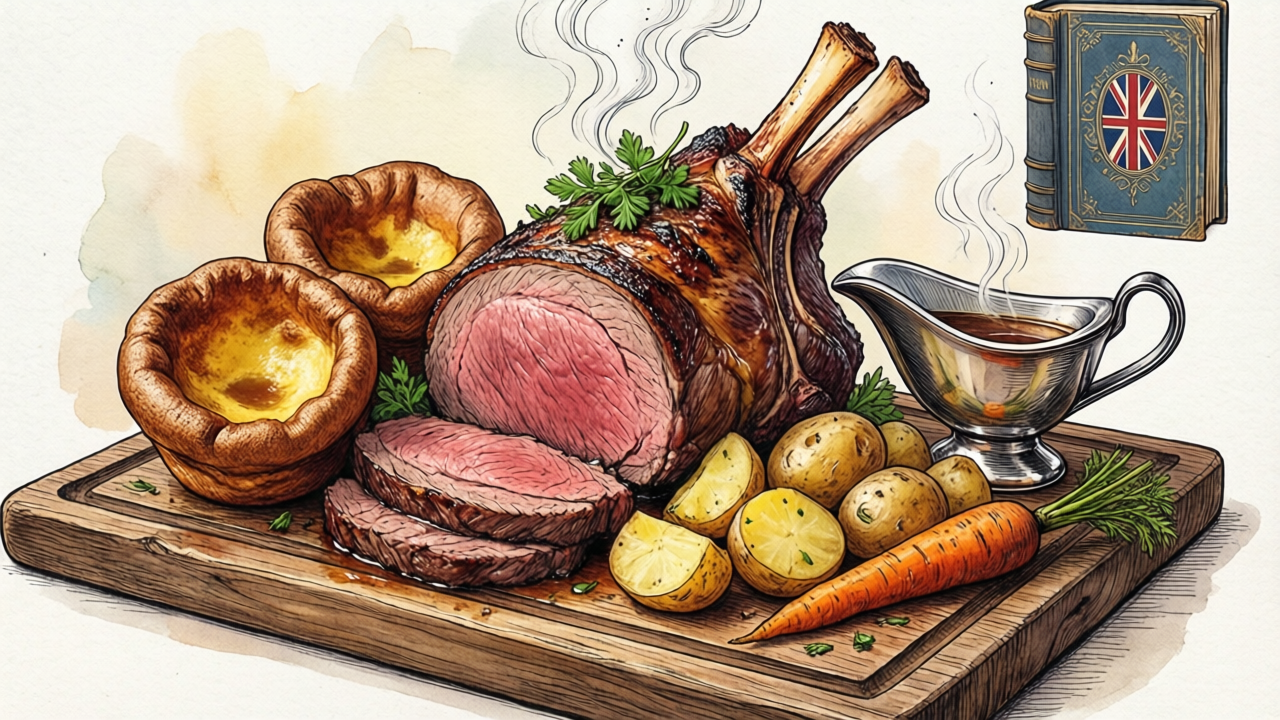
- A 2kg bone-in rib of beef — the butcher will re-tie the bone on, and the bone is the timetable: it conducts heat slowly and apologises for nothing
- Vegetable oil, or beef dripping if you are a traditionalist, which is to say if you enjoy the taste of memory
- Coarse salt and black pepper
For the potatoes: 1.2kg floury potatoes (Maris Piper, King Edward), peeled and cut into 5cm chunks; 3 tablespoons goose fat or vegetable oil.
For the Yorkshire puddings: 2 eggs; 140g plain flour; 200ml milk; a pinch of salt; oil for the tin.
For the vegetables: 6 carrots, peeled; 4 parsnips, halved lengthways; a small white cabbage, sliced, or a bag of broccoli florets; a handful of frozen peas, because the timetable provides for one component that asks nothing of you.
For the gravy: the roasting tray and everything dark in it; 1 tablespoon plain flour; 600ml hot beef stock — a made-up cube is part of the tradition and nobody should be shamed for using one; 1 teaspoon tomato purée; a splash of red wine, optional, and the only luxury in this post.
Method
- Take the joint out of the fridge an hour before it goes in. Cold beef into a hot oven is how you get grey edges and a middle that has stopped believing in things. Then weigh it, because the national rule applies: twenty minutes to the pound, plus twenty more for luck. The rule has never once been audited and is obeyed more widely than every speed limit in Britain.
- Rub the joint all over with oil or melted dripping and season it like you mean it. Sit it bone-side down on a rack in a roasting tray. Oven at 220C/200C fan for twenty minutes to set the outside, then down to 180C/160C fan for the remainder — about 15 to 20 minutes per 450g from here for pink. This is the moment you accept, as every Sunday since 1731, that you are now in the employ of a clock.
- Half an hour in, peel and chunk the potatoes and drop them into boiling salted water for seven minutes — not cooked through, just to the edge of politeness. The potato is the component that has to change platforms: parboiled first, shaken after, because a rough edge is the only kind that crisps on schedule.
- Drain the potatoes and shake them in the pan until the edges go fuzzy, like a traveller who has just missed a connection. Heat the fat in a big roasting tray until it shimmers close to smoking, tip the potatoes in, turn them until they are coated, and get them into the oven for 45 to 60 minutes, turned once, with the carrots and parsnips added around them for the final half hour — passengers on the same service, luggage stacked in the vestibule.
- Now the batter: flour and salt in a bowl, a well, the eggs beaten in, the milk added gradually until it moves like double cream. Lumps are allowed — the batter is the one thing permitted to be rushed. Rest it thirty minutes while the potatoes take their colour. The gluten needs to relax, and so do you; you are currently the person standing at the oven door tapping the glass, which is not a hobby, it is a symptom.
- When the Yorkshires are due, put oil in a muffin tin and get it properly hot in the oven — the batter must spit when it goes in, the way the joint did at step two, except the Yorkshire has much better manners about it. Fill each cup two-thirds from the jug and get the door closed. The Yorkshires have been announced at last; they will arrive in twenty minutes and they will not be delayed by the weather.
- Do not open the oven door while the Yorkshires are rising. That is not superstition, it is physics: a gust of cold air drops them flat, and there is no appeal process. This is the timetable’s last-minute platform change. Trust it, and stand well back.
- When the clock — the real clock, not the oven clock, which has always run on joint time — says the beef is done, take it out, tent it loosely with foil and leave it on the counter for twenty to thirty minutes. This is the most waiting you will do all week, and it is the step that decides dinner: rest lets the juices settle instead of running across the board the moment you carve. The foil is not a tent. It is a first-class lounge, and nobody is admitted.
- While the beef rests, the gravy: pour the fat off the roasting tray, then put two spoons of the dark stuff that was stuck to it on the heat. Stir in the flour, cook it out for a minute, and add the stock a ladle at a time, scraping up every brown fragment — those fragments are the entire reason the tray exists. Tomato purée in, wine if you are feeling expensive, five to ten minutes at a simmer until it coats a spoon, then season. This is the only part of the meal that can be late without consequence, which is precisely why it is always made last, like a statement from the board.
- Boil the cabbage — or the broccoli, and warm the peas — in the last few minutes. Carve the beef thick, plate everything at once, and accept that in a one-oven country the plates go in warm and the gravy boat waits by the phone. Lunch is late. Lunch is superb. Both were announced to the nation in 1731, in rhyming couplet, with medical claims attached.
No vegetarian variant, and the reasoning is on the record: the recent run of this column has been so heavy with vegetables that the cabbage is filing a grievance. The carrots, parsnips and broccoli are already working a full shift, and the joint has waited long enough for its own episode — it has, in fact, been waiting since a Frenchman first sneered at it. Cold leftovers make the sandwich that needs no timetable at all, which is the only form of roast beef that has ever been punctual.