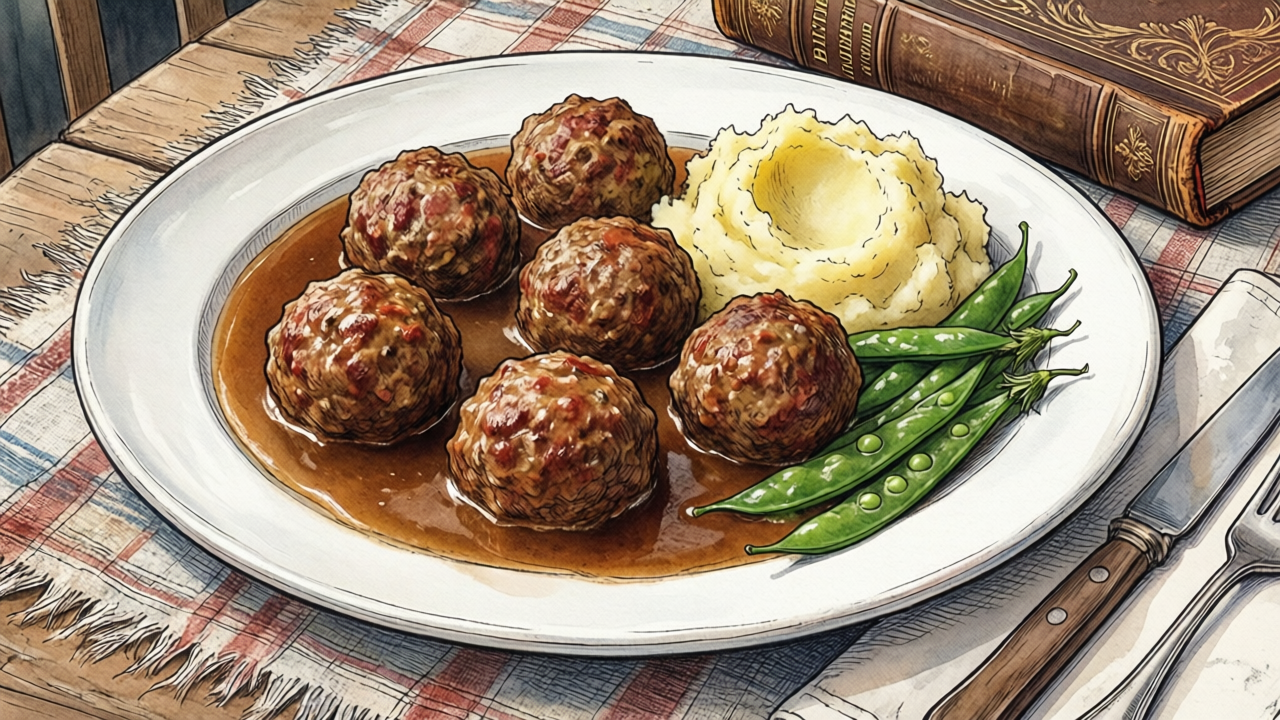
There is a chalkboard outside a pie shop in the Black Country on a November morning — heat lamps, pork pies sweating faintly under their jelly, the bakers’ window arranged with the seriousness of a small coroner’s court — and on it is the one item in Britain you can say out loud at the counter but cannot type into a search bar. The faggot: a seasoned pork bundle, traditionally wrapped in caul, served with mash and buttered peas, eaten by the tens of millions every year. That figure is an industry estimate from 2018, and it is offered here purely for balance. It is the most-eaten dish in Britain that the internet still declines to let anyone name.
The word is older than the scandal and older than the cooking. A faggot in English is simply a bundle: an ordinance of 1474 standardised a faggot of firewood as three feet long and two feet around, so Britain had the noun legislated, measured and sealed two and a half centuries before anyone thought to eat it. The dish did what poor dishes do — cheap meat, cheap bread, a lot of sage, and offal because the good joints went somewhere else. It was invented by farm labourers in the West Midlands and west Wiltshire, and travelled to South Wales in the mid-nineteenth century when the mines and works poached those same labourers off the land, recipe included. Yorkshire looked at the identical idea, couldn’t bring itself to use the word, and rebranded it “savoury ducks” — first printed in the Manchester Courier on Saturday 3 June 1843, a name that has been losing ground ever since. So the dish and the apology for the dish are both original. Only one of them ever made lunch.
The twentieth century gave the faggot its peak — rationing turns offal into a virtue — then its slow decline, and the twenty-first gave it a revival and a scandal with no judge. Somerfield ran a radio advert in 2004 — “I’ve got nothing against faggots, I just don’t fancy them” — which the regulator Ofcom ruled innuendo and banned. Facebook’s filters temporarily blocked British users in November 2013 for using the word in this exact culinary sense; Facebook called it a misinterpretation and moved on. A Google advert for a British café was pulled in September 2019 for the same offence, which is not an offence. Waitrose was back to selling beef faggots by 2014. The ratios of the affair, in one sentence: one word repeatedly bundled into a queue by machines, and beside it a perfectly innocent parcel of pork that no machine has ever mistaken for anything, because no machine has ever cooked it. Both are bundles. One of them is dinner — and this is the recipe for the one that is.
Ingredients
- 500g pork mince
- 100g pig’s liver — or 100g extra mince plus a spoonful of Marmite. The traditionalists have filed an objection. The objection is noted.
- 1 onion, very finely chopped
- 40g breadcrumbs, plus more for shaking
- 1 tbsp chopped fresh sage, or 2 tsp dried (the Black Country will forgive the dried if you don’t let them watch)
- 1 egg, beaten
- 1 tsp black pepper
- 8 sheets of caul fat from the butcher, if he has it — it’s the membrane around the pig’s kidney, and it is the traditional wrapper. If he hasn’t, butter does the job and this recipe will not pretend otherwise.
- 1 tbsp lard or oil, for browning
- For the gravy: 25g butter, 1 tbsp plain flour, 500ml good beef or vegetable stock, 1 tbsp Marmite
- Mash and garden peas, to serve, as is traditional and as is non-negotiable
Method
- Melt a knob of butter and sweat the onion on a low heat for fifteen minutes, until properly soft and sweet. This is the slowest step and it is not open to appeal. Content moderation clears a flagged word in about a day; an onion takes longer than that, and knows it.
- Blend the liver to a paste in a food processor, or have the butcher mince it twice. This is the step that reminds you what the dish actually is: the cheap cuts, committed to. Nose-to-tail is a restaurant word; the faggot is the receipt.
- Combine mince, liver, onions, breadcrumbs, sage, egg and pepper in a large bowl and mix with your hands until it holds together. The mixture must survive being bundled, which has been the legal definition of this dish since 1474.
- Chill the mix for half an hour, long enough for the fat to regain its nerve.
- Shape into eight oval faggots. If you have caul, wrap each one — the bundle, formally recognised as a bundle, per statute. Do not squeeze too hard. They’re dinner, not the internet’s reaction to a dictionary.
- Heat the lard in an ovenproof frying pan and brown the faggots on all sides — properly dark, and without embarrassment. The only thing ever embarrassed about this dish is what it’s called, and that was never the dish’s fault.
- While that browns, make the gravy: cook the flour in the butter for a minute, stir in the stock and Marmite, and simmer until it coats the back of a spoon — the historic British standard for both gravies and composure.
- Tip the gravy over the faggots in the pan, lid or foil on, and bake at 160°C for 40 minutes. Braising, not roasting: this is a dish that rewards exactly the patience its name never gets.
- Serve on mash, with garden peas, gravy poured over with confidence. This is the Black Country standard: mash, peas, no side dishes, and absolutely no explanation.
The vegetarian version works, and has nothing to be anxious about: pulse 400g chestnut mushrooms with a tin of drained butter beans in place of the meat, keep the sage, keep the gravy, make the stock vegetable. The filters never caught the mushroom one. The filters have never actually caught anything. And the verdict from the only honest tribunal available, the chalkboard: tens of millions a year, banned from a radio advert, blocked on a social network, removed from Google — and never once found guilty of anything except being a bundle. Order it at the counter. The counter has never blocked anyone.