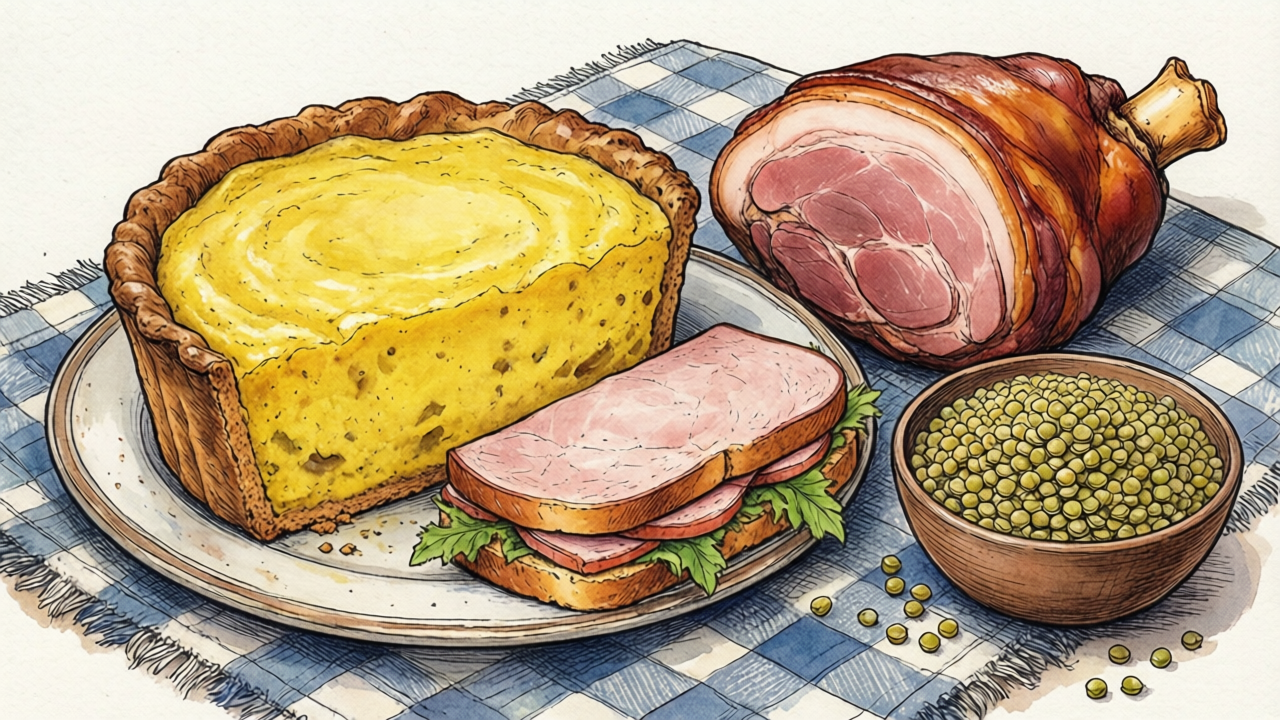
There is a wedge of it at every deli counter in the North East, sitting under the lights like a yellow halo: pease pudding. Split yellow peas boiled to a paste, traditionally with a ham or bacon joint, sold by the quarter pound next to the roast ham and the pickled beetroot, waiting for its one true purpose — spread an eighth of an inch thick inside a stottie cake with ham, and eaten standing up. Ask anyone from Newcastle, South Shields or Sunderland what it tastes like and they will describe the sandwich, not the pudding, because in the North East the pudding has never been a dish so much as a condiment with excellent manners.
Its paper trail is odder than most. The word pease is a small linguistic accident: in Middle English it was a mass noun, used like flour or oatmeal, until somebody reinterpreted the -s as a plural and invented the word “pea” to stand underneath it. The entire English language’s name for the vegetable is a back-formation — a mistake that won. And the dish’s most famous appearance in print isn’t a cookbook at all: it’s a hand-clapping game. “Pease Porridge hot, pease porridge cold, pease porridge in the pot, nine days old” was first recorded as a riddle in John Newbery’s Mother Goose’s Melody, around 1760 — the only national dish in Britain whose primary piece of marketing is a nursery rhyme, and whose most quoted line is, read honestly, a spoilage warning.
Which is the right note to start on, because pease pudding is the most unfussy save in British cookery: dried pulses, a ham bone, time. You boil once and eat three ways across a week, hot, cold, and in a sandwich — the rhyme isn’t a riddle, it’s a meal plan. Even its modern news appearances have been about logistics: in 2015 a man at Newcastle Airport was pulled from his EasyJet flight to Gatwick because security mistook his tub of pease pudding on the X-ray for Semtex. The pudding went in the bin, the man missed his flight, and the North East has never once apologised. Here’s the recipe, fresh instead of nine days old — though if you want to hit the rhyme’s full schedule, the fridge has no vote.
Ingredients
- 500g dried split yellow peas (the dry-pocket aisle; not the green kind, and not the frozen sweet kind — field peas, harvested dry, same species as the sweet ones, just with a harder career)
- 1 smoked ham hock or smoked bacon joint, about 1kg, on the bone
- 1 onion, halved
- 2 bay leaves
- 50g butter
- 1 heaped tablespoon English mustard, plus more to serve
- A good grating of nutmeg
- White pepper, and salt to taste
- To serve: hot mustard and pickled beetroot; or stottie cakes — or the best soft round bread your supermarket sells — and thick ham, sliced from the joint
Method
- Rinse the peas until the water runs clear, then cover with cold water and leave overnight. This is the rhyme’s “in the pot” stage beginning early, exactly like a working men’s club fridge: something is always soaking.
- Drain the peas, tip them into a large pot with the ham hock, onion and bay, and cover with about 2 litres of cold water. Bring to a bare simmer and skim the froth. Season nothing yet — the hock is saltier than it looks and will negotiate for you.
- Simmer gently for an hour and a half to two hours, until the peas collapse at a look and the hock is practically resigning itself from the bone. This cannot be rushed, and there is no shortcut and no reason to try — the dish has survived 260 years of nursery rhymes; it will survive two unhurried hours on your hob.
- Lift out the hock, let it cool, and slice or pull the meat. Reserve. Keep the cooking liquid — it isn’t waste, it’s the reduced stock the rhyme never admitted to.
- Drain the peas well, then beat them with the butter, mustard and nutmeg, mashing hard, loose with a splash of the cooking liquid if it seizes. Beat it until it’s the texture of a thick, confident hummus that has given up on garnishes.
- Season with white pepper and, if it needs it, salt — but taste twice before salting, because a smoked hock lies about how salty it is. Return the pan to a low heat and dry the paste out for a few minutes, stirring, until it pulls away from the base like it’s decided to leave.
- Spoon into a bowl, cover, and cool. It sets firmer in the fridge — the “cold” verse of the rhyme, and the one that makes the sandwich work.
- Serve it two ways. Hot: alongside the sliced ham, English mustard, pickled beetroot, and mash, which is the traditional plate. Cold: spread thick on a split stottie with ham, mustard optional, eaten in the number of minutes a Geordie sandwich is permitted to survive.
Keeps a good five days in the fridge — five, not nine; the rhyme was written in a world without refrigeration and has not updated its terms. (Veggie version: skip the hock, simmer the peas in vegetable stock with a smoked ham-style seasoning or a dash of smoked paprika and a vegetable stock cube; the North East will notice the substitution, but it will still eat it.) And if you’re carrying leftovers through Newcastle Airport security, perhaps mention it first. The X-ray has a prejudice, the bin is real, and nine days is the only age this pudding is legally required to reach.