Most borders are negotiated: exhausted diplomats, a map nobody consulted, a line that moves anyway. Britain’s oldest border was set by a river and a king. The chroniclers say that in AD 936, King Athelstan pushed the Britons out of Exeter and fixed the eastern edge of Cornwall at the River Tamar. Eleven centuries on, the line has not shifted an inch — which matters, because a nation that has completely settled its border has to argue about something else. The West Country found its somewhere else. The argument moved off the map and onto a scone.
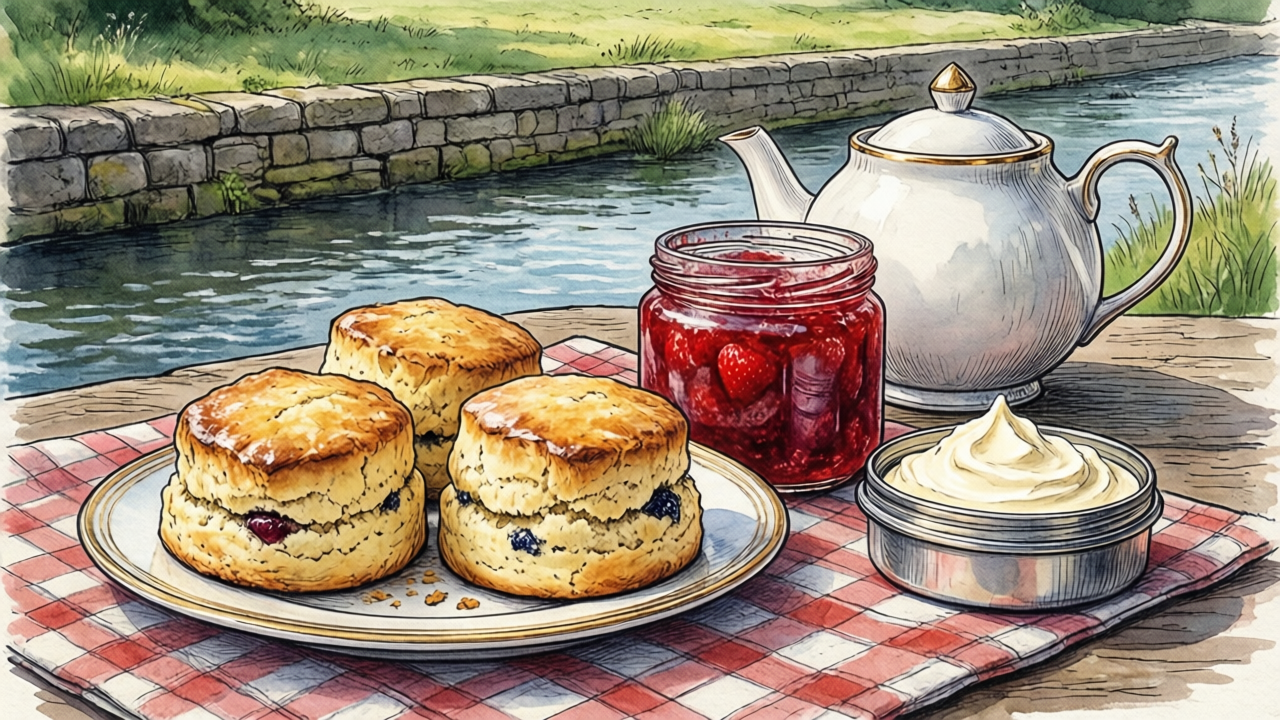
Because there is an order of events. A cream tea is tea, scones, clotted cream and strawberry jam, and there are two ways to assemble it. Devon spreads the cream first, then the jam: the scone as open country. Cornwall puts the jam first, then a dollop of cream on top: the scone as a pudding. Each county will explain its method to you unprompted, at volume, in a carvery, for as long as you are prepared to stand still. And the two methods are not recipes. They are jurisdictions.
The name is younger than the rivalry needs it to be. The OED’s first citation for “cream tea” is 1964, in a novel by Philip Maitland Hubbard — “We just bathe and moon about and eat cream teas” — a sentence so idle it earned its way into lexicography. But the researcher Foods of England found an older one: a letter to The Cornishman newspaper in September 1931 complaining that “for an alleged Cornish cream tea consisting of three slices of bread and butter, a splashing of cream and jam and two anaemic rolls, I was charged 1s. 6d.” That settles it: by 1931 the cream tea was old enough to disappoint someone in print. The bread-and-cream-and-jam tradition supposedly running back to Tavistock Abbey in the eleventh century is the sort of origin claim that means nobody has ever checked.
The law eventually got involved, took one look, and retreated to the dairy. “Cornish Clotted Cream” has held European protected status — a PGI, the same club the Cornish pasty joined in 2011 — since October 1998: Cornish milk, minimum 55% butterfat, all of it in the regulations. The cream is legally Cornish. Devon’s counter-move came in May 2010, when Langage farm launched a campaign at the Devon County Show to protect the name “Devon cream tea”, and the Guardian ran the headline “It’s scone wrong” — a standard the argument has been chasing ever since. The campaign for the whole cream tea registered nothing, and there was never much chance it would: what exactly gets protected? The cream is legally Cornish, the jam is legally nobody’s, and the scone is legally Scottish, whatever it has done to deserve living in the West Country. The order of events, meanwhile, has no jurisdiction at all. So here is a scone with no position in it. It cares only about being cooked properly, which is the one thing both counties can agree on, and the reason to make it yourself: the only border crossing in this dispute anyone ever completes is the one from the oven to the table.
Ingredients
- 450g self-raising flour, plus more for the surface
- 2 tsp baking powder — on top of the self-raising flour. Belt and braces; the West Country has never trusted a single authority
- 60g cold butter, cubed
- 30g caster sugar
- ½ tsp salt
- 1 egg, plus about 200–250ml whole milk
- To finish: strawberry jam; clotted cream — the legal minimum is 55% butterfat, which is also the delicious minimum, whatever county the tub claims; and a pot of tea
Method
- Heat the oven to 220°C — 200°C if it’s fan-assisted — and line a baking tray. Whisk the flour, baking powder, salt and sugar together. Sifting is not optional: a scone has no time to sort itself out later. Like a county boundary, the arrangement has to be right before anything arrives.
- Rub the butter in with your fingertips until it looks like breadcrumbs dropped during a parish meeting. Lumps are fine. This is a tradition a thousand years deep; it never learned to be even.
- Beat the egg into 200ml of the milk, make a well, and stir it into a soft, sticky dough with a table knife, loosening with the extra milk if it wants it. A knife, not a hand: your hand is warm, and warmth is not wanted here.
- Tip it onto a floured surface and pat out to about 2cm. Do not knead. Kneading builds gluten and gives you a chewy bread roll — precisely the “anaemic rolls” of that 1931 letter. Some grievances are worth taking seriously.
- Cut rounds with a straight-sided cutter, pressing straight down — no sawing, no twisting. A twist glues the layers shut at the edges like a customs post, and you want the layers free to move.
- Space the rounds on the tray, brush them with the leftover milk, and bake for 10–12 minutes, until risen and gold. They will have risen by the time they come out. The debate will not have.
- Move them to a rack and wait ten minutes, then split each scone while it is still warm — or press a fork all the way round the edge first and pull it apart along the holes. The fork marks the line and you just follow it, which is, in biscuit form, how every border in history has worked.
- Now commit, because sequence is everything. The Devon method: cream first, jam on top. The Cornish method: jam first, a dollop of cream to finish. You are not choosing a topping, you are choosing a county, and it is the closest Britain gets to voting by breakfast. The 1998 regulations cover the cream and nothing covers the order — which is either a drafting error or the most honest piece of food law ever written.
- Eat the same day, ideally within the hour, with tea. Some authorities hold that the tea takes no milk. It is the only cream-tea rule anyone has ever tried to enforce, and it has no more force than any of the others.
Two notes from across the water. Cornwall’s traditional vehicle is not the scone at all but the “split” — a slightly sweet white bread roll — while Devon fields the lighter “Chudleigh”; this recipe is technically a partition, and the fact that this sentence will enrage one county and mildly annoy the other is the sound of the border working as designed. And the children’s version is “Thunder and Lightning”: hot split, clotted cream, a run of golden syrup through it — a name like a weather warning issued by the Ministry of Food in 1953.
Athelstan put the border on the Tamar in 936, and by and large it has held ever since — the longest-standing agreement either county has ever reached, and it involved a river. Everything else they settle on a kitchen table: eleven centuries of good fences, paid for with one argument about the sequence of events on a biscuit. Jam first or cream first is genuinely not your fault — it is the only frontier in Britain you can cross twice before lunch, the toll is one scone, fresh out of the oven, taking no sides. Except yours.