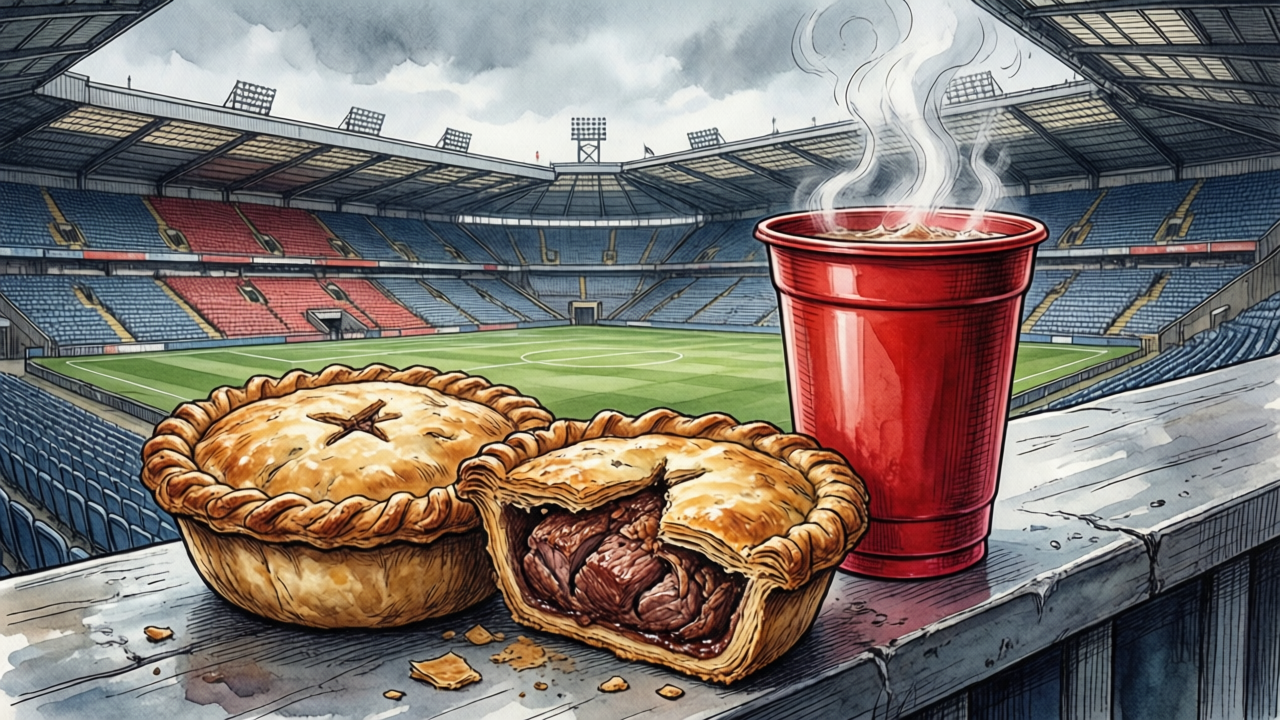
Half-time at a football ground lasts fifteen minutes, and in that time the concourse runs the most disciplined catering operation in peacetime Britain. Two pie kiosks, one urn of hot drink, and everybody is in the wrong queue. The pies sit under a lamp going slowly bronze, held upright by their own pastry, carried by men in scarves with both hands like something that might be taken off them. The meat pie is the traditional hot food of the British football terrace, before kick-off or at half-time, and it is so completely at home at football that the British Pie Awards hands out a Best Football Pie prize — a category that exists because somebody put a pie on a terracing step and somebody else had to keep score.
Its traditional partner is the cup: Bovril, stirred into hot water and drunk one-handed while the pie is kept aloft with the other. Bovril was invented in the 1870s by John Lawson Johnston, a Scottish butcher working in Canada, to solve an actual logistics problem — Napoleon III had ordered a million tins of beef for the Franco-Prussian War, beef keeps badly, so Johnston boiled it down into something that fitted in a pocket. They called it Johnston’s Fluid Beef, then renamed it Bovril: the Latin for ox, plus “Vril”, the magical fluid that powers the subterranean super-race in Bulwer-Lytton’s then-popular novel. The Victorians named their spread ox-magic; they simply spelt it politely. By 1888 it was sold in some 3,000 British pubs, grocers and chemists. At the Siege of Ladysmith, the garrison ran out and made the same paste out of horses, calling it Chevril — the only product name in history that opens as an apology.
And the patron occasion of all this is a match played on 13 February 1971 at Layer Road in Essex, on a cold Saturday, under floodlights of the period, which is to say: not very good ones. Colchester United — the U’s, elected to the Football League on 3 June 1950, eighth in the Fourth Division at the time — drew Don Revie’s Leeds United in the FA Cup fifth round. Leeds were top of the First Division with ten internationals. Colchester had a former England forward, Ray Crawford, who’d signed for his experience and repaid it with two goals, plus one from Dave Simmons: 3–0, then 3–2, and sixteen thousand people at Layer Road went home late. It is a founding myth of the club — and it happened in the same weather, on the same kind of concrete, that the terraces’ pie is engineered for.
The hand pie is the Colchester United of British pastry: cheap to field, unspectacular to watch, built for people with somewhere difficult to be, and at its best away from home.
Ingredients
- 600g chuck steak, cut into 1cm dice — ask for stewing steak and point at the marbled end of the counter
- 2 onions, chopped, and 2 carrots, diced small
- 2 tbsp plain flour
- 1 tbsp Marmite and 1 tsp Bovril — the Bovril is not a health decision, it is a heritage one
- 330ml mild brown ale, or a full-strength beef stock if you don’t cook with beer
- 400ml beef stock, 1 bay leaf, a few sprigs of thyme
- Butter, for the pan
- 450g plain flour, cold, for the pastry
- 100g lard and 100g cold butter, cubed — lard here is the centre-half of pastry: less stylish, concedes less
- 1 tsp salt, cold water, and 1 beaten egg to glaze
Makes eight hand pies, which is roughly one more than any individual will admit to eating.
Method
- Brown the steak hard and fast, in batches. Crowding the pan makes the meat stall and grey, which is what happens to any queue, side or kiosk that tries to move all at once. Lift each batch out and keep going.
- Melt butter and sweat the onions and carrots low and slow, ten or fifteen minutes. Nobody notices this shift and everyone depends on it: the left back of the flavour.
- Stir in the flour, then the Marmite, the Bovril and the ale. It will hiss like a concourse at half-time — enjoy it, it is the loudest the pan gets all day. Then the stock, bay and thyme, and the beef back in.
- Lid on, low oven around 150C fan, two and a half to three hours. The manager would call this time on the ball together; the chairman would call it a result.
- Unlid and reduce hard for twenty minutes, until glossy and sticky. Now run the one test that separates a hand pie from an ordinary pie in a dish: a spoonful on a plate, into the fridge, wait. It should set firm. A cold filling that can’t hold its own shape is a filling already on the substitute bench — the jelly is the load-bearing structure of the whole operation.
- Cool it completely, overnight if you can face it. Filling warm onto raw pastry gives a soggy bottom, and the soggy bottom is the one red card no terrace will debate afterwards.
- Rub the lard and butter into the flour with the salt, bind with cold water, rest half an hour. Roll and cut discs about 12cm across. Heap the cold filling on one half — generous, but tidy. You are going to have to pick this up in public.
- Fold, press, then crimp the edge. Aim for about twenty crimps: never audited, in pastry any more than in football, but they are not decoration, they are the chassis, and this pie is designed to be driven over.
- Egg wash, then 210C for 20–25 minutes until puffed and bronze. Rest ten minutes — which is exactly how much of half-time you have left.
They are excellent hot, with brown sauce, if you’re on a sofa — no laws were broken. But the proper test is to leave one on a windowsill until it’s completely cold and eat it standing up with one hand doing something else. If it survives that, it will survive a coat pocket, a matchday programme used as a plate, and your uncle’s hand. The vegetarian version keeps the pastry (all-butter, since lard has retired) and swaps the beef for 500g chestnut mushrooms and a tin of butter beans, with vegetable stock and the Marmite kept: leave the Bovril out, since the beef came out of the jar in 2004 and went back in 2006, and this is a dish that respects precedent.
Serve hot if you want comfort; serve cold if you want the truth, because this pie’s best results have always come away from home. It has never had the budget and never needed it — elected on merit in 1950, 3–2 against Leeds in 1971, and the away end, cup in one hand and pie in the other, has never once been asked whether it’s having a nice time.