Stand at the end of any British estate on a Sunday afternoon and you can read the plan from the ground: the drying greens with their concrete circles, the aerials leaning into each other like gossip, the shop with the two stools outside, the walkway that goes somewhere useful if you’re patient. The council estate is not just housing. It is a piece of civic design so committed to itself that it named its own streets — and in Sheffield, it named them at height.
Park Hill was built between 1957 and 1962, designed by Jack Lynn and Ivor Smith under city architect J. L. Womersley, on the theory that a street is a street wherever you put it — so why not eleven storeys up? They built four, and they gave them names: Norwich, Long Henry, Hague and Gilbert, each running through three levels of the estate, which the architects described, with magnificent confidence, as street, above street, and below street. An entire neighbourhood with its own vertical postcode system. It was the boldest version of a promise Britain had been making since the Addison Act of 1919 — “homes fit for heroes” — a promise that, by 1979, had 42% of Britons living in council homes. The biggest landlord in the country was your council, and it had opinions about your windows.
The tower-block era ended with a bang, literally: Ronan Point in Canning Town, 16 May 1968, a gas explosion on the eighteenth floor of a brand-new 22-storey tower, two months after it opened. Five people died, and the building learned that towers don’t lean, they fold. Britain kept the estate, quietly lost faith in the lift shaft, and got on with the real estate infrastructure, which was what people cooked at the top of it.
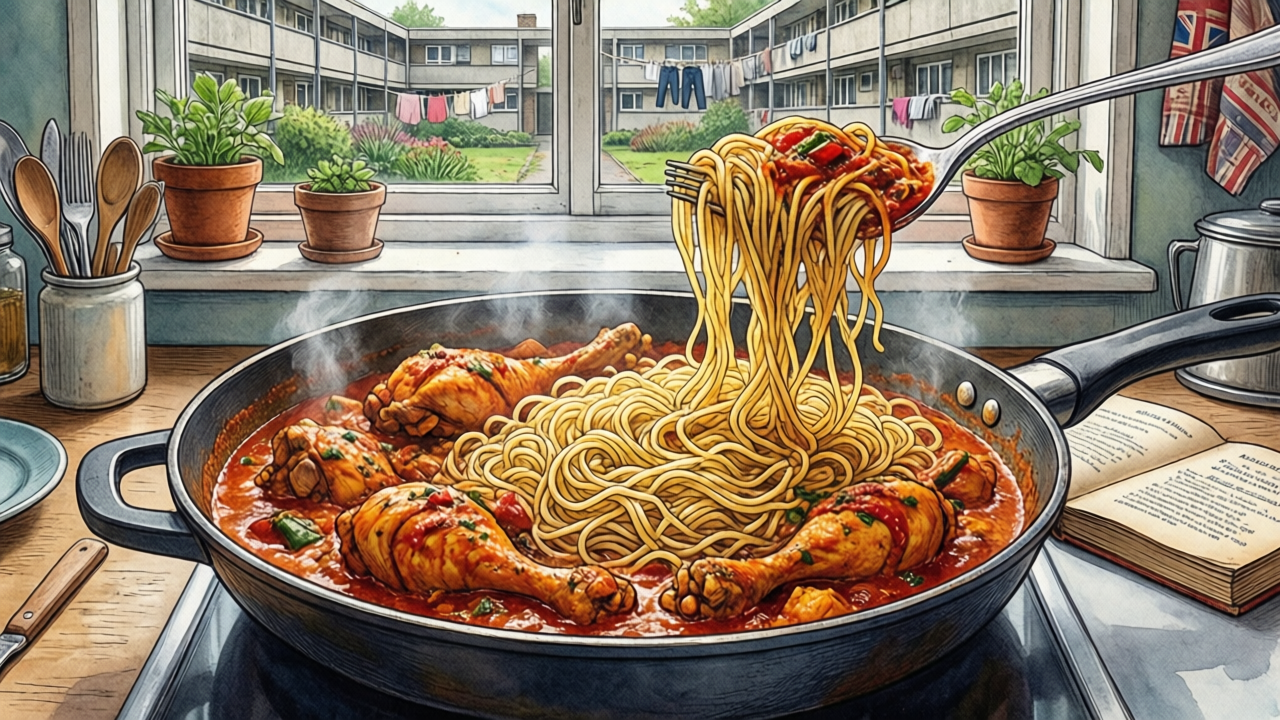
And nothing understood the estate like chicken goulash: a Hungarian stew that emigrated to Britain in the 1970s, was handed double cream and egg noodles, sat on the stove for four decades, and is now considered a local. A recipe imported, housed, and never once asked to speak English — the culinary new town, and every bit as divisive.
Ingredients
- 8 boneless, skinless chicken thighs (about 900g), patted dry — thighs, not breasts; this stew is a long-term tenancy and breasts won’t commit
- 2 large onions, sliced
- 2 level tablespoons sweet paprika, plus a teaspoon of hot paprika if you want the estate with opinions
- 1 tablespoon tomato purée
- 2 teaspoons caraway seeds, lightly crushed (spice aisle, and a fair swap for fennel if the aisle disagrees with you)
- 400ml chicken stock
- 100ml double cream
- 1 knob of butter + 1 tablespoon oil
- 500g egg noodles (the fresh kind in the chilled aisle, or dried — the streets in the sky aren’t fussy)
- 1 cucumber, sliced on the diagonal
- 3 tablespoons soured cream, 1 teaspoon vinegar, 1 teaspoon sugar, a shake of dried dill
Method
- Heat the oil and butter in a wide, heavy pan over a proper heat. The pan should behave like a well-managed front door: wide open, then shut firmly behind you.
- Brown the chicken in two batches until golden on all sides, then park it on a plate. Do not crowd the pan. A crowded pan is the lift at five o’clock: everyone squeezed in, nobody moving, nothing working for anyone.
- Turn the heat right down, tip in the onions, and sweat them for 12–15 minutes until soft and sweet. The onions get the slow lift. They wait politely. They have nowhere else to be.
- Push things off the heat for a minute with the paprika and tomato purée, stirring so the onions coat completely. Paprika goes off the flame, never into a dry fry — burn it and it turns bitter, and no quantity of later cream will talk it out of the grudge. Like the wheelie bins: easy to get wrong, permanent once you do.
- Return the chicken and any juices, pour over the stock, add the caraway, and cover. Simmer gently for 40 minutes. Lid on like a community hall booked for a children’s party: nothing escapes, everything gets damp, and something’s smelling of paprika by the end.
- Take the lid off and simmer another 10–15 minutes until the sauce thickens enough to coat a spoon. This reduction moves at the speed of a housing waiting list: slower than seems fair, faster than the waiting allows.
- Stir the cream through off the heat. The cream is the Right to Buy of this recipe — introduced in 1980 in the form of the splash everyone now insists was always planned, adds an instant layer of comfort, permanently changes what the dish fundamentally is, and causes half the purists to quietly emigrate from the pan. It is staying. The stew, unlike the policy, handles it well.
- Cook the egg noodles, drain, and pile them high on four plates. Pour the goulash and its sauce over the top, so the noodles carry everything and stay under it. This is your street in the sky: elevated, load-bearing, with all the important life happening at street, above street, and below street level. Park Hill named four of them after local roads. You’ve got one, but it works — which, by 1980s reputation, was more than the lifts could manage.
- Slip the cucumber slices into the soured cream with the vinegar, sugar and dill, and scatter it over the top with the juices from the bowl. The salad is the aerial on the balcony: adds nothing structural, changes the entire silhouette of the plate, and every guest would be alarmed to find it missing.
It keeps two days in the fridge and comes back better, like a bank holiday, only more reliable. Vegetarian version: brown 400g of Quorn pieces at step two and carry on — the sauce never asks questions, and the estate has always been the most welcoming part of Britain to new arrivals.
Because here’s the thing about goulash on an estate: by 1979, with 42% of the country living in council homes, a version of this exact pan was bubbling on a staggering number of hobs up and down the land, in kitchens built to a plan, out of a recipe bought at a plan, feeding people who’d been promised heroes and got something better — Sunday tea, hot, four portions, at whatever level you happen to have. The towers fell out of fashion, the cream settled, and the streets in the sky kept their names. The goulash didn’t even need regenerating. It’s the only part of the plan that worked first time.