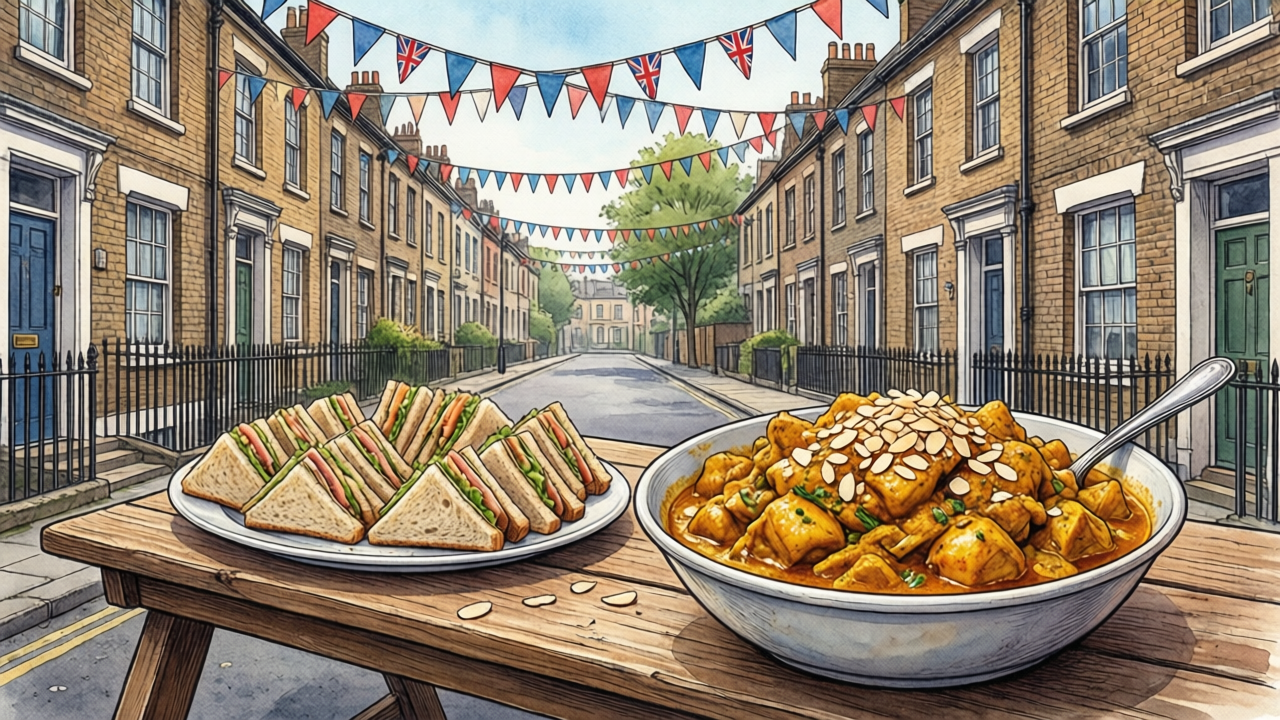
The road is closed. Not by the council — the council was asked, by a form, by Derek from number 42, three weeks ago, and the confirmation letter is still on his door — but the road is closed regardless. Trestle tables wobble into place along the pavement. Someone has brought a folding chair from 1987; someone else has brought three, which is how the balance of power at a British street party gets settled. And above it all, going up, going up: the bunting. Triangular flags on string between two houses, doing nothing, holding nothing up, first item on every national agenda.
The street party is not a recent invention. The tradition started with the “peace teas” of 1919, when residents put trestles in the road to celebrate the Treaty of Versailles — the nation’s first mass attempt at feeding strangers for no reason. By the Silver Jubilee of 1977 an estimated ten million people had taken to their streets, and every one of them faced the same logistics problem that has always faced them: you are about to serve lunch to forty people, nine of whom you know. By the coronation of 1953 the whole country was staring at that problem at once. Twenty-seven million people watched the ceremony live on television — the number of licence holders doubled that year, which tells you how many sets were bought purely to watch a service in a church — while three million packed the streets around the procession route. And on every street in the land, somebody asked the question that defines the genre: what can I make enough of, that survives being made a day early, carried down a garden path, and handled by other people’s children?
The national answer was invented for the Queen’s own coronation luncheon, and seventy-three years on it remains the only dish in British cookery designed from scratch around the street-party problem: make it in advance, serve it cold, stretch one bird across a crowd, and never, ever require a second kitchen. Its official name was Poulet Reine Elizabeth — chicken with a title, which tells you exactly who was in the room when the marketing decisions were taken.
The recipe came from the Cordon Bleu Cookery School in London, run by two principals: Constance Spry, the famous flower arranger, and Rosemary Hume, the actual chef, to whom the school gives main credit, with the students helping to fine-tune. And note the calendar: spring 1953. Sugar and eggs had just come off ration. Everything else, meat included, was a year away. The dish invented to celebrate a national banquet was designed in a country where a banquet was a rumour — which is precisely why it works. Small amount of chicken, generous amount of sauce, and the confidence to call the whole thing a celebration.
Ingredients
- 4 large bone-in chicken thighs (the original used a whole poached bird; thighs are the same dish with a better temperament)
- A small glass of dry white wine, plus water to cover (the 1953 recipe poached the chicken in “diluted, seasoned white wine”, which is just wine that has been told off)
- 1 bay leaf, a few sprigs of parsley, a sprig of thyme, 6 black peppercorns
- 3 tbsp mayonnaise
- 3 tbsp natural yogurt
- 2 tsp medium curry powder, plus ½ tsp turmeric — coronation chicken is traditionally bright yellow; that is not a metaphor, it is a colour requirement
- 2 tbsp apricot jam (the original used apricot purée and no dried fruit at all; sultanas are a later invention and optional, like most committee decisions)
- A squeeze of lemon
- 50g flaked almonds
- 2 sticks of celery, finely sliced (optional)
- To serve: soft white bread or brioche, and/or salad leaves — and rice if you want it served as it was in 1953, arranged on top of a rice salad, which is to say, enthroned
Method
- Put the chicken in a pan with the wine, enough water to cover, and the herbs and peppercorns. Bring it to the barest simmer. A rolling boil is for pageantry, and this recipe has plenty of that already without using it on the chicken.
- Poach 30–40 minutes, until the chicken is cooked through. Lift it out and strain the liquid, keeping both. The cooking liquor is the best stock in the house, and like the coronation itself, all the value is in the leftovers.
- When cool enough to handle, shred the chicken and bin the bones. The 1953 version served bone-in chicken salad on trestle tables. We have progressed since then, slightly.
- For the sauce, whisk the mayonnaise, yogurt, curry powder, turmeric, apricot jam and lemon until it is the bright yellow the recipe demands. Loosen it with a spoonful of the cooking liquor, the way a vicar loosens his tie once the important speeches are over. This sauce is the string; everything else is the bunting.
- Toss the shredded chicken through the sauce, with the celery if you’re using it. Season properly. Salt and pepper were never rationed, which is the only reason this dish, and British cooking generally, survived the twentieth century.
- Toast the flaked almonds in a dry pan until they smell like something good is happening. Thirty seconds from golden to charcoal — quicker than the transition from street party to tidy-up, and nobody ever got the timing right on either.
- Chill, ideally overnight. Non-negotiable. A street-party dish understands queuing, resting, and arriving before the guests do. The whole recipe was designed a week before the day itself, which is not scheduling, it’s a personality.
- Serve the next day in whichever rowdy configuration you prefer: between soft white bread (the correct answer), on salad, or over rice exactly as 1953 did it. Scatter the almonds over the top like a small, edible, extremely well-behaved procession.
Vegetarian version: roast 400g of cauliflower broken into florets with a glug of oil and a teaspoon of the curry powder until the edges catch, cool, and use it in place of the chicken. The sauce never notices, and frankly, neither did 1953.
Sandwich first, salad after. It keeps two or three days in the fridge, which is one day longer than the bunting stays up.
One hundred episodes, and the lesson has been the same one the street party teaches every Jubilee: a British celebration is just food put outside on a table so the neighbours can’t avoid it. Put the bunting up. It is the only flag in the land that admits it holds nothing up — and it is still, always, the first job.